When you specify a motor control centre, the biggest cost and maintenance decision after the feeder list is the construction type: are the starter modules fixed in place, plug-in, or fully drawout? A second decision follows: should the MCC be “intelligent”, with communicating motor relays and a link to the control room? The right answer depends on the cost of downtime in your plant, not on the size of the MCC alone.
The three construction types
IEC 61439-2 describes functional units as fixed, removable or withdrawable. In Indian MCC practice, they are usually called fixed, plug-in and drawout.
Fixed type
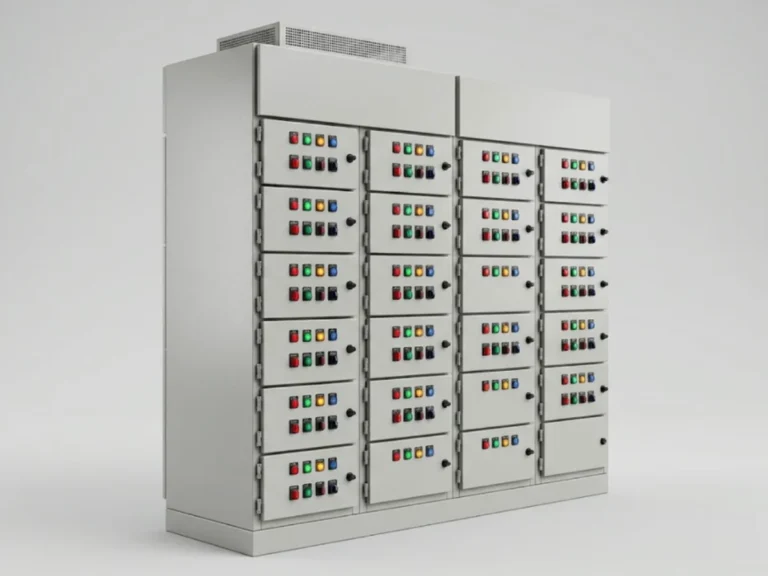
Components such as the MCCB, contactor and overload relay are bolted to a mounting plate inside the compartment, wired to fixed terminals. To work on a feeder you must isolate it, and usually the feeder is isolated through a door-interlocked switch or the upstream breaker. The neighbouring feeders may stay live depending on the form of separation. It is the lowest cost and smallest option. See the MCC panel page.
Plug-in (removable) type
The starter module is a unit that plugs onto the busbar through stabs and can be removed after isolation, but cannot be tested in a separate position. It speeds up replacement over a fixed type while keeping a cost somewhere between the two.
Drawout (withdrawable) type
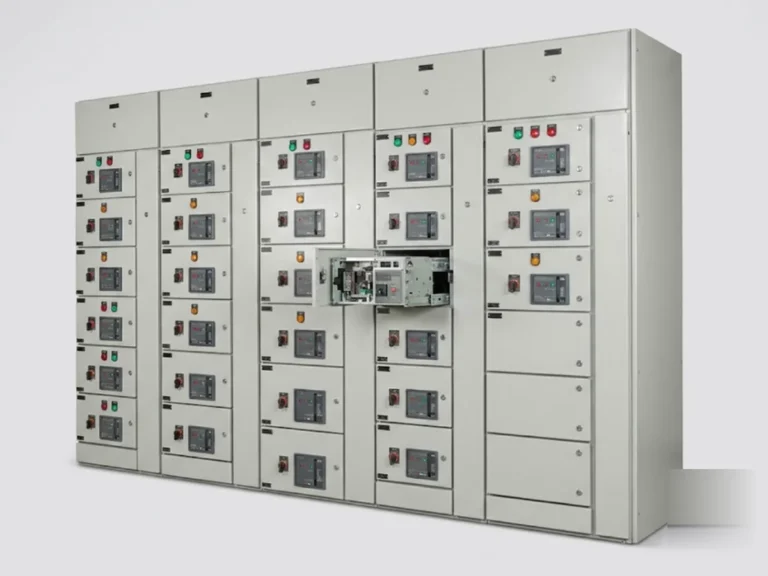
The module slides out on rails like a drawer. It has distinct positions: connected (service), test (power isolated, control live) and disconnected or isolated. Power and control contacts engage automatically, with door interlocks so the door cannot be opened with the module live. Modules of the same size are interchangeable. See drawout MCC panel.
Comparison
| Point | Fixed | Plug-in | Drawout |
|---|---|---|---|
| Initial cost | Lowest | Medium | Highest |
| Space | Most compact | Moderate | Largest per feeder |
| Time to replace a failed starter | Hours | Short | Minutes with a spare module |
| Testing control circuits | Only live or after a shutdown | Limited | Test position permits it |
| Safety during maintenance | Depends on isolation and form of separation | Better | Best, particularly with Form 3b or 4b |
| Typical use | Non-critical, small plants | Moderate duty | Process plants, continuous operation |
When drawout is worth the money
- Production stops are costly. If one failed starter should not mean hours without a pump, a spare module can be swapped.
- Many identical starters. Standard module sizes allow a few spare modules to cover a large lineup.
- High safety expectations. Isolating a module without opening live parts reduces exposure, particularly alongside Form 3b or Form 4b compartments.
- Frequent changes. If you often rework feeders or test control logic, the test position saves shutdowns.
- Remote or hazardous sites where a technician’s time on site is costly.
Fixed construction is sensible for small utility MCCs, auxiliary services where a stop does not matter, and where a planned shutdown is anyway part of routine maintenance.
What intelligent MCC means
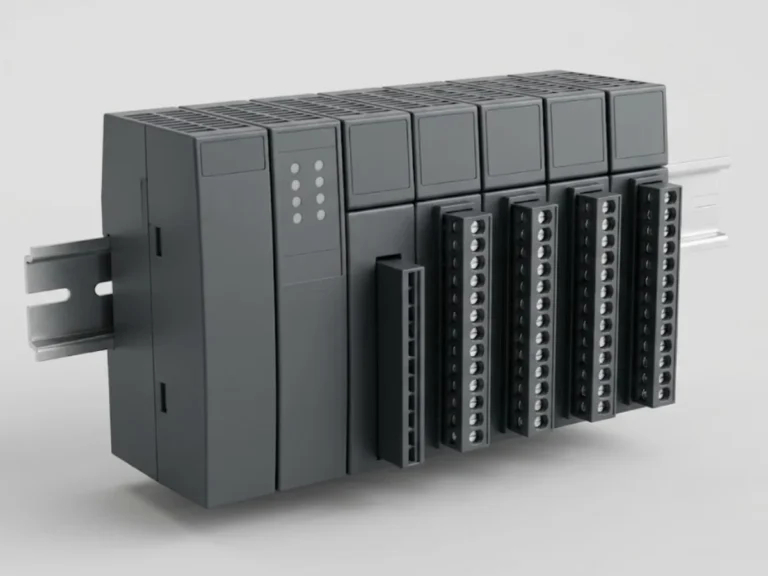
An intelligent MCC (IMCC) replaces the conventional overload relay and control wiring with a communicating motor protection and control unit in each feeder. The units connect over a fieldbus or industrial Ethernet to the PLC or DCS. See intelligent motor control center (IMCC).
- Digital protection: thermal overload, phase loss, unbalance, jam, earth fault, undercurrent, all in one unit with settings that can be changed from a PC.
- Data: motor current, run hours, number of starts, trip history and alarms available at the control room.
- Control: start, stop and status over the network, reducing hard-wired signals between MCC and PLC to a bus cable.
- Protocols: commonly Modbus, Profibus, Profinet or EtherNet/IP; confirm that the one you need is supported by the PLC or DCS. Industrial Ethernet switches and gateways link the network to the PLC.
When intelligent MCC is worth it
An IMCC costs more per feeder, but saves in other ways, and the break-even depends on the plant. As a rough guide it is worth considering when:
- The MCC has many feeders (twenty or more is a common threshold), all to be monitored by a PLC or DCS, where hard-wiring each signal costs real money and commissioning time.
- Motor condition data would help maintenance, for example catching a pump that is drawing more current each month before it fails.
- The MCC is far from the control room, which makes cable cost and wiring errors significant.
- The plant already has a PLC or SCADA system with a fieldbus and staff who can use the data.
It is not worth it for a small MCC with a few feeders and no PLC, or where nobody will look at the data. Unused diagnostics are expensive wiring. Some plants choose a middle path: conventional starters with a multifunction meter or a motor relay only on critical motors.
Specification checklist
- Construction type and form of separation for each section.
- Module sizes and a standard layout, with 20 to 25 percent spare modules.
- Short-circuit rating and busbar rating of the lineup.
- Starting method per feeder: DOL, star-delta, soft starter or VFD.
- For IMCC: protocol, number of nodes, a single or redundant network, and who supplies the software and settings.
- Test position, door interlocks, padlockable isolation and shutters.
The choice of construction and form affects personnel safety. Confirm with a qualified engineer against your maintenance procedures.
What to send us for a quotation
Send the motor list with kW, starting method and criticality, the busbar rating and fault level, preferred construction (fixed, plug-in or drawout), form of separation, spare modules wanted, and for IMCC the communication protocol and PLC or DCS make. You can request a quotation or contact us. We answer quotation requests within 24 hours. The full range is in switchgear panels.
Frequently asked questions
What is the difference between drawout and fixed type MCC?
In a fixed MCC, starter components are bolted inside the compartment and wired permanently, so servicing means isolating and working in place. In a drawout MCC the whole starter module slides out on rails with connected, test and isolated positions, allowing quick swap with a spare module and testing of control circuits with power isolated.
Is drawout MCC always better?
No. Drawout costs more and takes more space. It earns its price where production stoppage is costly, where many starters are alike and spares can be swapped, or where maintenance safety is a priority. For small utility or non-critical MCCs, fixed or plug-in construction is often adequate.
What is an intelligent MCC?
An intelligent MCC uses communicating motor protection and control units in each feeder, linked by fieldbus or Ethernet to a PLC or DCS. It gives protection, status, current and trip data in the control room and cuts the amount of hard wiring between the MCC and the control system.
How many feeders justify an intelligent MCC?
There is no fixed number. A common rule of thumb is around twenty feeders or more with a PLC or DCS already in place, because wiring savings and monitoring value start to outweigh the extra cost per feeder. Smaller MCCs may still justify it where motor condition data is valuable or the MCC is far from the control room.