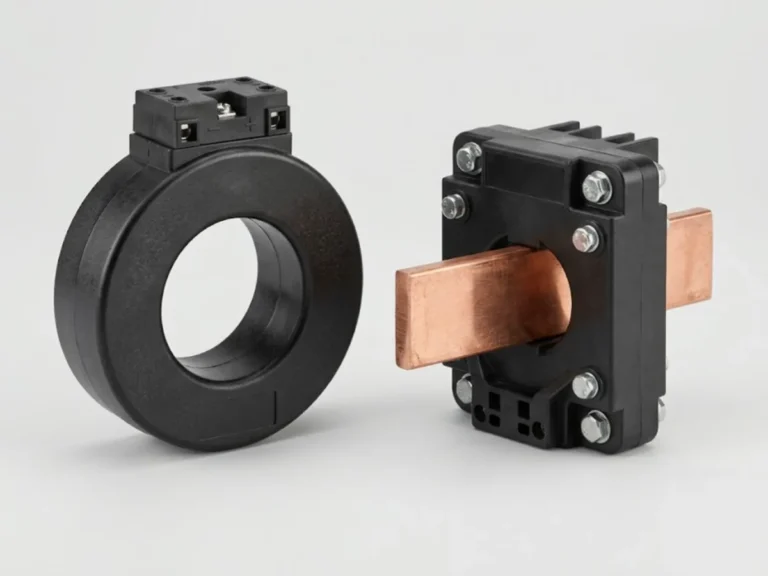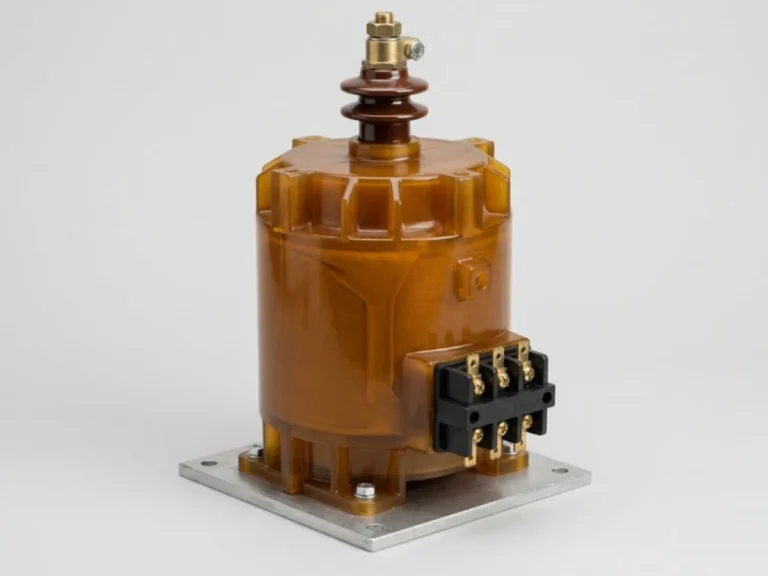
Current transformers (CTs) and potential (voltage) transformers (PTs or VTs) are the eyes of every metering and protection system. They scale high currents and voltages down to values that meters, relays and controllers can safely handle, and they isolate those instruments from the primary circuit. A wrongly specified CT is a common reason for a meter reading wrong or a relay that does not trip, so it pays to understand ratio, burden and accuracy class before ordering.
Ratio
A CT ratio such as 200/5 A means that when 200 A flows in the primary, the secondary delivers 5 A. A PT ratio such as 11000/110 V means that 11 kV on the primary gives 110 V on the secondary.
- Select the primary rating from the full-load current of the circuit, with the CT primary somewhat above it so normal load reads in the upper half of the scale. For a 1000 kVA transformer at 415 V (full-load current about 1391 A), a 1500/5 A or 2000/5 A CT is typical, depending on overload expectations.
- Select the secondary as 5 A or 1 A. 5 A is common on LT panels where the wire runs are short. 1 A is preferred when the CT is far from the meter or relay (long leads) and in many modern substations.
- Multi-ratio CTs can be reconnected for different primary ratings, which helps when load is uncertain.
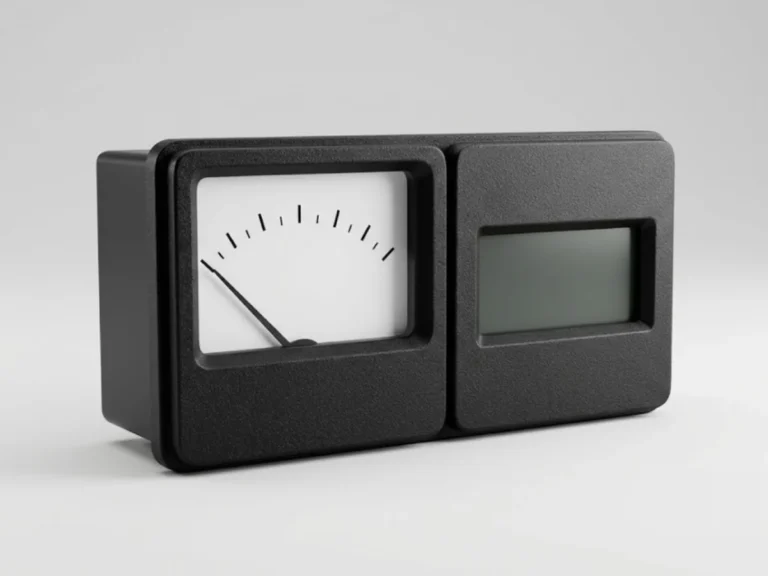
Our current transformers and potential transformers are used with the instruments in the instrument transformers and protection category.
Burden
Burden is the load connected to the secondary, expressed in volt-amperes (VA) at the rated secondary current, or in ohms. The burden includes the meter or relay, the connecting wire, and any terminal losses. Standard CT burdens are values such as 2.5, 5, 10, 15 and 30 VA. If the real burden exceeds the rated burden, the CT’s accuracy is lost and for protection it may saturate.
Worked burden example
- A digital meter input: about 1 VA.
- Lead length: 10 m run to the meter, so 20 m of 2.5 mm² copper out and back. Resistance of 2.5 mm² copper is about 7.41 ohm per km, so 20 m is about 0.148 ohm.
- Lead burden on a 5 A CT: I²R = 25 × 0.148 = about 3.7 VA.
- Total burden is about 4.7 VA, so a 5 VA CT is just adequate; a 10 VA CT leaves margin.
- With a 1 A secondary, the same leads burden is only 0.15 VA, which is why 1 A is better for long runs.
A burden that is much smaller than rated can also be a problem for some CT types, so match the CT to the actual connected load rather than choosing a very high VA “to be safe”.
Accuracy class
The accuracy class tells you the permitted error. CTs are made for two quite different jobs, so there are two sets of classes.
Metering class
Classes such as 0.2S, 0.5, 0.5S and 1.0 describe the ratio error (in percent) at rated current. Billing and revenue metering uses the tighter classes; ordinary panel indication can use 1.0 or 3.0. A “S” class (special) keeps its accuracy down to very low load, e.g. 1 percent of rated current, which matters for solar, night loads and revenue meters. Metering CTs are designed to saturate early at fault current, protecting the meter.
Protection class
Protection CTs have designations such as 5P10 or 10P20. Read it as: the composite error is 5 percent (or 10 percent) at the accuracy limit factor of 10 (or 20) times rated current. So a 5P10 CT remains accurate up to 10 times its rated primary current. Protection CTs must not saturate during a fault, or the relay sees a distorted current. For differential and restricted earth-fault schemes, a class PS (also called class X) CT is specified by knee-point voltage, magnetising current and winding resistance.
| Application | Typical CT class |
|---|---|
| Revenue and energy metering | 0.2S or 0.5S |
| Panel ammeters, multifunction meters | 0.5 to 1.0 |
| Overcurrent and earth-fault relays | 5P10 or 5P20 (check the relay’s required burden and ALF) |
| Transformer, motor or busbar differential protection | PS / class X, specified by knee-point voltage |
Potential transformers
PT ratings include the primary voltage (for example 11 kV, 22 kV, 33 kV or 415 V), secondary voltage (commonly 110 V line-to-line or 110/√3 V), burden in VA and accuracy class. Metering classes are 0.2, 0.5 or 1.0, protection classes 3P or 6P. A PT is built like a small transformer running near no load, and it must never be short-circuited on the secondary, the opposite of a CT. Secondary fuses or a miniature breaker protect the circuit. For voltage ratios with a neutral connection, ask whether the primary is rated for line-to-earth voltage and whether a third-winding (open delta) is needed for earth fault detection.
The most important safety rule for CTs
Never open the secondary of a CT while the primary is energised. With no secondary load, the core flux rises, producing a very high voltage across the open terminals that can injure people and damage insulation. Always short the secondary terminals (use the shorting link or test block) before removing a meter or relay. Conversely, the secondary of a PT must never be shorted. This is safety-critical; follow your site safety procedure and have a qualified person carry out the work.
How to specify
- Primary current and secondary (for example 400/1 A).
- Number of cores and class for each: metering core 0.5 class, 10 VA; protection core 5P10, 15 VA.
- System voltage and insulation level (LT or HT, with window type, bar type, wound type or ring type).
- Short-time thermal and dynamic rating that matches the system fault level.
- Mounting: window type for cables or bus bars, or mounted in an HT cubicle.
- Applicable standard: IS 2705 for CTs and IS 3156 for voltage transformers are the Indian standards usually quoted. Confirm the editions.
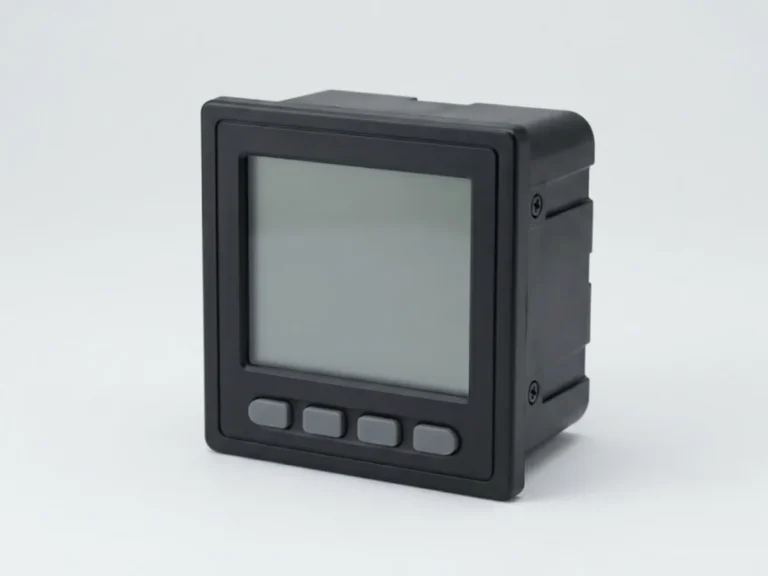
The CT feeds meters such as multifunction meters and panel meters, protection relays, and APFC controllers.
Common mistakes
- Choosing a CT primary rating far larger than the load, so the meter reads at the bottom of its range.
- Using a metering-class CT for a protection relay, or the reverse.
- Ignoring lead burden on 5 A circuits with long wires.
- Wrong polarity (P1/P2, S1/S2), which gives reversed kW and trips directional relays.
- Not earthing the CT secondary at one point as the scheme requires.
What to send us for a quotation
Provide the ratio, secondary current, number of cores, burden and class for each core, system voltage, installation type (indoor or outdoor, window or bar), short-time rating and any standard or tender clause. Use request a quote or contact us. Please confirm the final selection with a qualified protection engineer.
Frequently asked questions
What does a 200/5 A CT ratio mean?
It means that when 200 A flows in the primary conductor, the CT delivers 5 A on its secondary. The connected meter or relay is scaled to this ratio, so a reading of 2.5 A at the secondary corresponds to 100 A in the primary. The ratio must match the meter or relay setting.
What is burden in a CT?
Burden is the load on the CT secondary, expressed in VA at rated current. It includes the meter or relay and the connecting wires. If the actual burden exceeds the rated burden, accuracy suffers and a protection CT may saturate. Compute lead burden as I squared times R for 5 A circuits.
What does 5P10 mean on a CT?
5P10 is a protection class. The composite error will not exceed 5 percent at 10 times the rated primary current, the accuracy limit factor. It is meant for overcurrent and earth-fault relays. Metering classes such as 0.5 or 0.2S describe accuracy at normal load instead.
Why must a CT secondary never be left open?
With the primary energised and the secondary open, there is no opposing flux, so the core saturates and a very high voltage appears across the secondary terminals. This can injure people and damage insulation. Short the secondary before disconnecting instruments, and have a qualified person do the work.