For a transformer-to-panel run or a main riser, there are two basic options: parallel power cables on trays, or a bus duct (busbar trunking system), a factory-made enclosure holding insulated copper or aluminium bars. Bus duct costs more per metre, so people often drop it at the estimate stage without checking the full picture. Above a certain current, cables become awkward, and the comparison needs more than a price per metre.
What a bus duct is
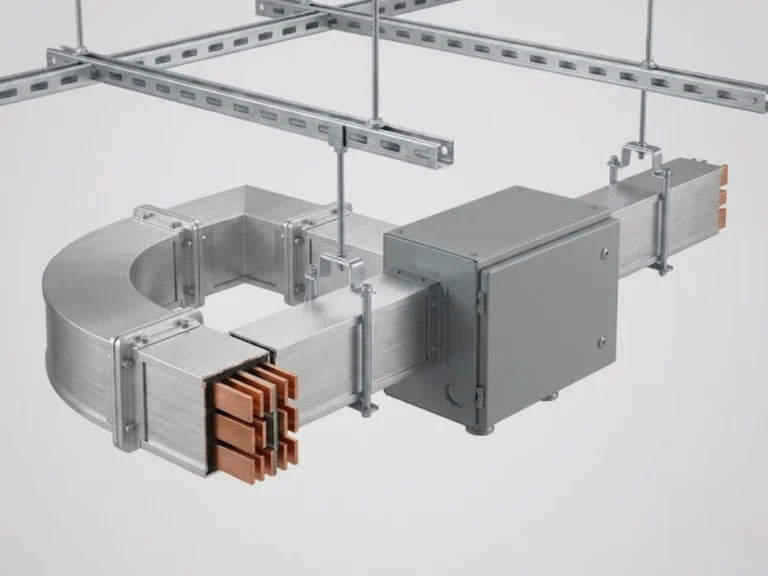
A bus duct is a set of bars, one per phase plus neutral and earth, enclosed in a sheet-steel or aluminium housing and supplied in standard lengths with joints, bends, tap-off boxes and end connections. Typical designs are the sandwich (compact) type, where the insulated bars are packed tight together, and the air-insulated type with spacers. Ratings go from a few hundred amperes up to 6300 A, with copper or aluminium conductors. Busbar trunking systems are covered by IEC 61439-6. See our bus duct up to 6300 amps page.
Where cables become hard
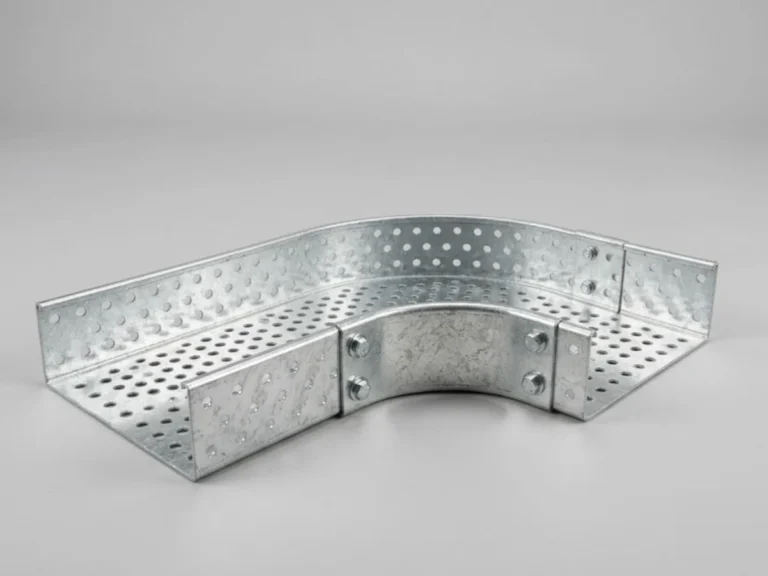
Take a 1600 A feeder from a transformer secondary to the LT panel. In cable, this can need several parallel runs of large-section single-core or multicore cable per phase, each run laid with enough spacing for heat dissipation, each terminated with lugs onto a busbar. The more runs, the greater the chance of unequal current sharing, and each extra run adds trays, glands and lugs.
The quick check is the cable and current calculator, followed by the derating for grouping and ambient temperature. At high currents, you often find that eight or more conductors per phase are needed once derating is applied. At that point, a bus duct is shorter, tidier and easier to terminate.
Comparison
| Point | Cables | Bus duct |
|---|---|---|
| Cost at low currents (below about 400 A) | Lower | Higher |
| Cost at high currents (1600 A and above) | Rises fast with parallel runs and trays | Often comparable or lower when the whole installed cost is counted |
| Voltage drop | Higher for the same current | Lower, with compact bars and low reactance |
| Space | Needs wide trays and bending radii | Compact, one enclosure |
| Flexibility for future tap-offs | Needs new cable and jointing | Plug-in tap-off boxes on some systems |
| Installation time | Slow; pulling, lugging, supporting | Faster; modular but needs accurate site survey |
| Fire behaviour | Depends on cable insulation and sealing | Metal enclosure; fire barriers needed at floor and wall crossings |
| Change of route | Easy to re-route a single cable | Needs a new length or bend, made to order |
When bus duct is the better choice
- Transformer to LT panel runs above roughly 1000 A. Short distances, high current, lots of parallel cables: the classic case.
- Vertical risers in multistorey buildings with tap-offs on each floor.
- Production halls with plug-in distribution along a line of machines, where layout may change.
- Locations where cable spacing and bending radius cannot be met.
- Where very low voltage drop matters at the end of a long high-current run.
When cables are the better choice
- Currents below about 400 to 600 A, where one or two cables do the job.
- Long routes with many turns and changes of level, because each bus duct bend or elbow is a custom item.
- Dusty, wet or corrosive spaces, unless the bus duct has a suitable IP rating and finish. Check IP54, IP65 or IP66 options against the environment.
- Underground or buried routes. Use armoured cable, see HT and LT power cables, with trays and lugs from cable trays and accessories.
Copper or aluminium conductor
Copper has higher conductivity, so a copper bus duct is smaller for the same current and generally handles heat better. Aluminium is lighter and costs less, but needs a larger cross-section, and its joints need good plating or contact treatment to stay reliable. For long runs or hot environments, many designers choose copper; for budget projects with enough space, aluminium works if the joints are well designed and torque-checked at commissioning.
Things to specify
- Rated current, voltage, short-circuit withstand (kA for 1 s) and frequency.
- Number of conductors: 3-phase, 4-wire (neutral), or 5-wire with a separate earth. For harmonic-rich loads, ask about an oversized neutral.
- Enclosure IP rating and whether outdoor, with a weather canopy.
- Connection flanges to transformer and to the panel, which must match their terminal positions exactly.
- Expansion joints and fire barriers where required.
- Site survey and drawing approval before manufacture. Bus duct is made to measure, so errors are costly.
- Joint torque and test records at commissioning. Loose bolted joints are the most common bus duct failure, so ask for a torque check after the first few weeks under load, and for infrared thermography of the joints at the first annual shutdown.
- Support spacing, hangers and vertical spring supports for risers, which are normally the installer’s responsibility but should be agreed in the scope.
Short-circuit rating, derating for ambient temperature and fire barrier details should be confirmed with a qualified engineer and checked against the manufacturer data.
One more practical check is the fire and building interface. Where a bus duct passes through a floor or a fire-rated wall, the opening needs a fire barrier or seal that keeps the wall rating, and the duct itself should not become a path for smoke or water between floors. Outdoor runs need a canopy or an IP-rated housing, and the entry point to the transformer should allow for thermal expansion and vibration through a flexible connection.
What to send us for a quotation
Send the current rating, voltage, fault level, route length, number of bends and risers, equipment connection details at both ends, ambient temperature and the installation location (indoor or outdoor). A simple layout sketch helps. You can request a quotation or contact us; we answer quotation requests within 24 hours. See also the switchgear panels category.
Frequently asked questions
Is bus duct better than cable?
At high currents over short to medium distances, such as transformer to LT panel runs above about 1000 A, bus duct is often better: lower voltage drop, less space and fewer joints. For lower currents, long irregular routes or underground runs, cable is simpler and cheaper. The best way to decide is to compare the full installed cost, not the price per metre.
What is the maximum rating of a bus duct?
Standard systems are available from a few hundred amperes to about 6300 A, in copper or aluminium. The right rating depends on load current, derating for ambient temperature and the short-circuit withstand needed. Ratings above that are possible with special designs, but for most industrial plants 6300 A is the practical top end.
Copper or aluminium bus duct, which should I buy?
Copper is more compact and thermally better, which suits hot environments and tight spaces. Aluminium is lighter and cheaper but needs a larger cross-section and good joint treatment. For critical, high-load or hot-site feeders choose copper; for economical runs with enough space, aluminium can work if jointing is right.
Does bus duct need a site survey?
Yes. Bus duct is made to measure with specific bends, flanges and tap-offs, so an accurate survey of routes, levels, equipment terminal positions and wall or floor crossings is essential before manufacture. Corrections after delivery are slow and costly, which is one reason errors at survey stage hurt more than with cable.