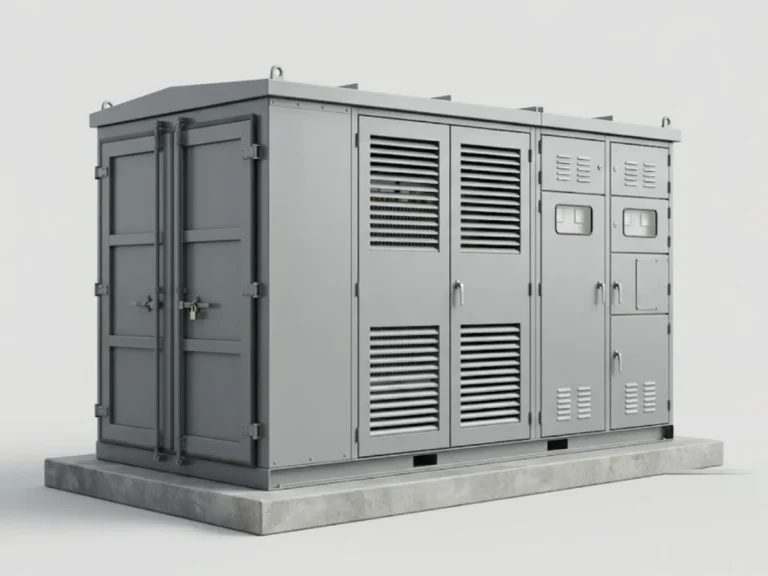
A conventional 11 kV/415 V substation is built on site: a civil building or yard, an HT panel room, a transformer bay, an LT room, cable trenches and earthing. A compact substation (also called a packaged, unitised or prefabricated substation) puts the same functions into one factory-assembled enclosure that is tested before it leaves the works and set on a foundation at site. It is not a different kind of electricity, only a different way to build the same chain.
What is inside
A compact substation has three compartments in a single steel enclosure, often arranged in a line or an L shape.
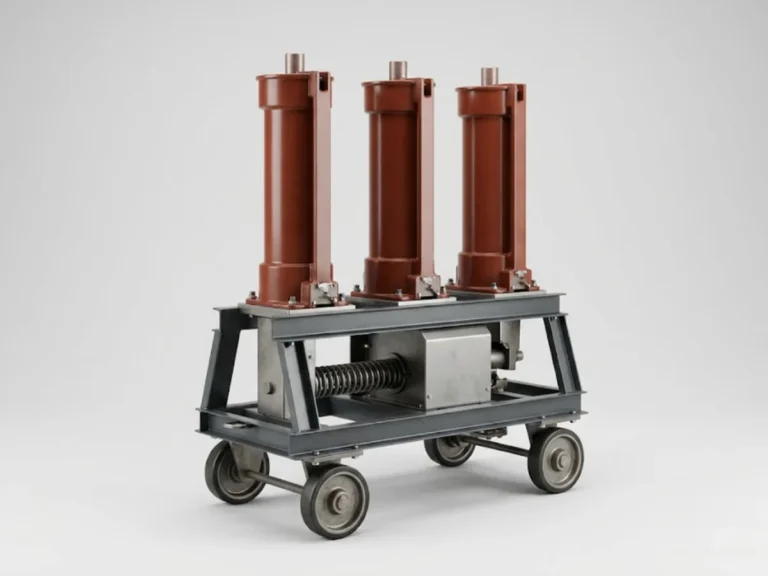
- HT (incoming) compartment. Medium-voltage switchgear that receives the 11 kV or 22 kV supply. This is usually a ring main unit (RMU) with load break switches, or a vacuum circuit breaker with protection relay where the metering and protection requirement is higher. See our switchgear panels and vacuum circuit breakers, and MV panels.
- Transformer compartment. An oil-immersed (often hermetically sealed) or dry-type transformer, with protection such as temperature indicators, pressure relief and sometimes a Buchholz relay. See our compact substation transformers and distribution transformers.
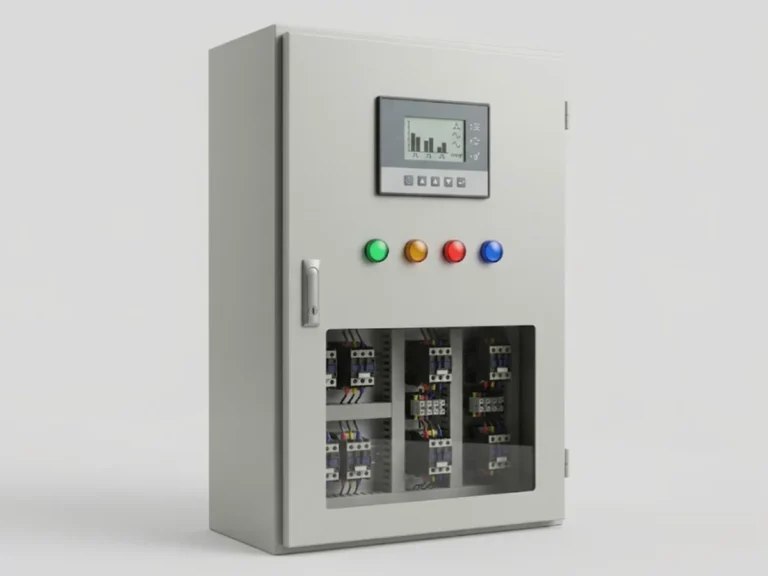
- LT compartment. An outgoing LV panel with an incoming ACB or MCCB, bus bars, outgoing feeders, metering, and often an APFC panel section for power factor correction. See low voltage panels.
Added to this are internal cabling or bus bar connections between compartments, an earthing system, lighting and ventilation inside, and sometimes a CT/PT metering section for utility billing. The whole unit is typically assembled and routine tested at the manufacturer’s works.
Conventional vs compact: what changes
| Aspect | Conventional substation | Compact substation |
|---|---|---|
| Construction | Civil building plus separately installed equipment | Factory-assembled enclosure on a plinth |
| Space | Large footprint | Compact footprint, often a fraction of the area |
| Time on site | Longer civil and erection time | Shorter: foundation, cable termination, earthing, commissioning |
| Flexibility | Easy to customise and expand | Fixed layout; extension needs planning |
| Cable and busbar lengths | Longer routes | Short, standardised connections |
| Typical rating | Any, including very large | Distribution range, usually up to around the low MVA region |
| Servicing | Walk-in rooms | Depends: walk-in or non-walk-in designs |
When a compact substation makes sense
- Space is tight. Industrial plots, urban sites and rooftop or podium locations where a civil substation room cannot be built.
- Speed matters. New sites, temporary power for construction, solar plants, and expansions where waiting for civil work would hold up production.
- Load near the demand centre. Placing a compact unit near a production block shortens LT cable runs and voltage drop.
- Multiple identical sites. Infrastructure rollouts, telecom, water supply and renewable plants often use standardised packaged designs.
- Solar and wind export. A compact unit with step-up transformer and HT switchgear is a convenient way to connect an inverter block to the grid. See our solar products.
When a conventional substation is still better
- Large capacity, well beyond the packaged range, or complex multi-incomer schemes.
- Plants that expect frequent additions, extra feeders or bus sections.
- Locations with strong aesthetic or heritage restrictions where a custom building is required.
- Where a specification explicitly calls for walk-in rooms and separate switch rooms.
Specifying one: the checklist
Electrical
- HV voltage and fault level (for example 11 kV, 20 kA for 1 or 3 seconds, depending on the grid).
- Transformer kVA, vector group, impedance, tap range and cooling. Use the transformer sizing calculator to work out kVA.
- HT switchgear arrangement: RMU with fuse switch or circuit breaker, protection relays, metering CT/PT.
- LV incomer and feeder ratings, short-circuit rating, metering and power factor correction.
- Earthing: neutral and body earthing, earth pits and an equipotential bond. See earthing materials.
Mechanical and site
- Enclosure material and finish (galvanised or painted steel, or other), IP degree, ventilation and anti-condensation measures.
- Cable entry from top or bottom and the type of plinth or foundation.
- Access for operation, transport, lifting and crane arrangement at site.
- Ambient temperature, pollution level, altitude and seismic or flood considerations.
Compliance
- Applicable standards, utility requirements for metering and protection, and inspection by the electrical inspector where required. The relevant international standard for prefabricated substations is IEC 62271-202; confirm how your DISCOM or tender refers to it.
Site work and commissioning
Plan the sequence before the unit arrives. Prepare the plinth or foundation to the manufacturer’s drawing, with cable trenches or pits aligned to the cable entry. Lift only at the marked lifting points, and check for transport damage before accepting the unit. Complete the earth connections, terminate HT and LT cables, and fill or top up any oil as required. Then carry out insulation resistance tests, protection relay checks and operation checks of the interlocks before the supply is energised. Switching sequence and safety interlocks must be followed strictly, and the commissioning should be done or supervised by a qualified engineer.
Common mistakes
- Choosing the transformer rating without checking the cooling in a closed enclosure. Heat can build up; the enclosure ventilation must be designed for the transformer losses.
- Forgetting that LV fault level depends on the transformer impedance. Verify the ACB/MCCB breaking capacity with your engineer.
- Leaving out space for cable bending radius and termination at site.
- Ignoring DISCOM approval for the metering arrangement before ordering.
What to send us for a quotation
Send the HV voltage and fault level, transformer kVA and type, LV load details, metering requirement, protection requirement, site conditions and any tender clauses. You can submit these on request a quote or write to us through contact us. Final design, earthing and protection should be confirmed with a qualified engineer and the DISCOM where applicable. See the wider transformers range and substation equipment.
Frequently asked questions
What is a compact substation?
A compact (packaged or unitised) substation is a factory-assembled enclosure containing HT switchgear, a distribution transformer and an LT panel, connected and tested together. It performs the same job as a civil substation but arrives as a single unit, so site work is limited to foundation, cabling, earthing and commissioning.
What are the advantages of a compact substation?
Smaller footprint, faster installation, factory testing and shorter internal connections. It can also sit closer to the load, cutting LT cable cost. The trade-offs are less flexibility for future expansion and a practical limit on the rating compared with a custom built substation.
What size transformer can be used in a compact substation?
Compact substations are normally made for the distribution range, from a few hundred kVA up to a couple of MVA, depending on the manufacturer's design and enclosure cooling. Larger or multi-transformer schemes are usually built as conventional substations. Confirm the practical limit with the manufacturer.
Do I need DISCOM approval for a compact substation?
If it connects to the utility HT network, the DISCOM normally has requirements for metering, protection and inspection that apply to any substation, packaged or not. Check the requirements of your DISCOM and the electrical inspector before ordering, and confirm the design with a qualified engineer.