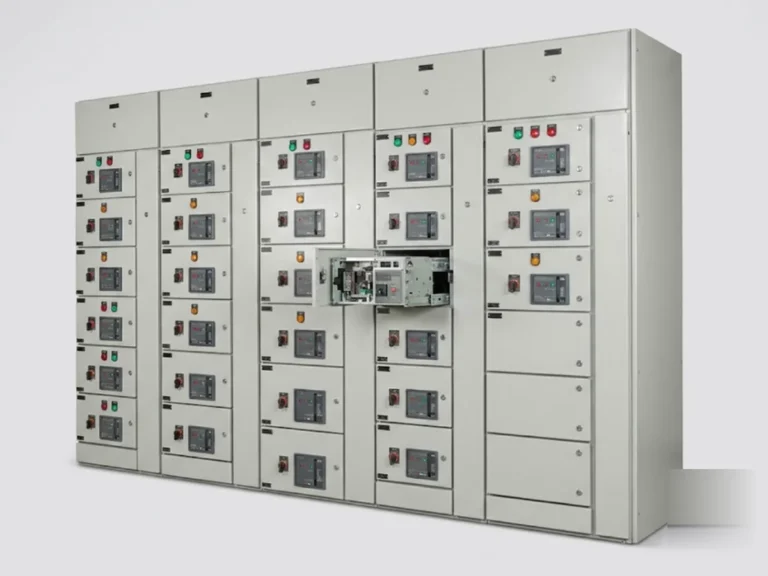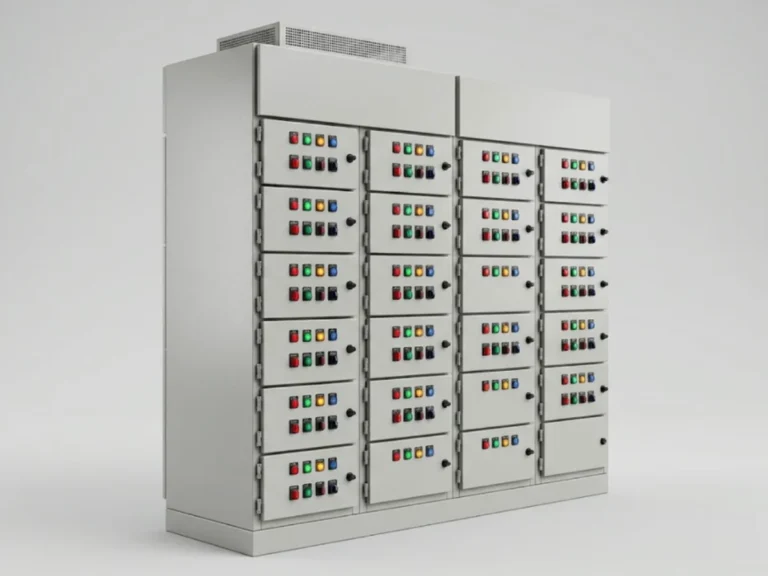
When a panel specification says “Form 3b” or “Form 4b”, it describes how much internal partitioning separates busbars, functional units (feeders) and the terminals for outgoing cables. The system comes from IS/IEC 61439-2 and its main purpose is to limit what can be touched and what a fault can spread to while someone works on one feeder with the rest of the board live.
More separation means safer maintenance and less downtime, but it also means more sheet metal or insulating barriers, more space and a higher price. Choosing the right form is one of the cheapest ways to improve plant safety, if you choose it deliberately.
The terms used
- Busbars: the main horizontal and vertical conductors that distribute power inside the panel.
- Functional unit: one feeder, for example an incomer or a motor starter, with its breaker, contactor and relay.
- Terminals for external conductors: where the site cables connect.
- Separation: a barrier or partition, made of metal or insulating material, between those parts.
What each form means
| Form | Internal separation |
|---|---|
| Form 1 | No internal separation. Everything sits in one enclosure. |
| Form 2a | Busbars separated from functional units. Terminals are not separated from busbars. |
| Form 2b | Busbars separated from functional units, and terminals for external conductors separated from busbars. |
| Form 3a | As Form 2, and functional units separated from one another. Terminals not separated from busbars. |
| Form 3b | As Form 3a, with the terminals for external conductors also separated from busbars. Terminals of a unit are not separated from the unit’s own compartment. |
| Form 4a | As Form 3, and terminals of each unit in the same compartment as their functional unit but separated from other units’ terminals. |
| Form 4b | As Form 4a, but the terminals of each unit sit in their own separate compartment, outside the functional unit’s compartment. |
The practical reading: the further you go from 1 to 4b, the more of the board stays isolated and safe to touch while you work on one part of it.
Practical meaning of each
Form 1
An open arrangement for small distribution boards, lighting boards, small APFC or control boxes where the whole board is isolated before anyone opens it. Cheapest, but any work needs a complete shutdown.
Form 2b
A good minimum for main distribution panels where bus access matters most. Cable terminals sit away from the busbar, so cable work is safer than in Form 1. Feeders are not separated from each other.
Form 3b
The most common choice for industrial MCCs and PCCs. Each feeder has its own compartment, so a breakdown or maintenance on one starter does not expose the neighbouring one. Cable terminals are accessible with the bus protected. Many Indian PCC and MCC specifications call out Form 3b as the standard.
Form 4b
The highest form. The cable terminals of each feeder are in their own compartment and can be worked on with the feeder itself isolated and the neighbours live. It suits continuous process plants, data centres, refineries and anywhere shutting a whole board is expensive or unacceptable. It is used mainly with drawout (withdrawable) construction. See drawout MCC panels and intelligent MCC.
How to choose
- Ask what a shutdown costs. If stopping the whole board stops production, move up to 3b or 4b.
- Consider who maintains it. A trained team with permit-to-work and lock-out systems may be comfortable with 3b. A mixed contractor workforce is better protected by 4b.
- Check the feeder type. A large ACB or MCCB feeder in a fixed, bolted-in arrangement usually does not need 4b; a motor feeder in a drawout module does.
- Allow for space. Higher forms use larger cubicles and wider cable alleys. In an existing substation, check room size before specifying 4b.
- Check the incoming cable arrangement. Bottom entry with many large cables needs enough cable alley depth for a separate terminal chamber.
A worked example
Take an MCC with twelve motor feeders for a water treatment plant that runs round the clock. The pumps cannot all be stopped to change one starter. Form 3b would give each starter its own compartment, but a technician connecting a new cable would still be working next to that starter’s live terminals unless the feeder is off. With Form 4b and a drawout module, the module is withdrawn, the terminal chamber stays separate, and the neighbours keep running. The extra cost buys exactly that ability to replace a single failed starter without a plant stop. For a utility board on a single lighting circuit, Form 2b would have been sufficient.
Common misunderstandings
- “4b means arc-proof.” No. Forms of separation do not guarantee internal arc withstand. Internal arc classification is separate and has to be asked for and tested.
- “IP rating and form are the same thing.” IP rating describes ingress of dust, water and fingers into the enclosure. Form describes partitioning inside.
- “Any manufacturer’s Form 3b is the same.” The standard sets the principle, but partitions can be metallic or insulating, and quality varies. Ask for drawings showing the segregation.
- “Higher form is always better.” If the board is rarely worked on, 2b or 3b may be a better spend than 4b, with money going to relays and meters instead.
These are general notes and not a design instruction. The form of separation on any given board should be confirmed with a qualified engineer and written into the purchase specification.
What to send us for a quotation
Tell us which form you want or the maintenance philosophy behind it, plus the single-line diagram, feeder list, fixed or drawout preference, enclosure IP rating, any internal arc requirement and the cable entry (top or bottom). You can request a quotation or contact us. Quotation requests are answered within 24 hours. See the full switchgear panels range and the MCC panel page.
Frequently asked questions
What is the difference between Form 3b and Form 4b?
In Form 3b, busbars, functional units and cable terminals are separated from each other, but a feeder's terminals share its compartment. In Form 4b, the terminals of each feeder are in their own separate compartment, so cable work can be done with that feeder isolated and its neighbours still live. Form 4b is the higher level of protection.
Which form of separation is standard for MCC panels?
Form 3b is the most common specification for industrial MCCs and PCCs in India, while Form 4b is used where continuity of service is critical or where drawout modules are required. The choice should be in your purchase specification, not left to the supplier's default.
Does a higher form of separation make a panel arc-proof?
No. Forms of separation reduce contact with live parts and limit fault spread, but internal arc withstand is a different property that has to be specified and tested separately. If personnel safety against arc faults matters, ask for internal arc classification in addition to the form.
Is Form 1 acceptable for an industrial panel?
Form 1 is acceptable for small boards that are always fully isolated before work, such as simple distribution or control boxes. It is not suitable where feeders must be maintained while others stay live. For MCCs and main distribution panels, Form 2b or higher is the normal minimum.