Most pump problems on site trace back to the selection stage: a pump chosen on motor kW alone, a suction line nobody checked, or a casing material picked to match the last pump rather than the liquid. This guide walks through the four numbers and decisions that fix a centrifugal pump selection: flow, total head, NPSH and materials, followed by motor sizing.
Start with the duty: flow and total head
A pump is selected for a duty point, not a power rating. You need two numbers at minimum.
- Flow (Q): how much liquid you need to move, in m3/h or litres per second. Use the peak demand, then check what the pump does at part flow, because most plants run below peak for most of the day.
- Total head (H): the energy the pump must add, in metres of liquid column. It is the static lift plus pipe and fitting friction plus any pressure you must deliver at the outlet.
Total head is the number buyers most often under-estimate. Measure the static difference between suction liquid level and discharge point, add friction loss for the actual pipe length, bends, valves and strainers at the design flow, and add residual pressure if the line ends in a nozzle, a pressurised tank or a filter. Pump curves are drawn for water; for viscous or dense liquids the head, flow and efficiency all shift, so tell the supplier the specific gravity and viscosity.
Worked example
You must lift 60 m3/h of clean water from a sump to an overhead tank. Static difference is 25 m, friction in the pipework at 60 m3/h is about 6 m, and you want 2 m of margin at the tank inlet. Total head is 25 + 6 + 2 = 33 m.
Hydraulic power in kW is Q (m3/h) multiplied by H (m) and divided by 367. Here that is 60 x 33 / 367, about 5.4 kW. If the pump efficiency at that point is 65 percent, shaft power is 5.4 / 0.65, about 8.3 kW. The next standard motor above this with some margin is 11 kW. Always read the efficiency from the pump curve rather than assuming a number.
Read the curve, not the catalogue headline
Ask for the performance curve and mark your duty point on it. Look for three things.
- The duty point should sit near the best efficiency point (BEP), roughly in the middle of the curve. Far to the left the pump runs hot and recirculates internally; far to the right it risks cavitation and motor overload.
- The shut-off head and the shape of the curve matter if two pumps will run in parallel.
- Check the power curve to confirm the motor is not overloaded anywhere along the flow range you will actually use.
Speed matters too. On 50 Hz supply, 2-pole motors run at about 2900 rpm and 4-pole at about 1450 rpm. A 4-pole pump is larger and costs more but is quieter, wears less and often has a lower NPSH requirement. For abrasive liquids, the slower pump usually lasts longer. If flow will vary a lot, consider a variable frequency drive; pump speed changes follow the affinity laws, where flow varies with speed and head with the square of speed.
NPSH: the check that prevents cavitation
Net positive suction head available (NPSHa) is the margin the suction side gives above the liquid’s vapour pressure. The pump’s NPSH required (NPSHr) is on the curve. NPSHa must exceed NPSHr with a safety margin, otherwise vapour bubbles form at the impeller eye and collapse, causing noise, vibration, falling head and pitted impellers.
For an open sump: NPSHa = atmospheric head – suction lift (or + flooded height) – friction loss in suction line – vapour pressure head.
Take a pump in Bangalore, where atmospheric pressure is lower than at sea level because of altitude, so assume about 9 m of water. The sump is 3 m below the pump centreline, suction friction is 0.5 m, and water at 30 degrees C has a vapour head of about 0.4 m. NPSHa = 9.0 – 3.0 – 0.5 – 0.4 = 5.1 m. If the pump needs 3.5 m NPSHr, the margin is 1.6 m, which is comfortable; most engineers want at least 0.5 to 1 m extra and more for hot liquids or critical duty.
Ways to raise NPSHa: shorten and enlarge the suction pipe, remove unnecessary fittings, lower the pump relative to the liquid level, or use a flooded suction. A suction pipe at least one size larger than the pump inlet, with an eccentric reducer (flat side up) and no air pockets, solves many problems before they start.
Materials and seals
Match wetted parts to the liquid, not to habit. The table shows the usual starting points; confirm against your liquid’s chemistry and temperature.
| Liquid | Typical wetted material | Watch for |
|---|---|---|
| Clean cold water | Cast iron casing, bronze or cast iron impeller | Bronze impeller improves corrosion resistance |
| Sea or brackish water, mild chemicals | Stainless steel or duplex grades | Chloride pitting in lower grades |
| Acids, alkalis, process chemicals | Stainless steel, lined or polymer pumps | Check concentration and temperature |
| Slurry, sewage, solids | Cast iron with wide-passage non-clog impeller | Passage size versus solid size |
For shaft sealing, a mechanical seal gives low leakage on clean liquids, while gland packing tolerates dirt but needs adjustment. Seal face and elastomer materials must suit the liquid too. Also decide the bearing arrangement and whether the pump is close-coupled to the motor or on a baseplate with a coupling.
Choosing a pump type
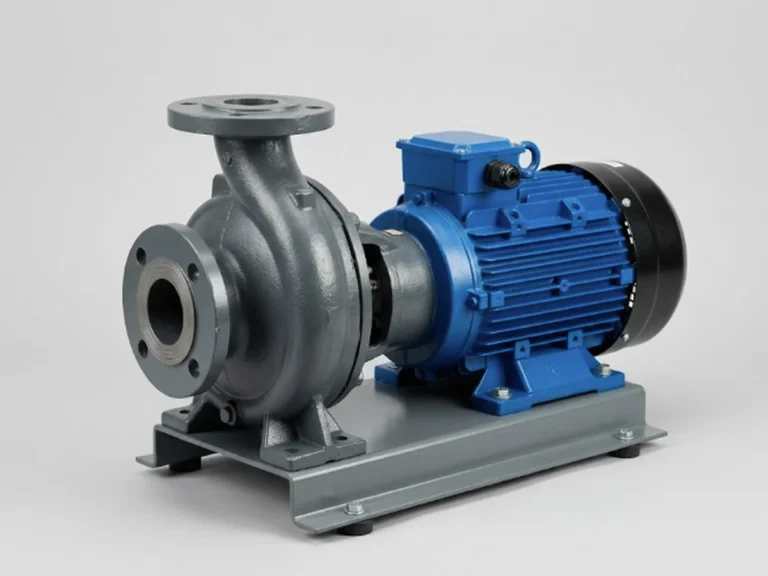
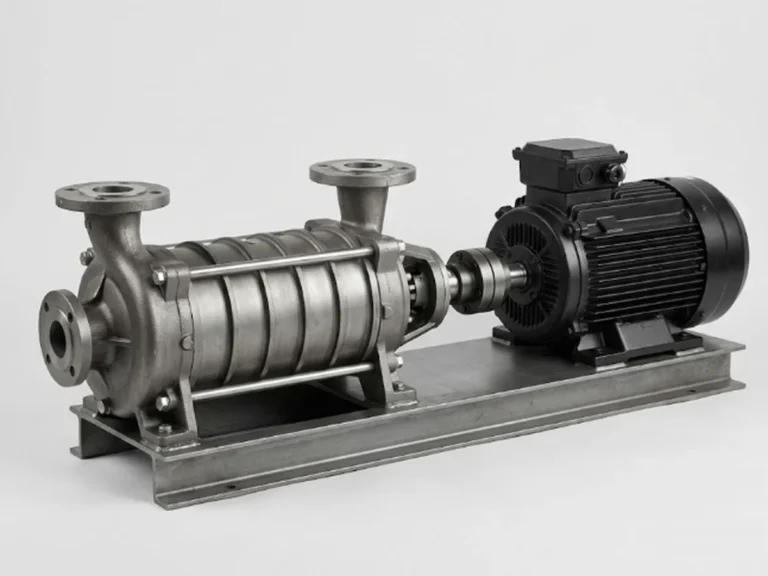
Within the centrifugal family, match the construction to the job. End suction monoblock pumps suit clean water at moderate head. Horizontal multistage pumps deliver higher head from one casing. Solid handling non-clog pumps move sewage and trade effluent. You can browse the full range under pumps and valves, or start from centrifugal pumps and narrow down. Pair the pump with a correctly rated motor and cable, using the motor current and cable calculator, before you finalise the order.
Finally, think about how the pump will be maintained. Ask for a back pull-out design if the motor is large, so the rotating assembly can be removed without disturbing the pipework. Keep the supplier’s recommended spares, such as the mechanical seal and wear rings, on the shelf for any pump that is critical to production.
What to send us for a quotation
Send the liquid and its temperature, flow, total head or the piping layout, suction condition (flooded or lift), site altitude, supply voltage and preferred speed, and any material or seal preference. A sketch of the suction and delivery line helps us check NPSH. Use the request a quote page or contact us; we answer quotation requests within 24 hours.
Frequently asked questions
How do I calculate the motor kW for a centrifugal pump?
Hydraulic kW equals flow in m3/h times total head in metres, divided by 367. Divide that by the pump efficiency at your duty point (read from the curve) to get shaft kW. Then choose the next standard motor rating with a margin, commonly 10 to 15 percent, and check the power curve so the motor is not overloaded at the far end of the flow range. Confirm the final choice with the pump supplier.
What is NPSH and why does it matter?
NPSH is net positive suction head. NPSHa is what your suction system provides above the liquid's vapour pressure; NPSHr is what the pump needs, from its curve. If NPSHa falls below NPSHr, vapour bubbles form and collapse inside the pump, which is called cavitation. It causes noise, loss of flow and pitted impellers, so keep NPSHa comfortably above NPSHr, with at least 0.5 to 1 m of margin.
Should I pick a 2-pole or 4-pole motor for the pump?
A 2-pole pump runs near 2900 rpm on 50 Hz and is compact and cheaper for the same duty, while a 4-pole pump runs near 1450 rpm and is physically larger. The slower pump is usually quieter, wears less in abrasive service and often needs less NPSH. For clean water at high head, 2-pole is common; for slurry or continuous heavy duty, 4-pole is often preferred.
Which pump material is right for my liquid?
Cast iron casings with bronze or cast iron impellers are common for clean cold water. Brackish water, chlorides and many chemicals call for stainless steel or duplex grades. Slurry and sewage need wide-passage impellers in tough cast iron. The right choice depends on pH, temperature, chloride content and solids, so share a liquid analysis with the supplier before ordering.