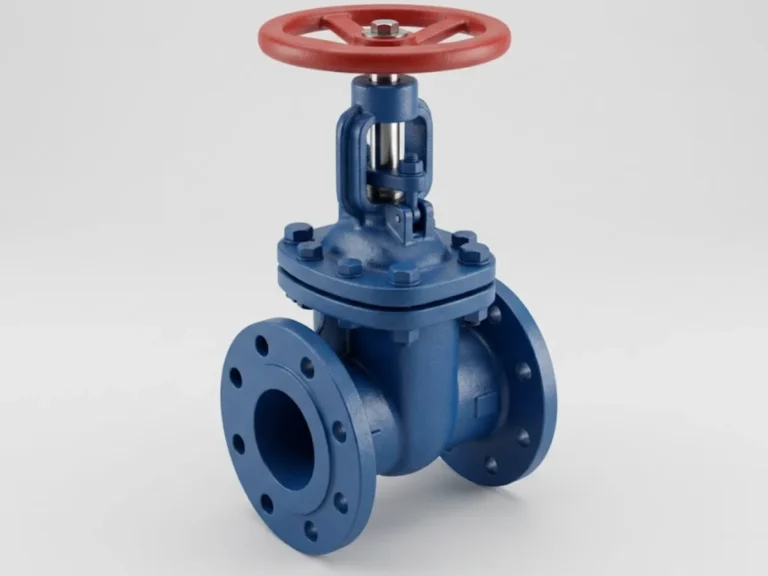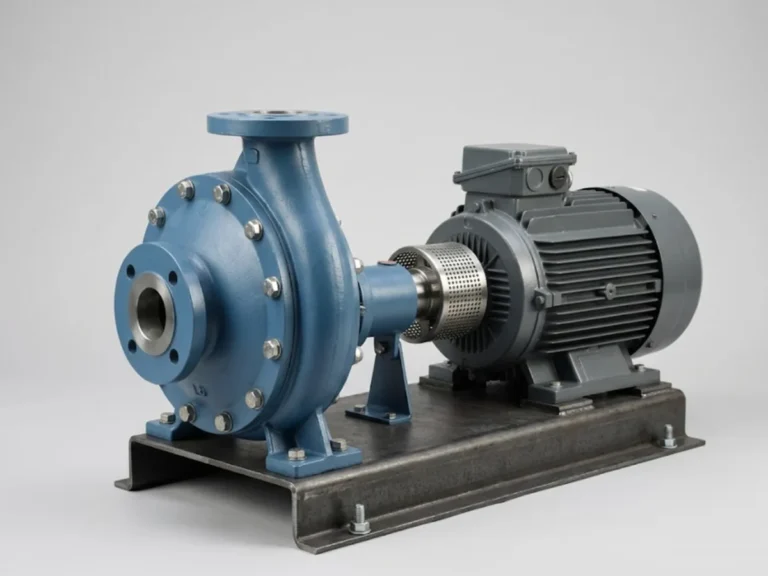
The pump gets the attention, but the valves around it decide whether the system starts, runs and stops cleanly. A wrongly placed gate valve, a slamming check valve or an undersized suction valve can cause cavitation, hammering and early pump failure. This guide covers the three valves found on almost every pump line: gate, globe and non-return, and where each belongs.
What each valve does
Gate valve: isolate, do not throttle
A gate valve lifts a flat wedge or gate out of the flow path. When fully open it offers little resistance, so it adds little head loss. It is meant to be fully open or fully closed.
- Use for: isolating a pump for maintenance, isolating sections of pipework.
- Do not use for throttling: a partly open gate vibrates, chatters and erodes the seat.
- Variants: rising stem (the stem position shows open or closed) and non-rising stem (saves headroom). Resilient-seated gate valves suit clean water service.
Globe valve: control the flow
A globe valve closes with a disc against a seat inside an S-shaped body. The flow path turns twice, so the pressure drop is higher, but throttling is stable and the valve seals tightly.
- Use for: regulating flow, bypass lines, vents and drains, and where tight shut-off with throttling is needed.
- Avoid for: large main lines where its pressure loss wastes energy.
- Direction: install with flow in the direction marked on the body.
Non-return valve (check valve): protect the pump
A non-return valve (NRV) allows flow in one direction only. On a pump delivery line it prevents backflow when the pump stops, which protects the pump from spinning backward and keeps the line full. Common types:
| Type | Characteristics | Typical use |
|---|---|---|
| Swing check | Hinged disc swings open; low head loss; can slam on closure if flow reverses quickly | Larger lines, clean water, moderate duty |
| Dual-plate (wafer) check | Two spring-loaded plates; compact and lighter; closes faster than swing | Space-limited installations, medium to large sizes |
| Lift check / ball check | Disc or ball lifts off a seat; ball types handle solids | Smaller lines, sewage with ball type |
| Nozzle or non-slam check | Spring-assisted, short closing stroke | Where water hammer risk is high |
Where the valves go on a pump line
Suction side: a foot valve with strainer on a suction lift pipe, or a gate or butterfly isolating valve on a flooded suction. Keep the suction line short, at least as large as the pump inlet, with no unnecessary fittings, and the isolating valve fully open in service. Throttling on the suction side invites cavitation. Check your suction arrangement against the pump’s NPSH requirement.
Delivery side, in order from the pump:
- Pressure gauge and flexible connection or expansion joint, if used.
- Non-return valve, close to the pump.
- Isolating (gate) valve after the NRV, so the NRV can be serviced with the line isolated.
- Control or globe valve if you need to trim flow.
Putting the NRV between the pump and the isolating valve lets you close the isolating valve and service the NRV or the pump without draining the whole line. Provide a bypass or priming arrangement if the design needs it.
Water hammer and slamming
When a pump trips, the flow in a long delivery line can reverse and close the check valve suddenly. The resulting pressure surge, known as water hammer, can damage pipes, supports and the pump. Reduce the risk by:
- Choosing a quick-closing, spring-assisted or non-slam NRV for long or high-head lines.
- Starting and stopping the pump gradually using a soft starter or variable frequency drive.
- Closing control valves slowly, and having the system checked by an engineer for surge on long mains.
Selection: size, rating and materials
- Size (nominal bore): match the pipe size, not the pump flange, unless a reducer is used.
- Pressure class: choose a rating (PN class or similar) above the highest pressure the line can see, including the pump’s shut-off head plus any static head and surge allowance.
- End connections: flanged for most pump lines; match the flange standard and drilling of the pipework and pump flanges.
- Body and trim material: cast iron or ductile iron for clean water, gunmetal or bronze trim for better corrosion resistance, stainless steel for chemicals or sea water. Match to the liquid and temperature.
- Service conditions: solids, temperature, vibration and frequency of operation affect valve choice.
Browse our valves and the pumps and valves category. For centrifugal duty see centrifugal pumps and the end suction monoblock pump. The final specification, especially on long mains, fire service or hazardous liquids, should be confirmed with a qualified engineer.
Common mistakes
- Using a partly open gate valve to throttle flow.
- Installing an NRV too far from the pump or in a vertical line with the wrong orientation for the type.
- No isolating valve after the NRV, so the line must be drained to service it.
- Pressure class based on working pressure only, ignoring shut-off head and surge.
- Reducing the suction pipe to match the valve size.
Butterfly valves are also common on pump lines, especially in larger sizes, because they are compact and light and give reasonable throttling. Check the seat material for the liquid and temperature, and leave enough straight pipe so the disc does not hit adjacent fittings. For very large water mains, engineers often prefer a butterfly or knife gate over a heavy gate valve. Whatever you choose, install valves with enough clearance to operate and service, and support the pipework so valve weight does not stress the pump flange.
What to send us for a quotation
Send valve type, size (nominal bore), pressure class, end connection and flange standard, body material, liquid and temperature, and operating pressure. If it is for a pump set, include the pump duty point. Use request a quote or contact us; we answer quotation requests within 24 hours.
Frequently asked questions
Can I use a gate valve to control flow?
It is not recommended. A gate valve is designed to be fully open or fully closed. Held partly open, the gate vibrates and the seat erodes, and it may not seal afterwards. Use a globe valve or another control valve to throttle flow, and keep the gate valve for isolation of pumps and pipe sections.
Where should the non-return valve be placed on a pump?
On the delivery line, close to the pump, between the pump and the isolating valve. This protects the pump from backflow and lets you close the isolating valve to service the NRV without draining the line. Check the orientation required by the type, since some check valves work only in horizontal lines or in vertical upward flow.
What causes water hammer when a pump stops?
When a pump trips, flow in a long or high-head delivery line slows and reverses, and the check valve closes. If it closes suddenly, the moving column of water stops abruptly, creating a pressure surge. Non-slam check valves, controlled pump stopping and surge analysis for long mains reduce the risk. Have an engineer assess critical or long lines.
How do I choose the pressure class of a valve for a pump line?
Choose a rating above the maximum pressure the line can see, which is not only the working pressure but also the pump's shut-off head plus static head and any surge allowance. Match the flange standard of the pipework too. If in doubt, give the pump duty and pipe layout to the supplier and ask them to confirm the class.