Mains power at your socket is a smooth sine wave at 50 Hz. An inverter has to build that shape from a battery’s DC, and the quality of the imitation varies a great deal between models. The difference decides whether a ceiling fan runs quietly, a fridge compressor stays cool and a laptop charger survives the year. This article explains the three waveforms you will meet in India and which loads justify the extra cost of a pure sine wave inverter.
The three waveforms
Square wave
The output switches abruptly between positive and negative with a flat top. It is the simplest and cheapest design. It has high harmonic content, which causes heating and noise in inductive loads. Few modern buyers want it, but older and very low-cost units still use it.
Modified sine wave (quasi-sine)
The output is a stepped approximation: positive step, a pause at zero, negative step. It is better than a square wave and runs resistive loads such as bulbs and heaters acceptably. Motors, transformers and some electronics tolerate it poorly because the harmonics increase losses and heat.
Pure sine wave
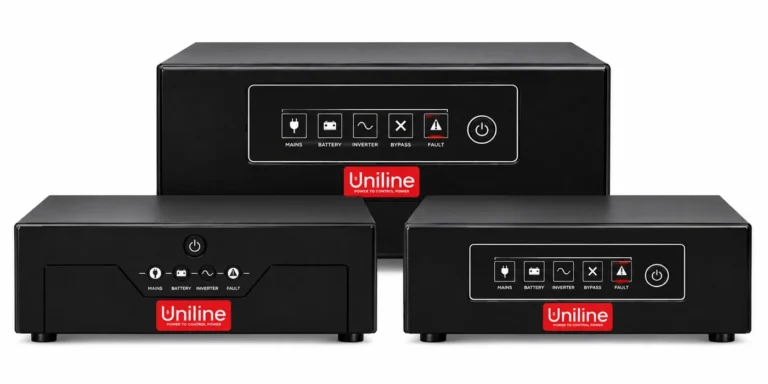
The output closely follows the smooth mains waveform, with low total harmonic distortion (THD). A good pure sine inverter keeps THD in the low single digits as a percentage, though the actual figure varies by model, so check the datasheet. Examples include the Uniline Pure Sine Wave Inverter, the Microtek Jumbo Home UPS JM SW and the Exide Inverterz Xtatic series; confirm each model’s waveform on its datasheet.
What happens to different loads
| Load | Square / modified | Pure sine |
|---|---|---|
| Incandescent bulb, heater | Works fine | Works fine |
| LED lights and drivers | Often fine, may flicker or buzz on some drivers | Clean |
| Ceiling fan, mixer, pump motor | Hum, extra heating, reduced efficiency | Quiet and efficient |
| Refrigerator, compressor loads | Extra heating of the motor; risk to long-term life | Designed operation |
| Computer, laptop, set-top box | Power supply runs hotter; some reject the supply | Normal |
| Laser printer | Can overheat the fuser or fail to start | Normal, but check surge rating |
| TV, audio equipment | Possible noise or lines on screen | Clean |
| Medical or lab instruments | Not suitable unless the maker allows it | Preferred, with the maker’s approval |
Check each appliance’s manual; some equipment states what waveform it accepts.
Why the harmonics matter
Think of a swing pushed at the wrong moments: the energy goes in, but not smoothly, and the swing shudders. A motor fed with a stepped waveform behaves much the same way, with torque ripple that you hear as humming and feel as extra heat in the casing.
A motor is an inductive load designed for a sine supply. Harmonic voltages drive extra current that does no useful work, so the winding heats up and the efficiency falls. The motor also tends to produce audible noise and, in the long run, shorter insulation life. For electronics, a switch-mode power supply with a poor waveform at its input can run hotter and may trip its protection. This is why a cheap non-sine inverter can appear fine for lights but trouble the first fridge or computer you add.
Is pure sine always worth the extra cost?
Yes, if you have
- A refrigerator, water pump, washing machine or other motor load.
- Computers, networking equipment, billing systems or other electronics.
- Medical devices, audio or video equipment, or any item where the maker asks for pure sine.
- Equipment that is expensive or hard to replace.
Maybe not, if
- You only run LED lights and a few fans for short periods, the budget is tight, and the load list is simple. Even so, a sine wave model will run fans quieter, so many buyers choose it anyway.
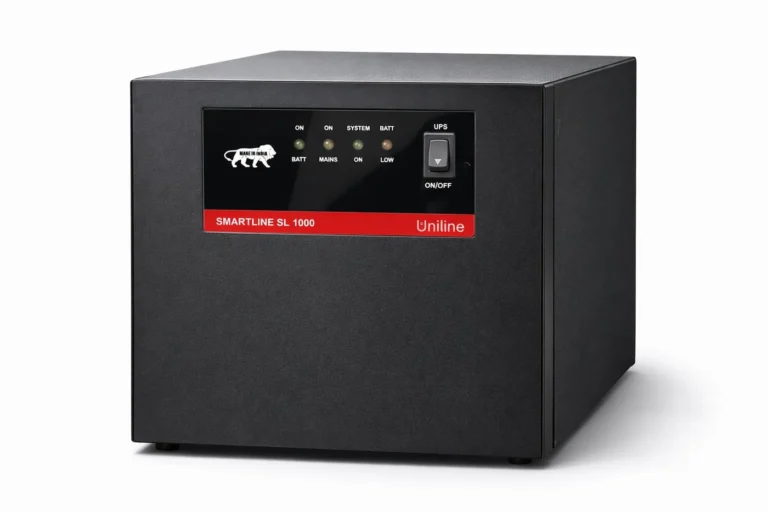
Home inverters with sine wave output are listed under home inverters and UPS. For small computer loads, UPS with a pure sine output on battery sit in line-interactive and offline UPS, such as the Uniline Smartline Sine Wave.
What else to look at besides waveform
- Surge capability. Motor loads draw a starting surge. A sine wave inverter with weak surge capability may still trip on a fridge start. Check overload rating.
- Efficiency. A good design wastes less energy as heat, which extends backup time.
- Transfer time for computers; see our comparison of inverters and UPS.
- Voltage window. A wide input range keeps the inverter on mains during voltage dips instead of draining the battery.
- Protections. Overload, short circuit, low-battery cut-off and reverse polarity protection are basic needs.
How to check what you are buying
Ask for the output waveform and THD in the datasheet. If the datasheet says only “sine wave”, ask whether it is pure sine on battery and on mains, and at which load. If you own a good multimeter that reads true RMS you can compare the output with and without load, but an oscilloscope check is the real test. Where waveform really matters for a critical load, request a demonstration or ask for the datasheet before ordering.
When you size the system, remember that VA, watts and battery bank all need to match. Our battery backup calculator helps with the battery side, and the product finder helps shortlist inverters by rating.
What to send us for a quotation
Send your appliance list with watts, any motor loads, the backup hours needed and whether the supply is single or three phase. Submit through request a quote or contact us via contact us. We answer quotations within 24 hours.
Frequently asked questions
Can I run a refrigerator on a modified sine wave inverter?
It may run, but the compressor motor will draw extra current, run hotter and produce noise, which can shorten its life. If a refrigerator is a regular load, a pure sine wave inverter is the safer choice. Also check that the inverter's surge rating covers the compressor start.
What is THD in an inverter?
THD stands for total harmonic distortion, a measure of how much the output differs from a perfect sine wave, expressed as a percentage. Lower is better. Pure sine inverters have low THD, while modified sine and square wave types have much higher figures. Look for the THD value in the datasheet.
Do LED lights need a pure sine wave inverter?
Most LED bulbs work on any waveform, but some drivers may flicker or buzz on a modified sine or square wave. Since LED lights are rarely the only load, a pure sine inverter that also serves fans and electronics is the more flexible choice.
Is a pure sine wave inverter more expensive to run?
Not in running cost. A well-designed pure sine inverter is efficient, and its cleaner output makes motor loads more efficient than on a stepped waveform. The higher price is at purchase. Compare efficiency and no-load consumption on the datasheet rather than assuming.