An undersized inverter trips on overload the first time the fridge compressor starts. An oversized one wastes money and runs inefficiently. Sizing is simple arithmetic once you list your loads honestly. This article takes you through it for a home, shop or small office, then ties the inverter size to the right battery bank.
Step 1: List only the loads you want to run during a cut
Do not add every appliance in the premises. Decide what must run and note its power in watts from the nameplate. Typical approximate values are shown below; use the nameplate where you can.
| Load | Approximate running power (W) | Note |
|---|---|---|
| LED tube or bulb | 9 to 20 | Low and steady |
| Ceiling fan | 50 to 75 (older types); lower for BLDC fans | Inductive |
| Television (LED) | 60 to 150 | Depends on size |
| Wi-Fi router | 10 to 20 | Often forgotten, always needed |
| Desktop computer with monitor | 150 to 300 | Sensitive to waveform |
| Refrigerator | 100 to 250 | Starting surge several times higher |
| Water pump (0.5 hp) | Around 400 to 500 | Starting surge several times higher |
The numbers above are indicative. A shop might add a billing computer, a printer, a point-of-sale terminal, CCTV and lights. An office adds several computers, a network switch and perhaps a small server.
Step 2: Add the running load and allow for surge
Add up the watts of everything that can run at the same time. Then check for motor loads. Fridges, pumps and compressors draw a starting current well above running current for a fraction of a second. The inverter must tolerate that surge, so choose a model whose overload capability covers it, or leave a margin. Check the inverter datasheet for its surge or overload rating.
Step 3: Convert watts to VA
Inverters are rated in VA, not watts. Divide the load in watts by a power factor, typically taken as 0.8 for mixed household loads:
Inverter VA = Total running watts / 0.8, then add 20 to 25 per cent margin.
Example: a home with 4 fans (200 W), 8 LED lights (80 W), a TV (100 W), a router (15 W) and a fridge (150 W) has a running load of about 545 W. Dividing by 0.8 gives 681 VA. With margin, a 1 kVA (1000 VA) inverter is the sensible choice. If you also wanted a 0.5 hp pump in the same circuit, the total would climb to nearly 1,050 W, and you would move to a 1.5 or 2 kVA unit.
Notice why VA and watts differ. VA is the product of voltage and current, while watts is the real power. Fans, pumps and compressors have a power factor below one, so the current they draw is higher than watts alone would suggest. Using 0.8 is a practical shortcut; if your inverter datasheet quotes a different power factor for its watt rating, use that.
Keep the average load on the inverter below roughly 70 to 80 per cent of its rating. That leaves room for surges and keeps the unit cooler.
Step 4: Choose battery voltage and bank size
The inverter fixes the system voltage. As a general guide, smaller inverters of about 1 kVA work from 12 V, mid-range ones from 24 V, and larger ones from 36 V or 48 V banks. This varies by model, so follow the manual. Higher voltage means lower current, thinner cables and less loss.
Then size the energy:
- Energy needed (Wh) = running watts x hours of backup.
- Divide by inverter efficiency, about 0.85, because the inverter itself consumes some energy.
- Divide by system voltage to get ampere-hours.
- Divide by the usable depth of discharge, often 0.5 to 0.8 depending on the battery type, to protect battery life.
Worked example, continuing from above (545 W, 3 hours, 12 V system):
- 545 W x 3 h = 1,635 Wh
- 1,635 / 0.85 = 1,924 Wh from the battery
- 1,924 / 12 V = 160 Ah
- 160 / 0.8 = 200 Ah usable-rated capacity
That calls for a 12 V, 200 Ah battery or its equivalent. Our battery backup calculator does this arithmetic for you, and the full set of tools is on the calculators page.
If you plan more than one battery, remember the difference between series and parallel. Series connection adds voltage and is dictated by the inverter’s system voltage. Parallel connection adds Ah at the same voltage. Use identical batteries of the same age, connect them with cables of equal length so they share current evenly, and never exceed the number the inverter maker permits.
Step 5: Pick battery type for your cuts
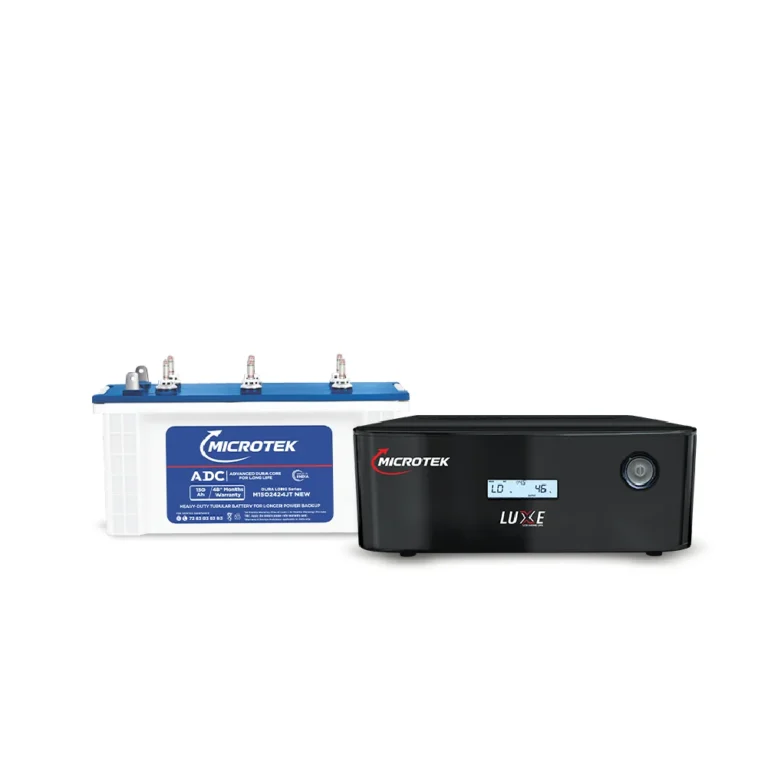
Daily long cuts favour tubular batteries, while rare short cuts allow other types. See the home inverter batteries category for options, and read our comparison of tall tubular, flat plate and SMF types before you decide. If you prefer a combined offering, the Microtek inverter and battery combo packs pair the two.
Shops and offices: extra points
- Computers and billing systems prefer a pure sine wave output and a short transfer time. For critical desktops consider a UPS rather than a plain inverter.
- Air conditioners have large starting currents and are rarely practical on a standard home inverter. Treat them as a separate, larger power-backup project.
- Three-phase premises may need a three-phase inverter or a UPS with a distribution scheme; talk to us before buying.
Browse home inverters and UPS for single-phase options, or use the product finder to narrow by rating.
What to send us for a quotation
Send us your load list with watts, the backup hours you want, your supply (single or three phase) and the space available for batteries. Submit it through request a quote or reach us via contact us. We respond to quotations within 24 hours.
Frequently asked questions
What size inverter do I need for a 2 BHK flat?
Add the watts of the fans, lights, TV, router and fridge you want during a cut. Many flats total 500 to 800 W, which suits a 1 kVA inverter with a 12 V battery, or a 1.5 kVA unit if you want margin. Calculate with your own appliance list, since fridges and pumps need surge allowance.
How many Ah battery for a 1 kVA inverter?
It depends on how long you need backup. A common pairing is one 12 V battery of 100 to 200 Ah. Multiply load watts by hours, divide by 0.85 efficiency and by 12 V, then divide by 0.8 for usable capacity. The result is your Ah requirement.
Can I run an air conditioner on a home inverter?
Generally not on a standard home inverter. Air conditioners draw large starting currents and a long running load that would need a much larger inverter and battery bank. If AC backup is essential, size it as a separate project with a qualified engineer.
Is it fine to choose a bigger inverter than needed?
Some margin is wise, but a hugely oversized inverter wastes money and has higher idle consumption. Keep your average load around 70 to 80 per cent of the rating or below. Battery bank size, not just inverter VA, then decides how long the load runs.