Quotations for solar equipment use three names that buyers often treat as the same thing: grid-tie inverter, solar PCU and hybrid inverter. They are not interchangeable. Each one decides whether you need batteries, whether your lights stay on during a power cut, and how the system behaves when the grid returns. Getting this choice wrong is the most common reason a solar purchase disappoints.
This guide explains what each unit does, where they overlap in Indian market naming, and how to choose. SKE Bharat supplies the electrical equipment, meaning inverters, batteries, panels, junction boxes and distribution boards. We do not design or install solar plants, so use this as a buying guide and confirm the final design with your solar engineer.
What each unit actually does
Grid-tie inverter
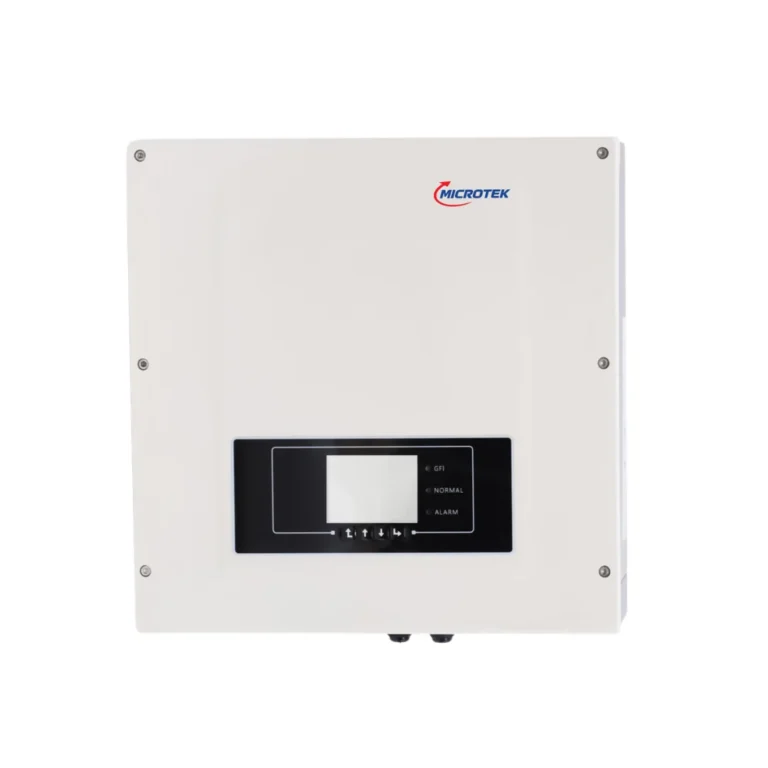
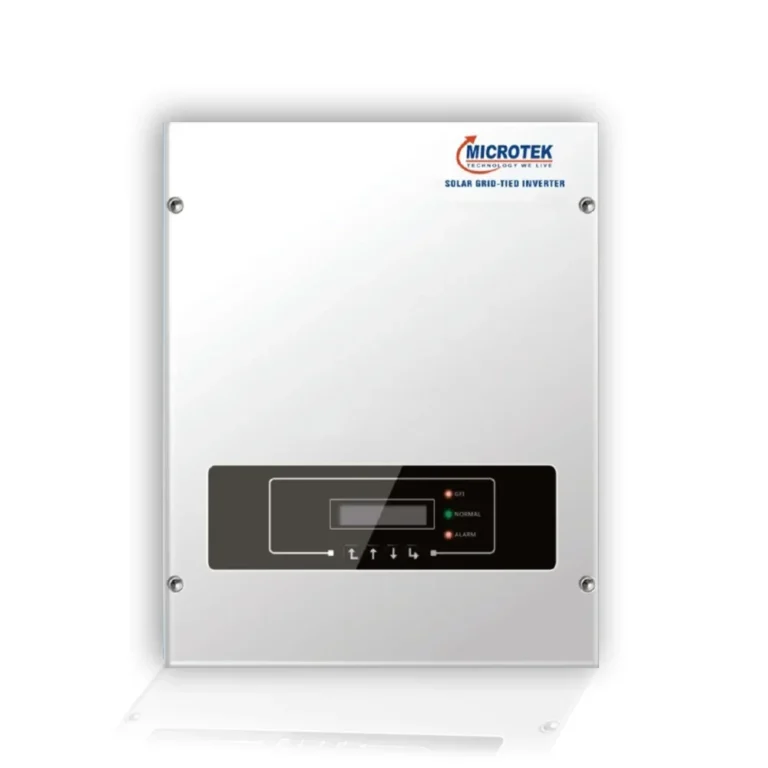
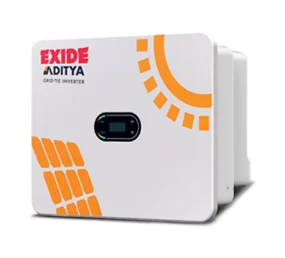
A grid-tie (on-grid) inverter converts the DC from the panels into AC and feeds it into your building supply in step with the grid. It has no battery. It needs the grid voltage and frequency to be present so that it can synchronise, and it stops within a short time when the grid goes away. This is a safety requirement called anti-islanding: it protects linemen working on a supposedly dead feeder. So a plain grid-tie system gives you no backup at all. See the range of solar inverters and PCUs, which includes three-phase grid-tied inverters, single-phase grid-tied inverters and the Exide Aditya GTI series.
Solar PCU
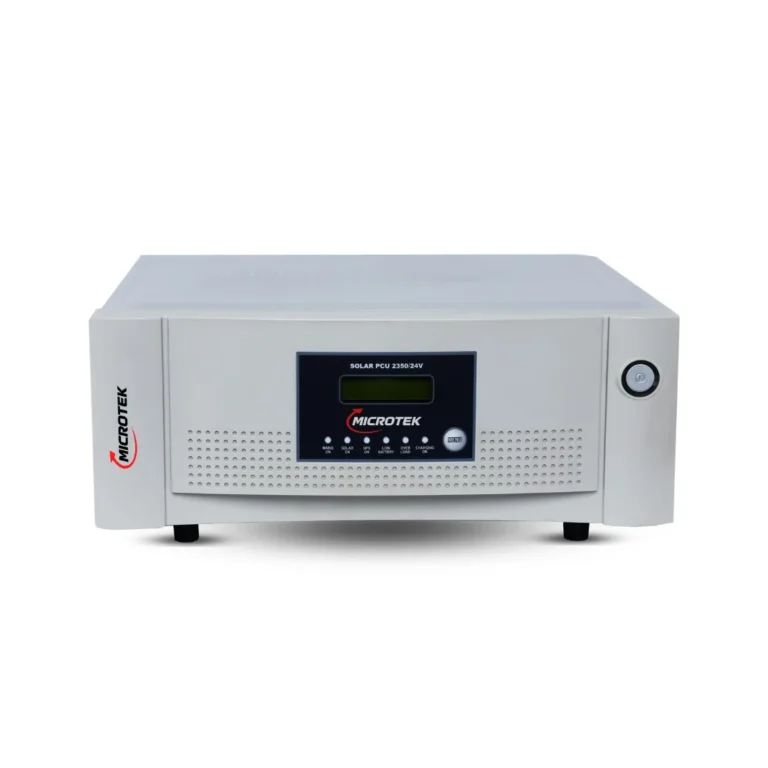
PCU stands for power conditioning unit. In the Indian market it usually means an inverter with a solar charge controller built in. The panels charge the battery bank directly through the charge controller (PWM or MPPT), the inverter runs your loads from the battery, and the grid acts as a backup charging source when sunlight is not enough. It is a battery-based, mostly off-grid style product used where the grid is unreliable or where a small, simple solar backup is wanted. Examples are the Microtek Solar PCU (PWM), Hi-End MPPT and Uniline Solaron MPPT PCU.
Hybrid inverter
A hybrid inverter manages three sources in one box: solar panels, a battery and the grid. It can run loads from solar first, charge the battery from surplus, draw from the grid when both are short, and run the building from the battery during an outage. Depending on the model and your utility’s rules, some hybrid inverters can also export to the grid. Whether a particular model can export, and whether your DISCOM allows it, must be confirmed before purchase. Browse Redon Solar PCUs (hybrid solar inverters) and the Exide solar hybrid inverters.
Naming overlaps here. Some manufacturers sell a battery-based solar PCU under the label “hybrid”, and others reserve it for units that can both charge batteries and synchronise with the grid. Always ask for the datasheet and check three things: does it need a battery, does it export, and what is the maximum PV input voltage and power.
Side-by-side comparison
| Point | Grid-tie inverter | Solar PCU | Hybrid inverter |
|---|---|---|---|
| Battery needed | No | Yes | Yes, usually (some can run without) |
| Works in a power cut | No, shuts down | Yes, from battery | Yes, from battery |
| Solar goes to the grid | Yes, subject to utility rules | Generally no | Model and utility dependent |
| Typical use | Daytime-heavy factory, shop, institution on stable grid | Small sites with frequent outages | Sites wanting solar plus backup in one system |
| Main cost driver | Panels and inverter | Battery bank | Battery bank and a more complex inverter |
| Main weakness | No backup | Limited by battery size and panel match | Cost and complexity; check export rules |
What happens when the grid fails
This is the question that settles most decisions. A factory that runs mainly in daytime hours and already has a diesel generator often wants a grid-tie inverter: the generator handles outages, and solar cuts the daytime grid bill. Be careful with the interaction, because a grid-tie inverter will not run from a generator unless the generator is stable enough to be accepted and the design handles reverse power. Confirm this with the inverter manufacturer before connecting.
A clinic, a school computer lab or a small shop with a long outage problem may prefer a PCU or hybrid system because the battery keeps essential loads running. But the battery sets the limit. If your backup load is 1.5 kW and you need 4 hours, you need roughly 6 kWh of usable battery energy, which in practice means a battery bank considerably larger than that after allowing for depth of discharge. See our battery backup calculator and the solar storage batteries for tubular, gel and lithium options.
How to choose for your site
- Stable grid, daytime load, no backup need: grid-tie inverter. Lowest cost per kW and no battery to replace.
- Unstable grid, small critical load: solar PCU, sized to the critical load only. Put non-critical loads on the normal supply.
- Want solar savings and backup together: hybrid inverter with a battery sized for the critical circuits.
- Large institution or factory with a UPS and genset already: grid-tie inverters on the main LT bus, and leave backup to the existing UPS and genset. Many plant engineers find this simpler than a large hybrid bank.
Sizing points buyers miss
- DC to AC ratio. Panels are usually installed with a total DC rating somewhat above the inverter’s AC rating. The allowed ratio is on the datasheet. Exceeding the maximum PV input power or voltage can damage the inverter, so do not guess.
- Panel voltage match. A PWM PCU needs the panel string voltage to suit the battery voltage. An MPPT unit accepts a wider range, which makes system layout easier. Read our guide to MPPT vs PWM charge controllers.
- Surge loads. Motors, compressors and pumps draw several times their running current at start. An inverter that carries the rated kVA may still trip on a pump start. Check surge capability, or use a soft starter or VFD on the motor.
- Protection. Whatever you choose, the DC and AC sides need correct breakers, surge protection and earthing. See the ACDB, DCDB and junction box guide.
Mistakes to avoid
- Buying a grid-tie inverter and expecting lights during a power cut.
- Buying a PCU rated in VA and loading it as if VA were watts. Check the power factor and the continuous watt rating.
- Sizing the battery for the inverter rating instead of the actual critical load.
- Ignoring the utility. Before any grid-connected system, check your DISCOM’s connection rules; read net metering in India: what to check.
For a wider view of solar electrical supply, see our solar solutions page and try the solar calculator for a first-pass sizing.
What to send us for a quotation
To quote accurately, send the type of site, sanctioned load, whether the grid is 1-phase or 3-phase, the loads you want to back up and for how many hours, the available shadow-free roof area, and any brand preference among Microtek, Exide, Uniline and Redon. Share it through our request a quote page or contact us and we will reply within 24 hours.
Frequently asked questions
Can a grid-tie inverter work during a power cut?
No. A standard grid-tie inverter needs the grid to be present to synchronise, and it shuts down when the grid fails. This anti-islanding action is required for safety so that solar power is not pushed into a line that utility staff believe is dead. If you need backup, choose a hybrid inverter or a solar PCU with batteries, or keep your existing UPS and generator.
Is a solar PCU the same as a hybrid inverter?
Not always. A solar PCU is an inverter with a built-in solar charge controller that charges a battery bank from panels, with the grid as a backup charger. A hybrid inverter manages solar, battery and grid together and, depending on the model, may also export to the grid. Manufacturers use both names loosely, so read the datasheet.
Do I need batteries for a solar system in a factory?
Not necessarily. Many factories run mostly in daytime and use grid-tie inverters without batteries, relying on the existing grid, UPS and generator for outages. Batteries add cost and replacement cycles. They make sense only when you have a defined critical load that must keep running, and a battery bank sized to that load.
What does PCU stand for in solar?
PCU stands for power conditioning unit. In India it normally refers to a solar inverter that includes a charge controller (PWM or MPPT) and a battery charger. It takes power from panels, charges batteries, and supplies AC loads, using the grid as an alternate charging source when sunlight is insufficient.