For substation DC supply, UPS banks, telecom and power-plant control, a stationary battery has one job: deliver on the day the supply fails, perhaps after years of sitting on float charge. The two lead-acid families used for that job are flooded (vented) cells and valve-regulated (VRLA) cells. Each has real strengths, and the wrong choice shows up years later as high maintenance or sudden loss of capacity. This guide helps you pick.
What separates the two
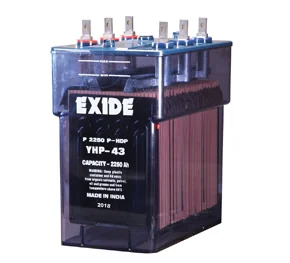
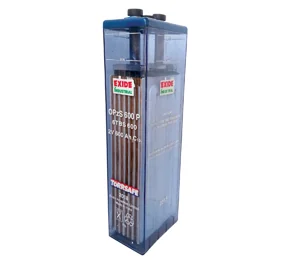
Flooded cells hold liquid electrolyte that you can see and test. Gas escapes through vents, so water is lost over time and must be replaced with battery-grade water. Cells are usually 2 V units in transparent containers, with Plante (pure lead positive plate) and tubular positive plate designs. Examples in our range include Exide Plante batteries (YAP / YKP / YHP), Exide TBS / OPzS tubular standby cells and TX HDP II tubular cells.
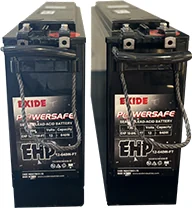
VRLA cells have the electrolyte absorbed in glass mat (AGM) or gelled, and a one-way valve that lets the cell recombine most of its gas internally. They need no water, but the valve means the cell can vent if overcharged. Examples are Powersafe EHP front terminal and top terminal cells for data centres, the Telecom VRLA NEPST and NMST range and the Gel Tubular GTB range.
Comparison for standby duty
| Point | Flooded | VRLA |
|---|---|---|
| Design life | Long; Plante and OPzS types are specified for the longest lives in the lead-acid family | Shorter; typically specified in the range of about 5 to 12 years by design |
| Water topping | Required at intervals | None |
| Condition checks | Visual, electrolyte level, specific gravity | Voltage, internal resistance or conductance, temperature |
| Heat sensitivity | Moderate | High; heat accelerates dry-out and thermal runaway risk |
| Ventilation | Needs a dedicated, ventilated room | Lower gas emission but still needs ventilation |
| Footprint | Larger; needs acid-resistant flooring, stands and often spill containment | Compact; can sit in cabinets and racks |
| Failure warning | Gradual, visible | Often hidden until a test or a real outage |
| Upfront cost | Often higher for large Ah | Generally lower for small and medium Ah |
Design-life figures are stated at a specified temperature, normally 25 degrees C. Indian plant rooms often run warmer, which reduces life, especially for VRLA.
Where each type fits
Choose flooded when
- You need long service life on a power-station, substation or process-plant DC system, and trained staff can maintain the cells.
- The installation has a purpose-built battery room with ventilation and acid-proof floor.
- Ambient temperatures are high and you want to be able to inspect and correct electrolyte.
- You want visible, gradual warning of ageing.
Choose VRLA when
- Space is restricted: the cells fit into UPS cabinets, telecom shelters or equipment rooms.
- You cannot assign people for regular topping and gravity checks.
- The room is air-conditioned and temperature-controlled.
- Battery replacement every several years is acceptable in your budget plan.
When you ask for quotations, state the discharge duration and the end voltage per cell. Two suppliers quoting the same nameplate Ah at different discharge times are not offering the same bank, and the difference only becomes visible when the bank is called upon in service.
Selection pitfalls
- Treating VRLA as no-maintenance. It needs periodic voltage, temperature and impedance checks, torque checks, and a capacity test at intervals. Without these, weak cells stay hidden.
- Ignoring temperature. Both types lose life at higher temperature; a rule of thumb quoted by many makers is that life roughly halves for each 8 to 10 degrees C above 25 degrees C. VRLA suffers more.
- Charger mismatch. Float and boost voltages differ between flooded and VRLA types. Set the charger accordingly. See our guide to float, boost and trickle charging.
- Underestimating ageing. Sizing should include an ageing factor and design margin so the bank still meets the load near end of life. Our battery bank sizing article gives the method.
- Wrong standard. Stationary flooded cells are generally covered by IS 1651, VRLA by IS 15549, and IEC 60896 parts; check which one your specification calls for.
Typical applications
| Application | Common choice |
|---|---|
| Substation or switchgear DC (110 V / 220 V) | Flooded Plante or tubular; VRLA used where space and maintenance are limited |
| Data centre or UPS | VRLA |
| Telecom 48 V | VRLA, gel, or lithium modules |
| Power plant control and emergency DC | Flooded tubular or Plante |
| Genset starting | Starting-duty batteries such as Exide Genplus |
Browse industrial and standby batteries for the whole range, battery racks, stands and cables for installation, and battery chargers and DC power supplies for the charging side. If your application is closer to a complete DC distribution system, we also supply DC distribution boards.
Cost over the life, not just at purchase
Compare options on cost per year of service. A flooded bank may cost more at the start and last much longer, but it needs a battery room, trained staff and routine water topping. A VRLA bank costs less to install and maintain on a day-to-day basis but may need replacing once or twice over the period a flooded bank serves. Include the cost of racks, room ventilation, cooling for VRLA, and labour for periodic tests when you compare. Ask the supplier for the design-life statement and the test conditions behind it.
What to send us for a quotation
Tell us the DC voltage, Ah or load profile, backup duration, ambient temperature, available space and whether a battery room exists. Send it through request a quote or contact us via contact us. We answer quotations within 24 hours. Final selection of a safety-critical battery system should be confirmed with a qualified engineer.
Frequently asked questions
Which lasts longer, VRLA or flooded batteries?
Flooded cells, especially Plante and OPzS tubular types, are normally designed for the longest lives in lead-acid. VRLA cells have shorter design lives. Both are rated at 25 degrees C, and high ambient temperature shortens life, with VRLA affected more. Check the datasheet's design-life statement for the exact model.
Can I mix VRLA and flooded cells in one battery bank?
No. They need different float and boost voltages, so a shared charger would mis-charge one type. Keep each type on its own string and charger setting, and avoid mixing different makes, capacities or ages within one string, since the weakest cells then limit the whole bank.
Does a VRLA battery need ventilation?
Yes. VRLA cells recombine most of their gas but can vent hydrogen under overcharge or fault, so the room still needs adequate ventilation. Follow the maker's guidance and your site safety rules, and keep the room temperature controlled, because heat is the biggest threat to VRLA life.
How often should standby batteries be tested?
Routine voltage, temperature and visual checks are done at frequent intervals, and a capacity discharge test is carried out periodically according to the maker's guidance and your plant's practice. Replacement is often considered when tested capacity falls to about 80 per cent of rated; confirm criteria with your engineer.