A good battery paired with the wrong charger setting will fail early, and a mediocre battery with a well-set charger often survives. Stationary batteries in substations, telecom, UPS and inverters spend most of their life on charge, so the charger matters as much as the cells. This article explains the stages (float, boost, equalise and trickle), typical voltage values for lead-acid cells and how to size and choose a charger.
The charging stages
Constant current (bulk) stage
After a discharge, the charger first delivers its maximum current, limited to a safe value, until the cell voltage rises to the set level. Most of the lost capacity is returned in this stage.
Boost charge
The charger holds a higher voltage, with current limited, to recharge the battery quickly after a discharge. Boost voltage is higher than float voltage and is applied for a limited time. Many chargers switch to float automatically when current falls to a set value, or after a timer.
Float charge
This is the long-term holding voltage. The battery stays fully charged while the charger supplies the DC load and only a small current flows into the battery to offset self-discharge. Correct float voltage is the single most important setting for battery life. Too low causes sulphation; too high causes water loss, corrosion of the positive grid and, in VRLA cells, dry-out.
Equalising charge
A periodic higher-voltage charge for flooded cells, used to bring all cells to the same state and mix the electrolyte. Many VRLA manufacturers do not recommend routine equalising, so follow their instructions.
Trickle charge
A very low current charge to counter self-discharge. In older Indian practice the word is used loosely for float charge on a stationary bank. Some simple chargers give a small constant current, which is only suitable where the maker allows it, since unregulated trickle current can overcharge a sealed battery over time.
Typical voltages per cell (lead-acid)
| Stage | Flooded cell (per 2 V cell) | VRLA cell (per 2 V cell) |
|---|---|---|
| Float | About 2.20 to 2.25 V | About 2.25 to 2.30 V |
| Boost / equalise | About 2.30 to 2.40 V | Lower end of this range, as the maker permits |
These are typical ranges at about 25 degrees C. Always use the exact figures from the manufacturer’s datasheet for your cell. Multiply by the number of cells to get the bank voltage; for example 55 cells at 2.25 V is about 124 V for a 110 V system, and 24 cells at 2.25 V is 54 V for a 48 V system. Equipment connected to the bank must tolerate the boost voltage, or be isolated during boost charging, usually through a dropper diode or a voltage-dropping arrangement.
Temperature compensation
Battery charge voltage needs to fall as temperature rises and rise as it falls. A typical compensation is a few millivolts per cell per degree C relative to 25 degrees C, as stated by the maker. In hot Indian plant rooms a charger without compensation will tend to overcharge the battery. For VRLA banks in warm rooms, temperature compensation is strongly advisable.
Charger types
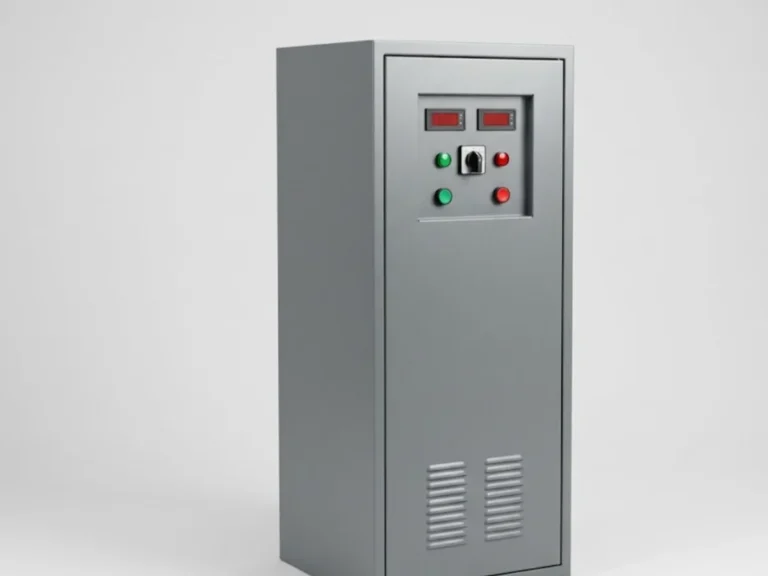
- Thyristor (SCR) controlled chargers are robust and common in substations and power plants, with float and boost modes and ripple filters.
- High-frequency switch-mode chargers and rectifiers are compact, efficient and common in telecom and UPS. Their output suits sensitive loads when well filtered.
- Chargers built into inverters and UPS have limited current and preset profiles; check that the profile matches the battery type.
- Lithium chargers use a constant-current, constant-voltage profile with BMS communication, no equalising and usually no float in the lead-acid sense.
Our battery chargers and DC power supplies page covers options, and for control-panel supplies you may also need DIN-rail power supplies (SMPS).
How to size the charger
- Add the continuous DC load that the charger supports while charging.
- Add the battery charging current. For lead-acid this is commonly set at 10 to 20 per cent of the Ah rating (0.1C to 0.2C), based on the recharge time required and the maker’s current limit.
- Allow margin for ageing and input voltage variation.
Example: a 200 Ah, 110 V bank with a 15 A continuous load and a 0.15C recharge current of 30 A needs a charger of about 45 A, and a standard rating just above this would be chosen. Recharge time is roughly the Ah removed divided by the charging current, increased by 10 to 20 per cent for charge efficiency. Final charging current limits must follow the cell maker’s data.
Common mistakes
- Leaving a flooded-cell charger setting on a VRLA bank, or the reverse.
- Boosting too often or for too long, which dries out cells.
- Float voltage set from a general rule without temperature compensation.
- Charger only sized for the load, so the battery never recharges fully after a discharge.
- Uncontrolled “trickle” chargers on sealed batteries.
- Connecting a load that cannot tolerate boost voltage while boost is active.
- Poor connections that make cell voltages read wrong and mislead the charger.
Where to read more and what to buy
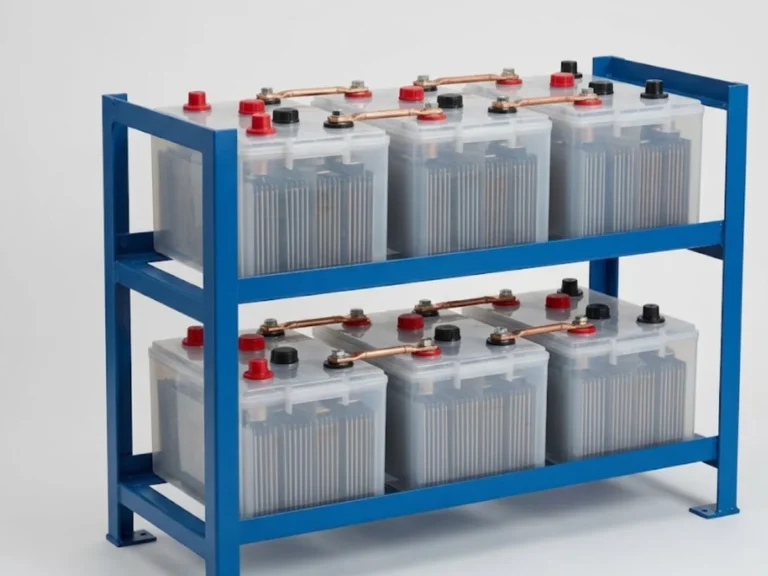
Charger choice depends on the bank: see chargers and accessories, industrial and standby batteries and, for the cell options, our comparison of VRLA and flooded types. Bank racks and cabling come under battery racks, stands and cables. Use the battery backup calculator to estimate capacity before choosing the charger. Charger settings on a live plant should be changed only by a qualified engineer.
What to send us for a quotation
Send the DC voltage, battery type and Ah, continuous load, input supply (single or three phase), recharge time needed and ambient temperature. Submit through request a quote or write via contact us. We answer quotations within 24 hours.
Frequently asked questions
What is the difference between float and boost charging?
Boost charging uses a higher voltage for a limited time to recharge a battery quickly after a discharge. Float charging uses a lower voltage that is held indefinitely to keep the battery full without damage. A good charger moves automatically from boost to float, and each setting should come from the cell datasheet.
What float voltage should I use for a 12 V VRLA battery?
A 12 V VRLA battery has six cells, so at roughly 2.25 to 2.30 V per cell the float voltage is about 13.5 to 13.8 V at 25 degrees C. Use your maker's exact figure and apply temperature compensation where the room is warm or cold.
Is trickle charging the same as float charging?
In practice many people use the terms interchangeably for stationary banks, but they are not identical. Float is a regulated constant voltage. Trickle is a small, often constant, current. A regulated float is safer for sealed batteries, because unregulated trickle current can overcharge them over months.
How do I decide the charger current for my battery bank?
Add the continuous DC load current to the battery charging current, usually 10 to 20 per cent of the Ah capacity for lead-acid, then choose the next standard rating with some margin. Confirm the battery maker's maximum charging current, and verify the recharge time against your outage frequency.