A switchgear DC supply is the last line of defence in a substation: if the AC fails, the battery must still trip and close breakers and keep relays and indication alive. A telecom 48 V bank has a similar duty with a steady load. Sizing either one is not a matter of picking a round Ah number; it follows a duty cycle, an end voltage and a few correction factors. This article explains the basics so you can check a supplier’s proposal or prepare your own enquiry.
Know the voltage and cell count first
Lead-acid cells are nominally 2 V each. The bank voltage therefore sets the number of cells.
| System | Common nominal voltage | Typical lead-acid cell count |
|---|---|---|
| Telecom | 48 V | 24 cells |
| Switchgear, relays, control | 110 V DC | 55 cells |
| Large substations, power plants | 220 V DC | 110 cells |
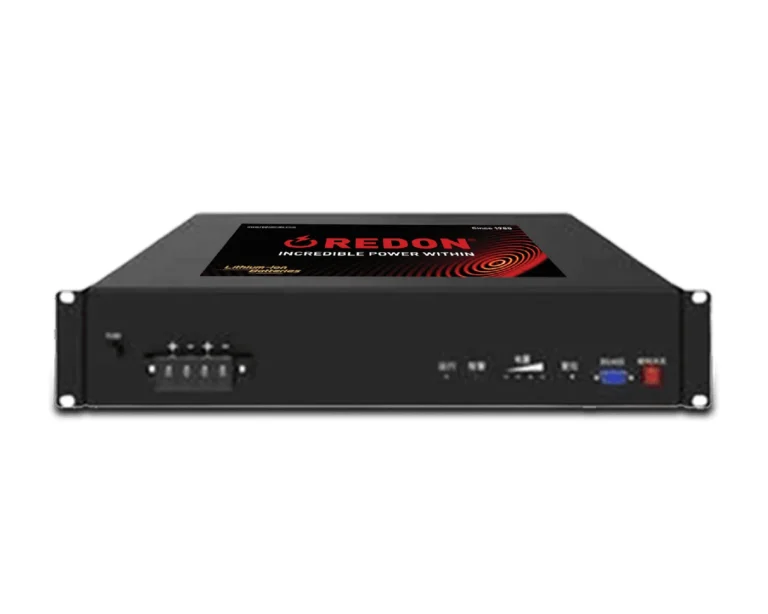
The cell count is a design choice and depends on the end-of-discharge voltage and the allowed DC bus voltage window, so confirm the number with the equipment manufacturer. Lithium 48 V telecom systems use a different pack design, for example sixteen LFP cells for a nominal 51.2 V, as in the Redon 48 V telecom battery modules.
The sizing method
Step 1: Build the load profile
Divide the DC load into three groups:
- Continuous loads: protection relays, indication lamps, SCADA and communication equipment, trip-circuit supervision. These draw current for the full backup time.
- Momentary loads: breaker tripping and closing coils, spring-charging motors, emergency contactors. These are heavy but last seconds.
- Emergency loads: DC emergency lighting and similar equipment, which run for a defined period.
List each load in amperes and the time it must run. Plot it as a stepped graph of current versus time. The bank must cover the whole profile, including the highest momentary step at the end where the battery is most discharged.
Step 2: Fix the backup duration
The required duration comes from your specification: typically a few hours for substation DC supply and a few hours for telecom on a grid-connected site, longer where mains is unreliable. Use the duration given in your project specification or utility practice rather than a general value.
Step 3: Apply the correction factors
Take the required ampere-hours from the duty cycle and multiply by:
- Ageing factor: often 1.25, so the bank still meets the load when it has fallen to about 80 per cent of its rated capacity at end of life.
- Temperature factor: from the datasheet, if the minimum battery room temperature is below the 25 degrees C rating (cold reduces capacity).
- Design margin: commonly 10 per cent for load growth and uncertainty.
Then select the next standard cell size from the manufacturer’s discharge tables at the stated end-of-discharge voltage per cell. Larger blocks will not scale linearly, so use the tables for the actual discharge time.
Worked examples
Example 1: 110 V DC substation bank
Assume a continuous load of 8 A for 8 hours, a tripping coil load of 15 A for 1 minute at the end of the period, and a breaker closing step of 40 A for 5 seconds.
- Continuous: 8 A x 8 h = 64 Ah
- Tripping: 15 A x (1/60) h = 0.25 Ah, and closing: 40 A x (5/3600) h = about 0.06 Ah (small in ampere-hours, but they set the voltage drop that the bank must withstand)
- Required Ah is about 64.3 Ah
- x 1.25 ageing = 80.4 Ah; x 1.10 margin = 88.4 Ah
The nearest standard cell above this, taken from the discharge table at the 8-hour rate, would be selected, with the high-current steps checked separately against the cell’s short-time current ratings. Treat this example as an illustration of the method, not a design.
Example 2: 48 V telecom bank
A site load of 2,000 W for 4 hours:
- Current = 2,000 W / 48 V = about 41.7 A
- Energy requirement = 41.7 A x 4 h = about 167 Ah
- x 1.25 ageing x 1.10 margin = about 229 Ah
The bank would be chosen at about 250 Ah, at a 4-hour discharge to the specified end voltage. Telecom loads behave as constant power, which means current rises as voltage falls, so use the maker’s constant-power or discharge tables for final selection. A lithium design would apply a different usable-capacity factor and would not need the same ageing allowance, so follow the lithium maker’s guidance.
Charger and cell type
Step 4: Size the charger
The charger must supply the continuous load and recharge the battery in a given time:
Charger current = continuous load current + battery charging current
The charging current is typically between 10 and 20 per cent of the Ah capacity for lead-acid, depending on the recharge time required. For example, with a 250 Ah bank and a 40 A load, a charger of about 40 A + 25 to 50 A is needed. Our article on float, boost and trickle charging explains the charging stages, and the battery chargers and DC power supplies page lists charger options.
Step 5: Decide the cell type and accessories
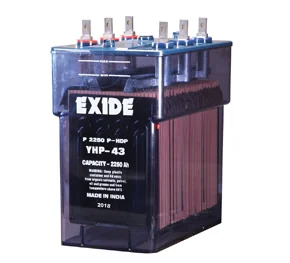
For a long-life switchgear DC bank, flooded Plante or tubular cells such as Plante YAP / YKP / YHP are often chosen, while VRLA, including the telecom VRLA NEPST and NMST range, is chosen for cabinet installations. Nickel-cadmium cells are also used for harsh duty; see Ni-Cd batteries. The bank needs racks, inter-cell links and cables, listed under battery racks, stands and cables, plus a DC distribution scheme such as a DC distribution board.
Common sizing errors
- Sizing only on continuous load and missing the closing and tripping peaks.
- Forgetting that cold sites reduce usable capacity.
- Using nominal Ah at the 10-hour rate for a 1-hour load.
- Leaving out ageing, which causes failure at the first outage after year four or five.
- Choosing a charger that can only supply the load, not recharge the battery within the required time.
Browse industrial and standby batteries and chargers and accessories for the matching equipment. Because this is safety-critical, have the final design reviewed by a qualified engineer.
What to send us for a quotation
Send the DC voltage, the load schedule (continuous and momentary, with amperes), backup hours, minimum site temperature, cell type preference, and available space. Submit through request a quote or write via contact us. We respond within 24 hours.
Frequently asked questions
How many cells are in a 110 V DC battery bank?
A 110 V lead-acid bank is commonly built from 55 cells of 2 V each, and a 220 V bank from 110 cells. The exact count depends on the end-of-discharge voltage and the permitted voltage window of the connected equipment, so confirm it with the switchgear or relay supplier before ordering.
Why do we multiply by 1.25 in battery sizing?
The 1.25 ageing factor allows for the battery's capacity falling to about 80 per cent of rated at end of life. Without it, the bank would meet the load when new but fail to do so in later years. Your specification may call for a different factor.
How is the charger rated for a battery bank?
Add the continuous DC load current to the current needed to recharge the battery in the required time. For lead-acid this is commonly around 10 to 20 per cent of the Ah rating. Also confirm the charger has float and boost modes suited to the cell type.
Can lithium replace lead-acid in a 48 V telecom bank?
Yes, lithium 48 V modules are used in telecom. The rectifier must support lithium charging, and sizing differs because lithium has higher usable capacity and no ageing allowance in the same form. Confirm compatibility with the maker of the rectifier and the lithium pack.