Switchgear Panels
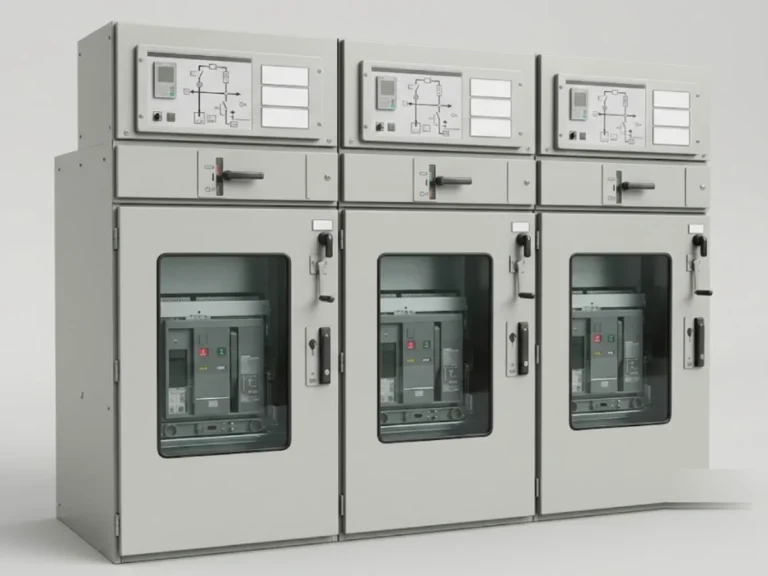
17.5 to 33 KV HT Panels
Indoor HT switchgear panels for 17.5 kV to 33 kV class distribution.
On request- StandardIEC 62271-200
- Voltage Class17.5 kV - 33 kV
Made to Order
Download specification sheet (PDF)
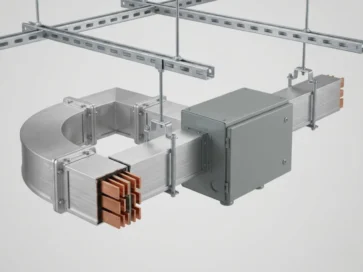
Sandwich and air-insulated busway systems carrying heavy current between transformers and panels with low losses.
Made to order against your specification. Fill what you know; our engineers will confirm the rest.
Representative image. The actual product, make and appearance depend on the supplier and your specification.
Also searched as: busduct, bus duct system, busway, sandwich bus duct, air insulated bus duct, bus duct from transformer to panel
Bus duct is chosen when cables become impractical, for example when a transformer needs several parallel cables per phase. Begin with rated current, system voltage, fault level and the route length with every bend, tee and riser.
Mistakes include ignoring thermal expansion, no allowance for fire barriers where it crosses walls and floors, and measuring route length from a drawing instead of site. For links from a transformer, see distribution transformers. Plug-in tap-offs suit rising mains. Always give the vertical and horizontal route sketch with dimensions.
Ratings, dimensions and certification are confirmed against your enquiry. Use Send an enquiry and our engineers will respond within 24 hours.
When currents are high enough that many parallel cables per phase become bulky and costly to terminate, or when you need tap-off points along a run. For short, lower-current links, cables can still be simpler. A comparison needs the current, route and bends.
Provide rated current, voltage, fault level, conductor material preference, indoor or outdoor routing, and a dimensioned route sketch with bends, risers and tap-offs. Also give the transformer and panel connection details at both ends, so flanges can be matched.
A bus duct, or busway, is an enclosed system of busbars used to carry heavy current from one point to another, such as from a transformer to a panel. The conductors are made of aluminium or copper and are enclosed in a housing.
It is used to carry large currents between a transformer and the main LV panel, and between panels, with low losses and neat installation. It is used in plants, buildings and power rooms in place of heavy cables.
In a sandwich type, the busbars are placed close together with insulation between them in a compact housing. In an air insulated type, the bars are spaced apart with air between them. The choice depends on the current, space and application.
Send the current rating, voltage, route length, layout drawing with bends and tap-offs, conductor material, indoor or outdoor use and protection degree. Price depends on rating, length and make, so send details for a quotation.
| Panel Type | Bus duct / busway |
|---|---|
| Standard | IEC 61439-6 |
| Voltage Class | LT, up to 6300 A |
| Construction | Aluminium or copper, enclosed |
| Protection Degree | IP54 - IP66 |
| Typical Use | Power transmission |
Indoor HT switchgear panels for 17.5 kV to 33 kV class distribution.
On requestMetal-enclosed medium-voltage switchgear for motor starting and distribution from 3.3 kV to 11 kV.
On requestAuto Mains Failure panels that start the generator and transfer the load automatically when mains power fails.
On requestAutomatic Power Factor Correction panels that switch capacitor banks to hold power factor near unity and avoid utility...
On requestWhat a compact or packaged substation contains, how it differs from a conventional civil substation, when it makes sense and what to specify before you order.
6 min readTransformers & Power QualityA step-by-step method to size a 11 kV/415 V transformer for a factory or building, with a worked example, standard kVA ratings and the mistakes that…
6 min readSwitchgear, Panels & ProtectionFixed MCCs cost least, drawout MCCs cut downtime, and intelligent MCCs add data. Here is how to decide which construction your plant actually needs.
6 min read