A gearbox trades speed for torque. A 1470 rpm motor cannot drive a conveyor at 35 rpm by itself, and the gearbox does that job. The four common industrial families, helical, bevel-helical, worm and planetary, differ in efficiency, shaft layout, torque capacity and price. This guide compares them and shows how to size one, so that you choose by the job and not by habit.
How the four types work
Helical gearbox
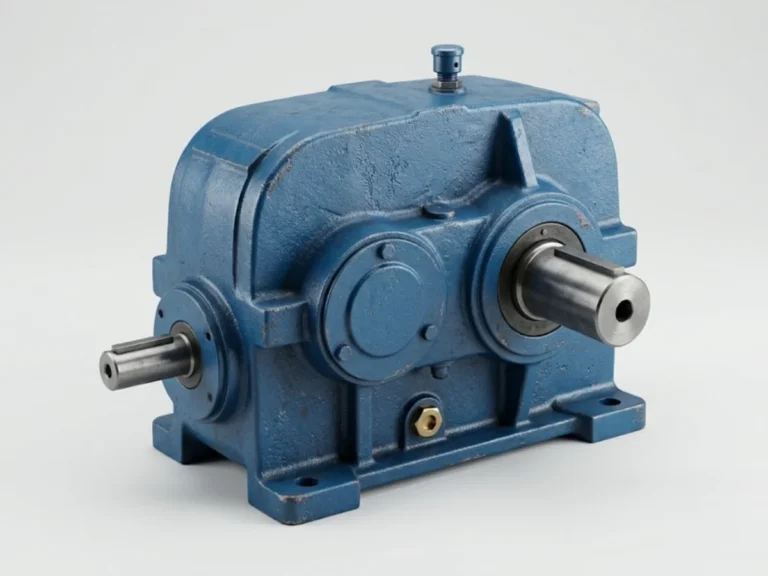
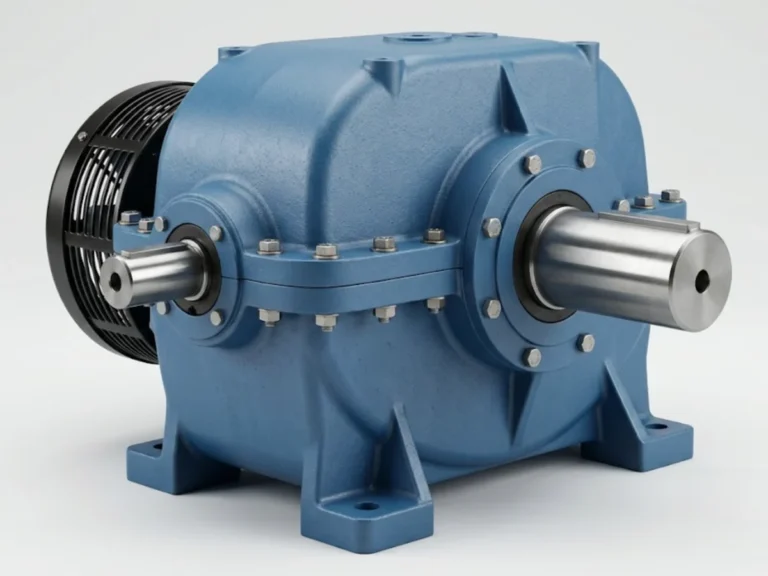
Helical gears have teeth cut at an angle, so they mesh gradually and run smoothly and quietly. Gear stages stacked in series give the required ratio. In a parallel-shaft arrangement the input and output shafts are parallel but offset; in an inline (coaxial) arrangement they are on the same axis. Typical efficiency is about 96 to 98 % per stage, so a two-stage unit is at roughly 95 % or higher. They are the workhorse for conveyors, mixers, extruders, crushers and general drives. See our helical gearbox, inline helical and parallel helical ranges.
Bevel-helical gearbox
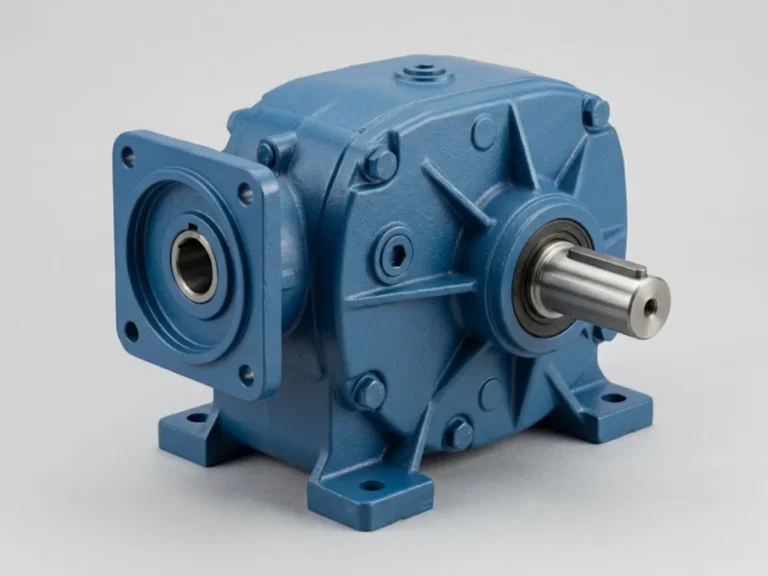
A bevel gear stage at the input turns the drive through 90 degrees, followed by helical stages. The result is a right-angle gearbox with the efficiency of a helical unit, around 94 to 97 % in typical designs. It suits applications where the motor must sit beside or below the driven shaft, such as bucket elevators, large conveyors, kilns, cooling tower fans and heavy-duty mixers. See the bevel helical gearbox.
Worm gearbox
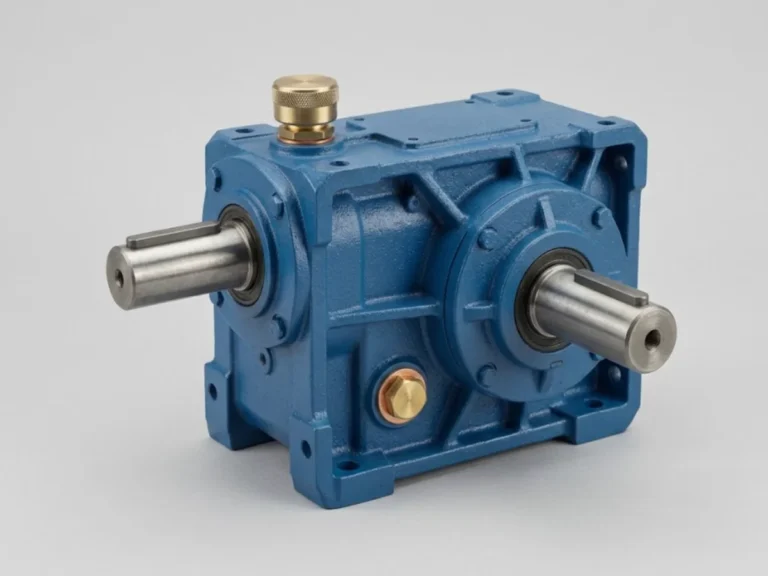
A worm (screw) meshes with a worm wheel at a right angle. A single stage can give high ratios, from around 5:1 to 60:1 or more, in a compact, low-cost, quiet unit. The trade-off is efficiency: sliding contact generates heat, and efficiency can be as low as 50 to 60 % at high ratios and about 85 to 90 % at low ratios. High-ratio worm gears may be self-locking, but they should not be relied upon as a brake, because vibration and wear can let the load drift. A holding brake is the safe choice. See the worm gearbox.
Planetary gearbox
A central sun gear drives several planet gears that run inside a ring gear, and the carrier takes the output. The load is shared across several gear meshes, so a planetary unit gives very high torque in a small, coaxial package, with efficiency about 95 to 97 % per stage and low backlash. Single-stage ratios are typically 3:1 to 10:1, and stages are stacked for more. They are used for winches, mixers, mobile machinery, wheel drives, mining conveyors and servo applications. See the planetary gearbox.
Comparison table
| Type | Shaft layout | Typical efficiency | Strengths | Limits |
|---|---|---|---|---|
| Helical (parallel or inline) | Parallel or coaxial | about 95 to 98 % | Efficient, long life, wide ratio range | Larger and costlier than worm at small sizes |
| Bevel-helical | Right angle | about 94 to 97 % | Efficient right-angle drive, high torque | Higher cost, heavier |
| Worm | Right angle | about 50 to 90 %, falls with ratio | Compact, quiet, low cost, high single-stage ratio | Heat, wear, low efficiency, not a reliable brake |
| Planetary | Coaxial | about 95 to 97 % per stage | Very high torque density, low backlash | Higher cost, needs good lubrication |
The efficiency values are typical ranges; the maker’s catalogue gives the exact figure for each size and ratio.
How to size a gearbox
A gearbox is chosen by the output torque it must deliver continuously, multiplied by a service factor. The steps are:
- Output speed and ratio. Ratio = motor speed / required output speed.
- Output torque. T (Nm) = 9550 x P (kW) / n (rpm), where n is the output speed, and multiply by the gearbox efficiency.
- Service factor. Multiply by a factor for the load: about 1.0 to 1.25 for uniform loads such as a lightly loaded centrifugal pump, around 1.5 for moderate shock such as a conveyor, and 2.0 or more for heavy shock, such as crushers or rolling mill drives. The duty hours and starts per hour also matter.
- Thermal rating. Worm and some helical units can be limited by oil temperature rather than mechanical strength at continuous duty, so check the thermal rating or add cooling.
- Check overhung load on the output shaft (chain sprocket or belt pulley), the mounting position and the shaft type: solid, hollow or flanged.
Worked example
A belt conveyor is driven by a 15 kW, 1470 rpm motor, and the belt needs an output of about 37 rpm. The ratio is 1470 / 37 = about 40. Output torque is 9550 x 15 / 37 = 3871 Nm at 100 % efficiency; with a two-stage helical unit at about 96 % efficiency the torque delivered is about 3700 Nm. With a service factor of 1.5 for moderate shock, you need a gearbox with a mechanical rating of at least 3700 x 1.5 = about 5550 Nm at this ratio. If you chose a worm gearbox for the same ratio and its efficiency was 70 %, the delivered torque is only about 2700 Nm for the same motor, and the unit would also dissipate about 4.5 kW as heat. That is why high-power, continuous duty drives usually use helical gearboxes instead of worm gears.
Choosing by application
- Conveyors, general mixers, extruders: inline or parallel helical.
- Space-constrained right-angle drives with moderate duty: worm up to a few kW, bevel-helical above that.
- Heavy right-angle drives (elevators, kilns, large agitators): bevel-helical.
- High-torque compact drives, winches, tracked and mobile machinery: planetary.
- Hoists and lifting gear: geared brake motors with the brake on the motor side, see gear motor with brake, or a helical gearbox with an external brake.
When the motor is bolted directly to the gearbox, the flange, shaft diameter and keyway must match, covered in motor frame sizes and mounting types. For a pump or fan application with a VFD, the gearbox must be rated for the full speed range, as described in our drives range.
Installation and maintenance basics
- Fill with the lubricant grade and quantity stated for the mounting position; horizontal and vertical mounting use different oil levels.
- Fit the breather in the highest position. A blocked breather causes oil leaks at seals.
- Change the first oil after the running-in period given by the manufacturer, then follow the maintenance schedule; monitor oil temperature.
- Align the shafts and avoid excessive overhung load.
- Check for noise, vibration and leaks regularly.
Browse the complete gearbox category and the motors category for combined drive packages.
What to send us for a quotation: motor kW and rpm, required output rpm or ratio, output torque, the driven machine and service conditions, hours per day, starts per hour, mounting position, shaft type and size, and overhung load. Send them through the request a quote page or contact us; we reply within 24 hours.
Frequently asked questions
Which is better, a helical or a worm gearbox?
Helical gearboxes are more efficient, run cooler and last longer under continuous heavy duty, so they are preferred above a few kW. Worm gearboxes are compact, cheap and quiet and give a high ratio in one stage, which suits light, intermittent duty. Choose by power, duty hours and the cost of lost energy, not purchase price alone.
What is a service factor in a gearbox?
It is a multiplier applied to the calculated load to allow for shock, duty hours and starts per hour. A gearbox rated for 1000 Nm used with a service factor of 1.5 can carry a 667 Nm load. Uniform loads need about 1.0 to 1.25, moderate shock about 1.5, and heavy shock 2.0 or more, as given in the manufacturer's tables.
Can a worm gearbox hold a load without a brake?
Do not rely on it. High-ratio worm gears can be self-locking in theory, but vibration, wear and lubrication changes can allow the load to creep or back-drive. For hoists and other safety applications use a mechanical brake on the motor or shaft. Confirm the arrangement with a qualified engineer.
When is a planetary gearbox worth the extra cost?
When you need high torque in a compact coaxial package, low backlash or high efficiency in several stages, such as winches, mixers, mining conveyors and servo drives. For simple conveyor and pump duties, a helical gearbox usually gives lower cost with similar efficiency. Compare mounting space, torque and price per rating.