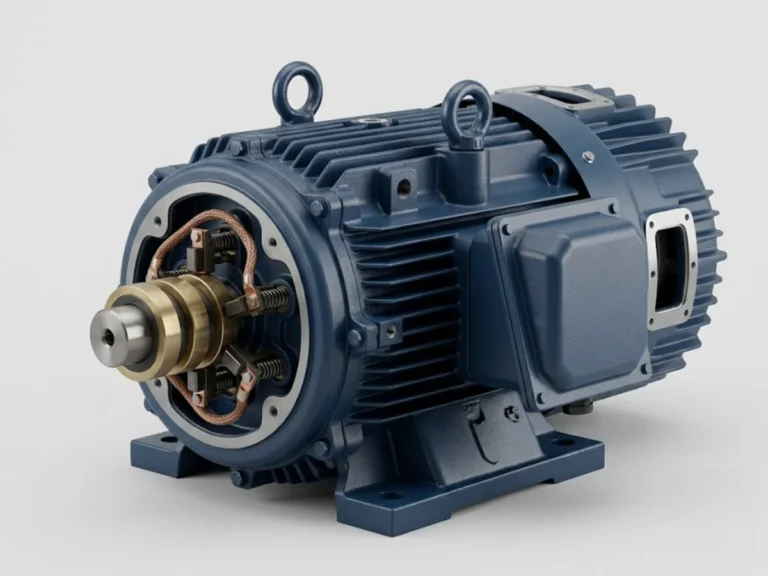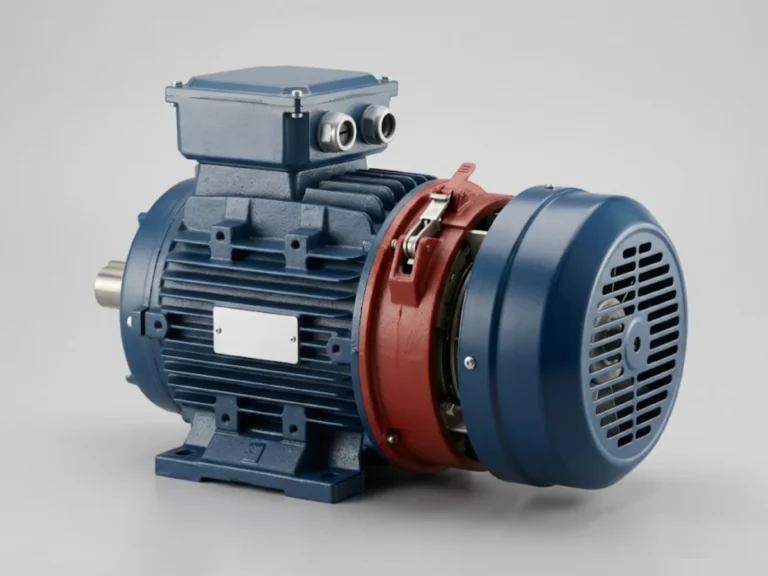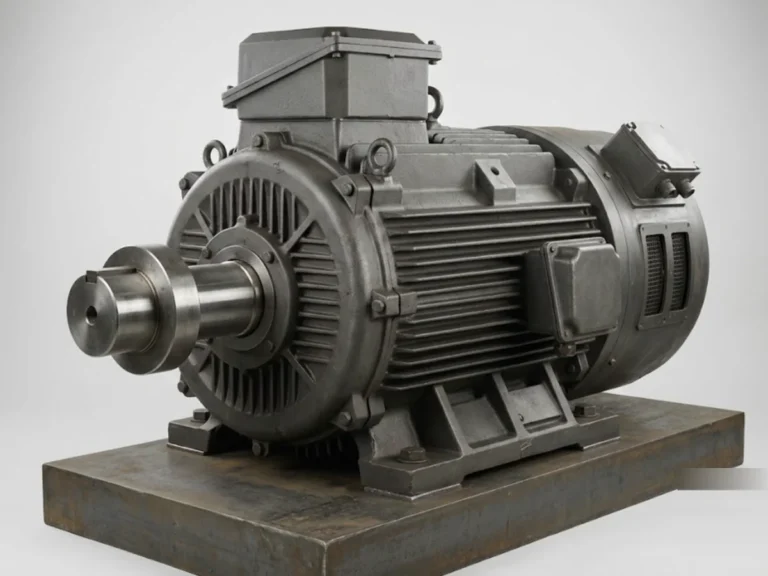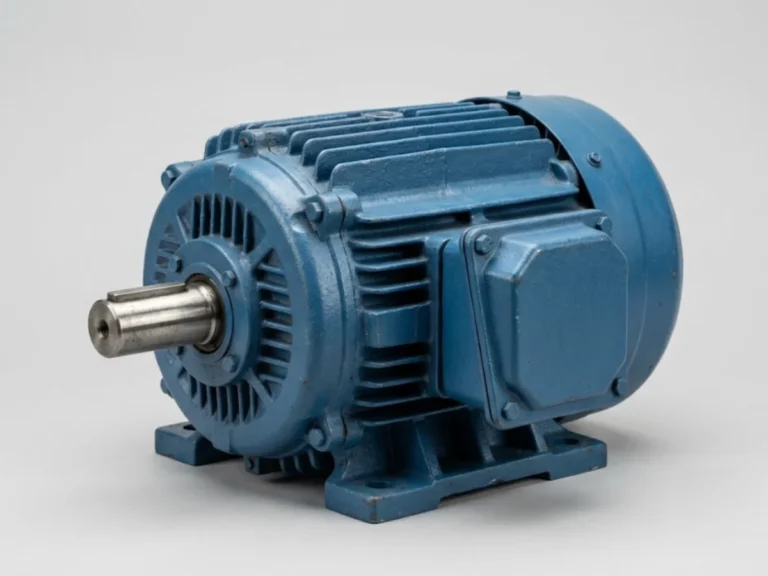
A standard industrial motor is designed to start, run for hours and stop. A crane hoist or a roller table in a rolling mill does the opposite: it starts, reverses and stops many times every hour, often against a heavy load, in heat and dust. A general purpose motor put on this duty overheats, loses its insulation and fails early. This guide explains what crane duty and mill duty motors do differently and what to specify when ordering.
The duty cycle is the root difference
Motor duty is defined in IEC 60034-1. S1 is continuous running at constant load. Crane and mill drives use intermittent duty types:
- S3: a repeating cycle of load period and rest period, with no significant heating from starting. The rating is quoted with a cyclic duration factor (CDF), such as S3 40 %, meaning the motor is loaded for 40 % of each cycle.
- S4 and S5: intermittent duty including the effect of starting (S4) and electric braking (S5). These are the realistic ratings when starts are frequent.
Crane motors are commonly rated for cyclic duration factors such as 25 %, 40 %, 60 % and 100 %, and a number of starts per hour such as 150, 300 or 600. A motor labelled 22 kW S3 40 % can deliver more than 22 kW for short periods but its continuous rating is lower. Always read the duty on the nameplate (see how to read a motor nameplate), because the same frame can carry very different kW values depending on duty.
What is built differently
| Feature | General purpose motor | Crane or mill duty motor |
|---|---|---|
| Duty rating | S1 continuous | S3, S4 or S5 with CDF and starts per hour |
| Peak torque | About 2 to 2.5 x rated | Higher; designed for 2.5 to 3 x rated and above, check datasheet |
| Rotor design | Optimised for efficiency | Low-inertia rotor for fast acceleration and reversal |
| Insulation | Class F, B rise | Class F or H with extra impregnation, vibration-resistant |
| Construction | Cast iron or aluminium | Rugged frame, high-strength shaft, often heavy bearings |
| Rotor type | Cage | Slip-ring (wound rotor) or cage on VFD |
| Brake | Not fitted | Often fitted (hoist) with spring-applied brake |
| Environment | Factory | Dust, heat, scale, steam, vibration |
The figures above are typical; the manufacturer’s datasheet defines the actual values.
Crane duty motors
EOT cranes, goods cranes, hoists, cross-travel and long-travel drives need smooth control of torque and speed in both directions. The traditional crane motor is a slip-ring motor, where resistors in the rotor circuit give stepwise speed control and a high starting torque with moderate line current. See the crane duty slip-ring motors in our range, and the explanation in slip-ring vs squirrel-cage motors.
For a hoist, the brake is as important as the motor. A spring-applied electromagnetic brake holds the load when power is lost, and releases when the motor is energised. Check that the brake torque exceeds the maximum load torque by the margin your crane standard requires; this is a safety item that needs an engineer to confirm. The crane duty brake motors combine motor and brake in one unit, and the brake motor category lists other versions.
Cranes now also use cage motors on VFDs. The drive gives soft, controlled acceleration, reduces mechanical shock on the structure and gearbox, and allows fine speed control. Such motors need a brake, an encoder in many cases, and often a braking resistor to handle regenerative energy when lowering. Compare with DC options in our article on DC and AC motors in mills and cranes.
Mill duty motors
Rolling mills, rerolling mills and steel plants impose tougher conditions:
- Shock loads. A billet entering the stand causes a sudden torque rise, followed by an impact load on the shaft and bearings.
- Reversal and frequent starting. Roller tables and manipulators start, stop and reverse many times a minute.
- Heat, scale and dust. Ambient temperatures near the furnace and mill, scale falling from hot steel, and abrasive dust. Totally enclosed construction with the right IP level is needed, and sometimes forced ventilation.
- Water and coolant. Splashing from roll cooling water.
The rerolling mill duty motor and roller table motors in our range are designed for these conditions. Where a DC drive is used for main mill stand control, the mill duty DC motors are the equivalent.
How to select: what to tell the supplier
- Duty cycle: S3 or S4, CDF percentage and starts per hour, not just kW. If the real cycle is not known, log the current for a typical shift.
- Peak torque requirement and the load inertia, especially for roller tables, to check the acceleration time.
- Motor type: slip-ring or cage, and the drive: rotor resistance, VFD or DC drive.
- Brake: required or not, brake torque, voltage and manual release.
- Environment: ambient temperature, dust, water, explosive atmosphere, and enclosure class.
- Mounting and shaft: see frame sizes and mounting; many crane motors have special flanges and double shaft extensions.
- Thermal protection: thermistors or PT100 in the winding for motors on frequent starts.
A frequent mistake is replacing a crane motor with a general purpose motor of the same kW. It fits the base but its thermal capacity is too low for the number of starts, and it fails within months. Another is leaving the brake and resistor sizing unchanged when changing the motor type. Use the AC motor and DC motor categories to see what is available, and ask us when in doubt.
What to send us for a quotation: the old motor nameplate (kW, duty, rpm, rotor data), frame and shaft dimensions, brake details, duty cycle and starts per hour, drive type, ambient conditions, and the crane or mill application. Use the request a quote page or contact us; we reply within 24 hours.
Frequently asked questions
Can I use a normal motor on a crane?
It is not recommended. A standard S1 motor is designed for continuous running, and the repeated starts, reversals and high starting torque on a crane overheat the rotor and winding. It may work for weeks but will fail early. Use a motor rated for crane duty, S3 or S4 with the right cyclic duration factor and starts per hour.
What does S3 40% mean on a motor nameplate?
It means intermittent periodic duty where the motor runs under load for 40 percent of each cycle and rests for the remaining 60 percent. The motor can then deliver its rated kW without overheating. If the actual load period is longer than 40 percent, the winding will run too hot, so check the true duty cycle.
Why do crane motors have a brake?
The brake holds the load when the motor is not energised and stops the hoist safely after a power failure. Spring-applied electromagnetic brakes are common because they close when power is lost. Brake torque must exceed the load torque with an adequate margin, which is a safety decision to be confirmed by a qualified engineer.
Are mill duty motors different from crane duty motors?
They share intermittent duty and rugged construction, but a mill duty motor is built for shock loads, heat, scale and dust around rolling mills, and often reversal on roller tables. Crane duty motors focus on hoisting torque control and brakes. The enclosure, cooling and insulation are chosen for the actual environment, so specify the site conditions.