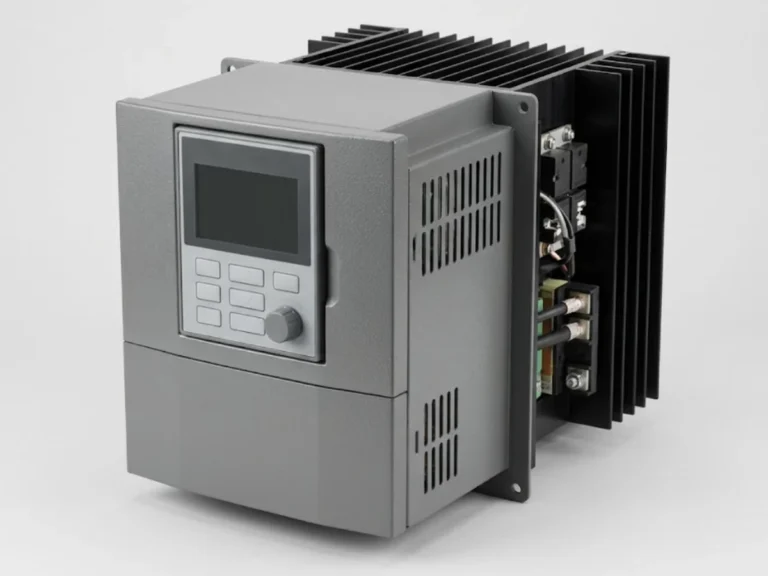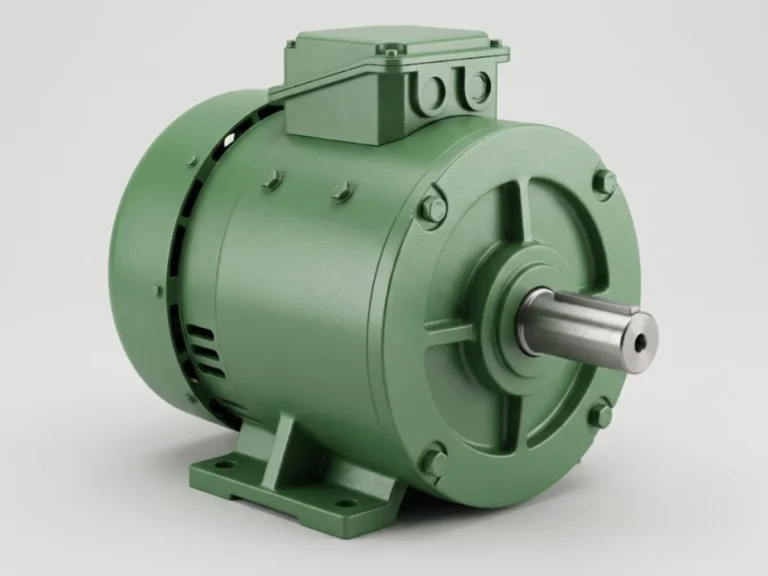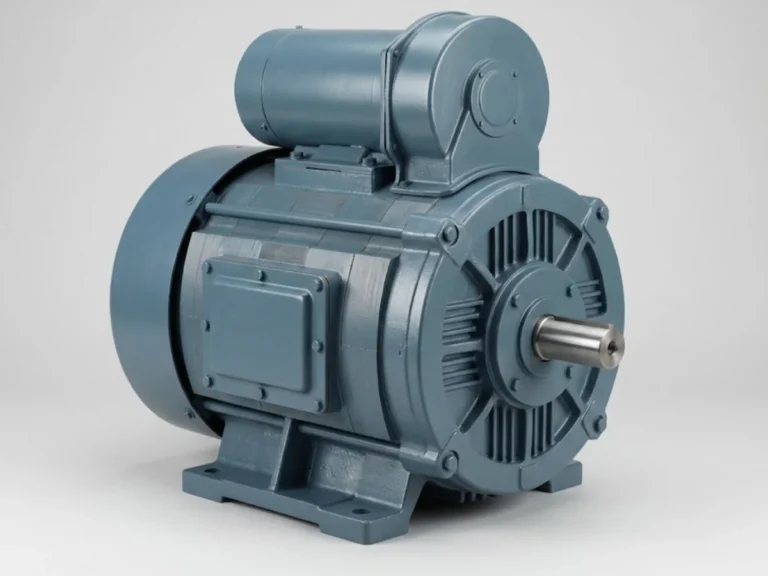
For decades, DC motors were the standard for rolling mills, hoists and other loads needing precise torque and speed control, because a DC motor with a thyristor drive gives smooth control with simple electronics. Modern AC vector drives have closed most of that gap, and new installations now lean strongly towards AC. But many Indian rerolling mills, steel plants and cranes still run DC, and decisions on repair, retrofit or replacement come up every year. This article compares the two on engineering grounds.
How DC motors control torque and speed
In a separately excited DC motor, the armature current produces torque and the armature voltage sets speed, while the field current sets the flux. A DC drive (a thyristor converter) varies the armature voltage to control speed up to base speed, then weakens the field to go above base speed at constant power. Because torque is directly proportional to armature current, torque control is simple and fast, and full torque is available from zero speed. A four-quadrant converter, with a second bridge, allows the motor to reverse and regenerate to the supply.
The cost is the commutator and brushes. Carbon brushes wear, the commutator needs inspection and skimming, and brush gear in mill dust, scale and humidity needs regular cleaning. The mill duty construction, with a rugged frame, forced ventilation and reinforced insulation, deals with shock loads but does not remove the maintenance.
How AC vector drives do the same job
With flux vector control, a VFD calculates the torque-producing and flux-producing components of motor current separately and controls them like a DC machine. With an encoder, a cage induction motor can deliver full torque at zero speed and respond quickly to load changes. With sensorless vector control, torque response is good down to low speed but holding torque at standstill, as on a hoist, is usually better with an encoder or a closed-loop mode. A regenerative or active front end drive returns braking energy to the supply, or a braking resistor dissipates it.
The AC motor has no commutator or brushes, so it needs far less maintenance, tolerates dust better and has a long bearing-limited life. Details on cage and slip-ring options are in our slip-ring vs cage comparison.
Side-by-side comparison
| Aspect | DC motor and DC drive | AC motor and vector VFD |
|---|---|---|
| Torque at zero speed | Full, simple | Full with encoder or closed-loop vector control |
| Speed control | Armature voltage and field weakening | Frequency and voltage, field weakening above base speed |
| Maintenance | Brushes, commutator, brush gear | Bearings only |
| Dust and humidity | Sensitive; needs clean ventilation | IP55 or higher TEFC is common |
| Motor size for same kW | Larger and heavier | Smaller and lighter |
| Power factor on supply | Low at low speed (thyristor drive) | High (diode front end VFD) |
| Regeneration | Easy with 4-quadrant drive | Needs regenerative front end or braking resistor |
| Initial cost | Motor and drive cost compared case by case | Drive cost higher; motor cost lower |
| Overload capability | High, short-time | Depends on drive rating; size for peak |
Rolling mills today
A mill stand, with its load impacts when a billet bites, high peak torque and wide speed range, favoured DC. Many working rerolling mills still have DC main drives, and a DC motor in good condition on a stable thyristor drive can run for decades with proper brush and commutator care. Typical reasons to stay with DC:
- The motor, foundation, cooling arrangement and drive panels already exist and work.
- Spares for the DC drive and motor are available.
- Replacing with AC would need new motor foundations, couplings, cabling and panel rework.
Typical reasons to move to AC:
- Brush and commutator failures, mill dust and downtime cost more than the retrofit.
- The analogue DC drive electronics are obsolete and difficult to repair.
- New mills and new auxiliary drives (roller tables, cooling beds, pinch rolls) can be specified with AC from the start.
An intermediate option is to keep the DC motor and replace the old analogue drive with a modern digital DC drive, which restores control quality and diagnostics at moderate cost. See our DC drives and the motors: mill duty DC motors, solid yoke DC motors and laminated yoke DC motors. A laminated yoke construction is generally preferred when the motor is supplied from a thyristor converter, since it handles the ripple current with lower losses and faster current response; a solid yoke motor suits a smoother supply or older installations. Confirm which suits your drive.
Cranes today
EOT cranes used slip-ring motors with rotor resistors for years, and DC hoists on special cranes. Today the common upgrade is a cage motor on a vector VFD with a spring-applied brake and braking resistor, giving better load control, less mechanical shock and no resistor panel to maintain. The brake sizing, load holding and emergency stopping on a hoist are safety-critical, so the design must be reviewed by a qualified crane engineer. See crane duty and mill duty motors, the crane duty brake motor and rerolling mill duty motor in our range.
Retrofit checklist: DC to AC
- Record the DC motor rating: kW, armature and field voltage and current, base and maximum speed, and the torque at base speed.
- Check the machine duty: peak torque, overload time and the speed range, including operation above base speed.
- Choose the AC motor frame, shaft and mounting; see motor frame sizes and mounting. An AC motor of the same kW is usually smaller, so a new base or adaptor may be needed.
- Select the VFD with enough current for peak torque, with an encoder interface and a regenerative or braking option.
- Plan the cabling, cooling, earthing and PLC interface, and allow commissioning time.
- Compare lifecycle cost: not just capital, but brush and commutator service, downtime and spares.
Discuss each case with a qualified engineer. We can help with both routes, from motor spares and drive panel spares for existing DC plants to AC motors and AC drives for upgrades. The categories DC motors, AC motors and drives and motor starters give the full range.
What to send us for a quotation: the existing motor nameplate (kW, armature and field data, rpm, frame), the drive make and model, the machine and duty, the fault or the reason for change, and whether you want repair, a like-for-like DC replacement or an AC conversion. Use the request a quote page or contact us; we reply within 24 hours.
Frequently asked questions
Are DC motors obsolete in rolling mills?
No. Many mills still run DC drives successfully, and parts and repair are available. New installations mostly choose AC with vector drives because of lower maintenance. DC remains sensible where the motor, foundation and drive are in good condition and the cost of conversion is not justified. Decide on lifecycle cost, not on fashion.
Can an AC motor give the same torque control as a DC motor?
Yes, with flux vector control. A cage induction motor with an encoder on a vector drive can deliver full torque at zero speed and fast torque response, comparable to DC. Sensorless control is adequate for many loads but check holding torque at standstill, which matters on hoists. Size the drive for peak torque.
What is the difference between solid yoke and laminated yoke DC motors?
A laminated yoke is built from stacked steel sheets and handles the current ripple of a thyristor converter with lower losses and faster response. A solid yoke is made from solid steel or cast material and suits smoother supplies and robust older applications. For a thyristor-fed drive, a laminated yoke is generally preferred; confirm with the maker.
Should I replace only the DC drive or the whole system?
If the motor is sound, replacing the old analogue drive with a digital DC drive is often the cheapest way to restore reliability. Replace the whole system with AC when brush and commutator maintenance, dust, downtime or lack of spares are the main costs. Compare lifecycle cost, including civil and cabling work, before deciding.