The nameplate is the motor’s identity card. When you need a replacement, a starter, a cable or a VFD, every number you need is stamped on that small metal plate. Unfortunately the plate is full of abbreviations and the ratings interact, so a misreading leads to the wrong overload setting or the wrong spare. This guide goes through each field in the order you usually see it, then checks a sample plate with arithmetic.
The main electrical fields
Output power: kW or HP
This is the mechanical power available at the shaft, not the electrical power drawn from the supply. Indian motors are marked in kW; some older plates show HP, where 1 HP is about 0.746 kW. A 15 HP motor is therefore about 11 kW.
Voltage and connection
The rated line voltage, for example 415 V, and the winding connection, shown as a delta or star symbol. A plate marked “415 V delta” means the winding is intended for delta at 415 V, which is what allows star-delta starting. A dual marking such as “415 V star / 240 V delta” shows a motor for different supplies, and a motor rated 690 V star / 415 V delta can be used on both by changing the terminal links. The voltage range or tolerance may also be shown.
Current
The full-load current in amperes at the rated voltage. It is the base for the overload relay setting and the cable and fuse selection. If the plate shows two currents for two connections, use the one for your connection.
Frequency
50 Hz for Indian supply. A motor marked for 50/60 Hz changes speed with frequency.
Speed
The full-load speed in rpm, for example 1470 rpm. It is slightly below the synchronous speed (3000, 1500, 1000, 750 rpm for 2, 4, 6 and 8 poles). The difference gives the slip: (1500 – 1470) / 1500 = 2 %.
Power factor (cos phi) and efficiency
Power factor shows how much of the current does useful work; typical values at full load are about 0.8 to 0.9 and fall sharply at light load. Efficiency is the ratio of shaft output to electrical input. Newer plates show an efficiency class such as IE2 or IE3, and sometimes efficiency at 100 %, 75 % and 50 % load. For more on classes, read our IE2 vs IE3 guide.
Mechanical and protection fields
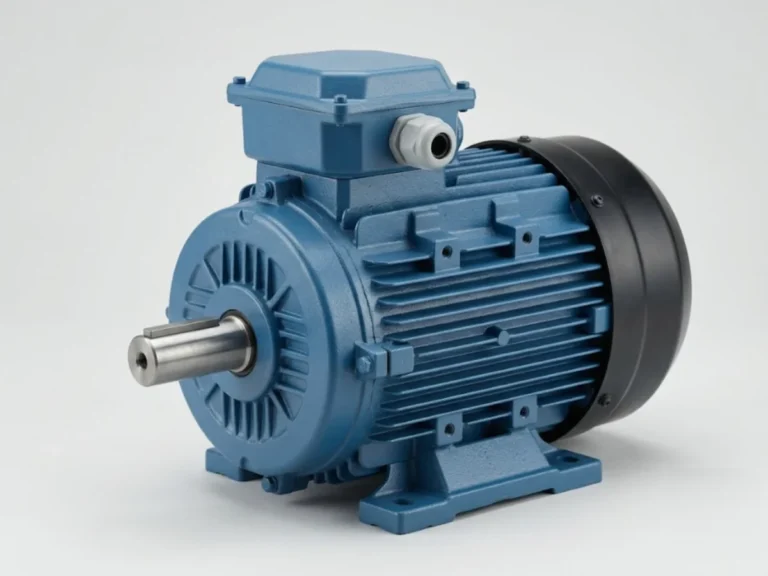
- Frame (for example 180L): the number is the shaft centre height in mm, and the letter shows the body length. It decides the mounting dimensions. See frame sizes and mounting types.
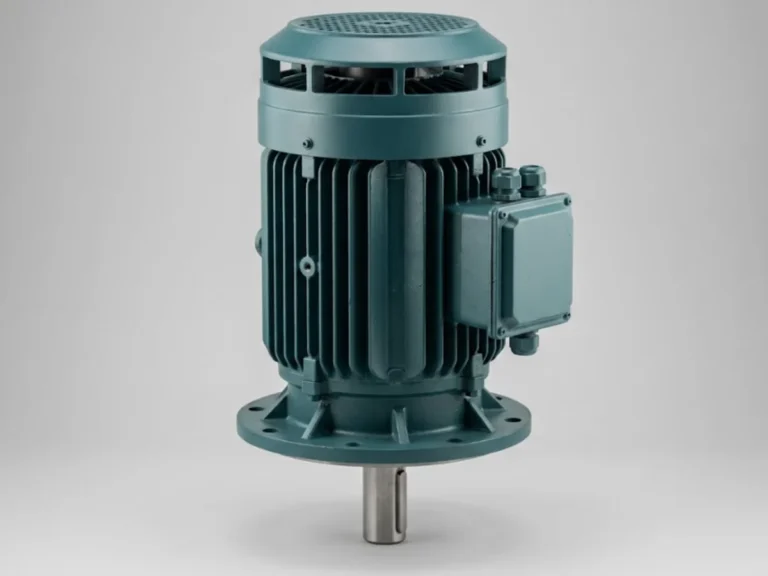
- Mounting code (IM B3, B5, B35 and so on): how the motor is fixed, by feet, flange or both.
- IP code (IP55): the first digit is protection against solids (5 means dust-protected) and the second against water (5 means water jets). IP55 is typical for factory motors, and IP56 or IP65 is used in wetter or dustier locations.
- Cooling code (IC411): a totally enclosed motor cooled by a shaft-mounted fan blowing over the frame.
- Insulation class (F or H): the maximum winding temperature the insulation can take: class B is 130 degrees C, F is 155 degrees C and H is 180 degrees C. Many motors are insulated in class F but rated for class B temperature rise, leaving margin.
- Ambient and altitude: standard rating is for 40 degrees C ambient and altitude up to 1000 m. A different value will be marked.
- Duty (S1, S3 40 %): S1 is continuous duty. S3 with a percentage is intermittent duty, as used on cranes. Using an S1 motor on S3 duty or the reverse is a common error.
- Service factor (for example 1.1): the permitted overload; a service factor of 1.1 means the motor may carry 110 % of its rating continuously under stated conditions. A plate with no service factor means 1.0, so do not overload.
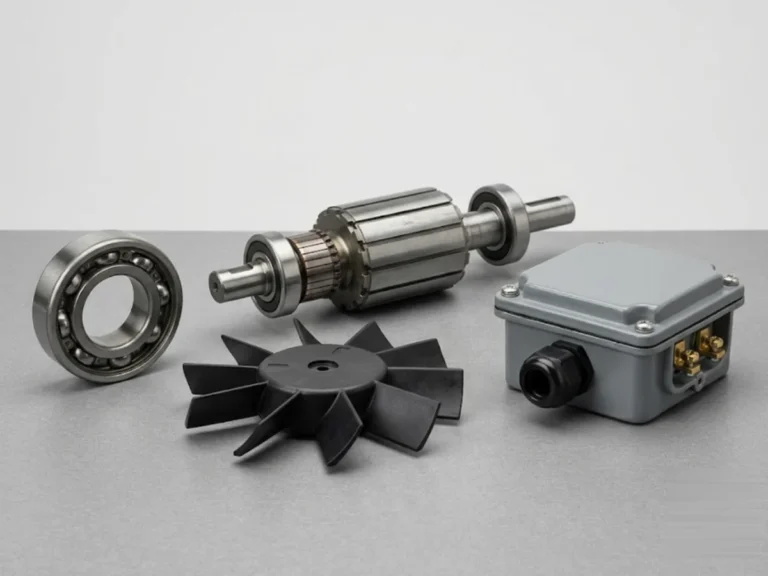
- Bearing numbers: some plates give drive-end and non-drive-end bearing sizes such as 6309 and 6209, useful when ordering spares and grease amounts.
- Weight, serial number, year and standard: needed to order spares or trace a repair history. Indian motors normally state the relevant IS standard.
Slip-ring motors have extra fields, rotor voltage and rotor current, which must be used for sizing the starter. Compare the two types in slip-ring vs squirrel-cage motors.
Worked check: a 22 kW sample plate
Suppose a plate reads: 22 kW, 415 V delta, 38 A, 50 Hz, 1470 rpm, cos phi 0.86, efficiency 93 %, IP55, insulation class F, S1, frame 180L.
- Input power at full load = 22 / 0.93 = about 23.7 kW.
- Current from the formula: I = P / (1.732 x V x cos phi x efficiency) = 22000 / (1.732 x 415 x 0.86 x 0.93) = about 38 A. The calculated and stamped currents agree, which is a useful sanity check.
- Speed 1470 rpm means a 4-pole motor with 2 % slip.
- Output torque = 9550 x 22 / 1470 = about 143 Nm.
- Overload relay setting: close to 38 A, within the relay range.
If the stamped current were far from the calculated value, suspect that the plate was changed or the motor was rewound for a different rating. You can run this calculation with the motor current and cable calculator.
Using the nameplate for selection and replacement
When you buy a like-for-like replacement, give the supplier the plate photo and check these points: kW and rpm, frame and mounting (the feet and shaft must fit), voltage and connection, duty, IP rating, and the efficiency class you want. If the old plate is unreadable, measure the shaft diameter, shaft extension length, foot hole spacing and shaft centre height, and tell us the load.
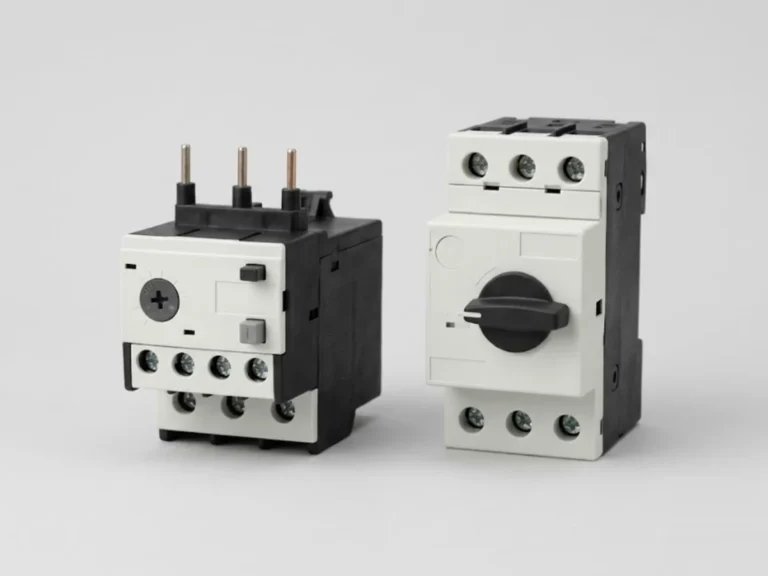
The plate also tells you which protection to use. The full-load current sets the thermal overload relay or MPCB range, the kW decides the contactor and starter, and the cable is sized for the current with allowance for starting and installation conditions. Browse the AC motor range and motor spares if you need replacement parts.
Do not rely on the plate alone if the motor has been repaired. A rewound motor may have a different winding, and the plate may no longer describe it. Measure the running current on load with a clamp meter to see what the motor actually draws.
What to send us for a quotation: a clear photo of the full nameplate, the shaft end and foot dimensions if the plate is missing, the duty, and the driven machine. Send it through the request a quote page or contact us and we will reply within 24 hours.
Frequently asked questions
What does IP55 on a motor nameplate mean?
IP55 is the ingress protection rating. The first 5 means the motor is protected against dust to a level that stops harmful deposits, and the second 5 means it withstands low-pressure water jets from any direction. It is the usual standard for factory motors. For washdown areas or heavy dust, ask for IP56, IP65 or higher.
What does insulation class F mean?
Class F insulation is rated for a maximum winding temperature of 155 degrees C. Many motors have class F insulation but are rated for the lower class B temperature rise, so the winding runs well below its limit at full load. That margin helps in hot ambients, with voltage variation and for longer insulation life.
Can I run my motor above its nameplate current?
Not continuously, unless the service factor allows it. Running above rated current overheats the winding, which shortens insulation life. If the motor regularly draws more than its rated current, the load is too high or the supply is poor. Measure current and voltage and discuss a larger motor or a load check with an engineer.
How do I convert HP to kW on a nameplate?
Multiply HP by 0.746 to get kW. A 10 HP motor is about 7.5 kW, a 15 HP motor about 11 kW and a 20 HP motor about 15 kW. Indian suppliers commonly list motors by kW, so convert the old plate before you ask for a replacement, and check the frame and rpm as well.