A cable that is too small overheats, wastes energy and can fail in a fault; one that is too large wastes money and may not fit the lug or gland. Cable sizing is three checks done in order, and the size you buy is the largest result: current-carrying capacity, voltage drop, and short-circuit withstand. The method below applies to LT cables (1.1 kV) and gives you numbers to sanity-check a supplier or consultant’s schedule.
Check 1: current carrying capacity
Start with the load current. For a three-phase motor:
I = P (watts) / (1.732 x V x efficiency x power factor)
Example: a 22 kW, 415 V motor with efficiency 0.92 and power factor 0.88 draws 22000 / (1.732 x 415 x 0.92 x 0.88), which is about 38 A. Always use the nameplate current of the actual motor when you have it, and use the motor current and cable calculator as a cross-check.
Next, apply the protective device. The cable must carry at least the setting of the overload device, and the protection must guard the cable. Then apply derating factors to the manufacturer’s current table, because catalogue ratings assume reference conditions:
- Ambient temperature: higher air or ground temperature reduces the rating.
- Grouping: several cables on a tray side by side or bunched in ducts heat each other.
- Laying method: in air, on trays, in conduit, directly buried or in ducts each have a different table.
- Soil thermal resistivity for buried cables.
Divide the required current by the product of all derating factors to find the minimum tabulated rating. A 38 A motor feeder in a hot plant bundled with other cables might need a cable tabulated for 55 A or more. Use the cable manufacturer’s tables and the factors in the standard your project follows.
Check 2: voltage drop
Voltage drop matters because a motor that sees low voltage draws more current and may fail to start. As a design target, many specifications limit drop to about 3 percent for a feeder at running current and about 5 percent from source to final load, with starting drop checked separately (often limited to 10 to 15 percent at the motor terminals during start). Your project specification governs.
For three-phase circuits: Vd = 1.732 x I x (R cos(phi) + X sin(phi)) x L, with R and X in ohm per km and L in km. For short, small cables the reactance term is minor.
Worked example: the 22 kW motor above, 38 A, 100 m of 16 sq mm copper XLPE cable. Taking a conductor resistance of about 1.4 ohm/km at operating temperature (confirm from the cable datasheet) and power factor 0.88:
Vd = 1.732 x 38 x (1.4 x 0.1) x 0.88, about 8 V, or roughly 2 percent of 415 V. Acceptable.
Starting check: assume 6 times full-load current, so about 228 A at power factor 0.3. The resistive part gives 1.732 x 228 x 0.14 x 0.3, about 16.6 V. Adding the reactive part brings the drop to around 4 to 5 percent, which is within typical limits. For a 300 m run, the same cable would be unacceptable and you would step up to 35 or 50 sq mm. Long motor feeders are almost always sized by voltage drop, not by current.
Check 3: short-circuit withstand
The cable must survive a fault until the protective device clears it. The minimum conductor area is S = (I x square root of t) / k, where I is the fault current in amperes, t is the clearing time in seconds, and k is a constant that depends on conductor and insulation.
| Conductor / insulation | Typical k value |
|---|---|
| Copper / PVC | 115 |
| Copper / XLPE | 143 |
| Aluminium / PVC | 76 |
| Aluminium / XLPE | 94 |
Example: a feeder with 20 kA prospective fault current, cleared in 0.5 s, using copper XLPE: S = 20000 x 0.707 / 143, about 99 sq mm. So 120 sq mm copper, not 70, even if current and voltage drop would allow it. Fast-acting breakers or HRC fuses limit let-through energy and reduce the required size; confirm the clearing time from the device curve rather than assuming it. Compare the fault level at the source using your transformer rating; see our transformer sizing calculator for the transformer side.
Putting it together
- Calculate load current from kW or nameplate.
- Choose the protective device and settings.
- Find the derated current-carrying size.
- Calculate voltage drop for running and starting.
- Check short-circuit withstand for the fault level and clearing time.
- Take the largest size, then check that the lug, gland and terminal can accept it.
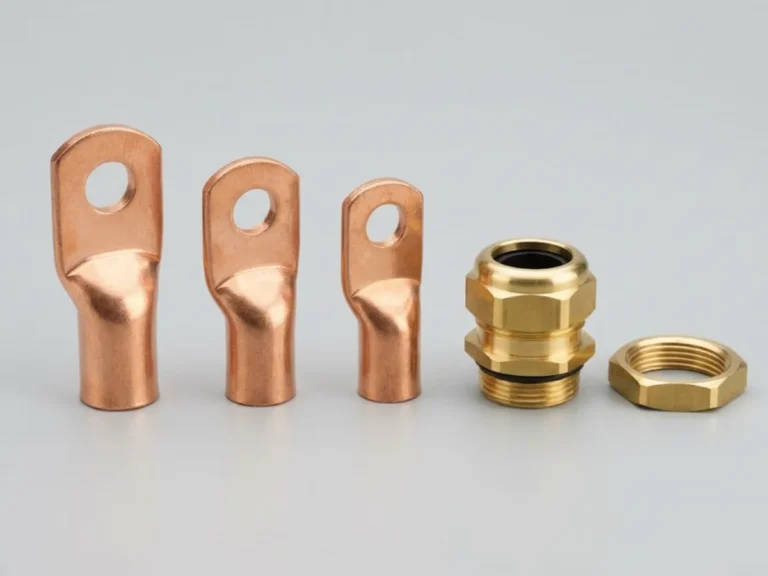
Confirm the final selection with a qualified engineer, especially for critical feeders and long runs. Browse HT and LT power cables, and plan terminations early with cable lugs and glands; large sizes need big lugs and glands that some panels simply cannot take.
Common mistakes
- Sizing by current only and ignoring voltage drop on long runs.
- Forgetting grouping derating when many cables share a tray.
- Using the same size for aluminium as for copper.
- Ignoring neutral loading with harmonic loads such as VFDs and UPS, where the neutral can carry high current.
- Not checking that the earth conductor and armour meet the fault duty.
Do not forget the earth and neutral conductors. The protective earth conductor must withstand the same fault current, and in installations with many VFDs, UPS units or LED lighting, the neutral can carry significant harmonic current, so some designers use a full-size neutral rather than a reduced one. Ask the consultant to state the neutral and earth sizing on the cable schedule.
What to send us for a quotation
Send the load list or cable schedule: load, voltage, route length, laying method, conductor material and cable construction. If you only have the motor kW and distance, we can help size from there. Use request a quote or contact us, and we respond within 24 hours.
Frequently asked questions
What cable size is needed for a 22 kW motor?
At 415 V a 22 kW motor draws roughly 38 to 40 A. For a short run in air, a 10 or 16 sq mm copper XLPE cable can carry that after normal derating, but for 100 m or more voltage drop and starting drop can decide the size. Use the motor nameplate current, apply derating, and check voltage drop and short-circuit withstand before choosing.
How much voltage drop is acceptable in a cable?
Many specifications aim for about 3 percent drop at full load on a feeder and about 5 percent overall from source to equipment, with a separate starting check for motors. The exact limit depends on the project specification and standard being followed. Excess drop causes motors to draw more current and can prevent them from starting, so follow the figure your consultant specifies.
Why does short-circuit rating affect cable size?
During a fault the conductor heats rapidly before the breaker or fuse clears it. If the conductor is too small, it overheats and damages the insulation. The minimum area is the fault current times the square root of clearing time, divided by a constant for the conductor and insulation. At high fault levels this can demand a larger cable than the load current needs.
Do I need to derate cable for grouping and temperature?
Yes. Catalogue current ratings assume reference conditions. Higher ambient temperature, cables laid close together on a tray, ducts, and poor soil thermal resistivity all reduce the safe current. Apply derating factors from the cable manufacturer's tables or the applicable standard, and divide your required current by the combined factor to find the minimum tabulated rating.