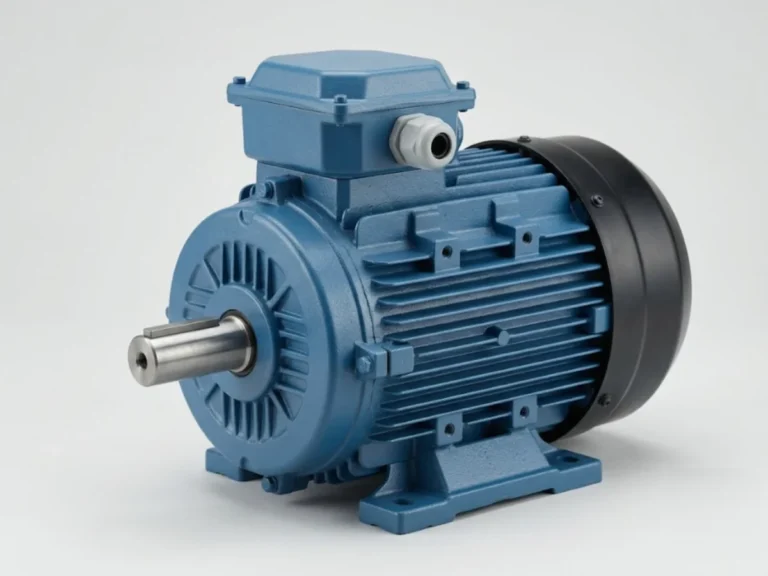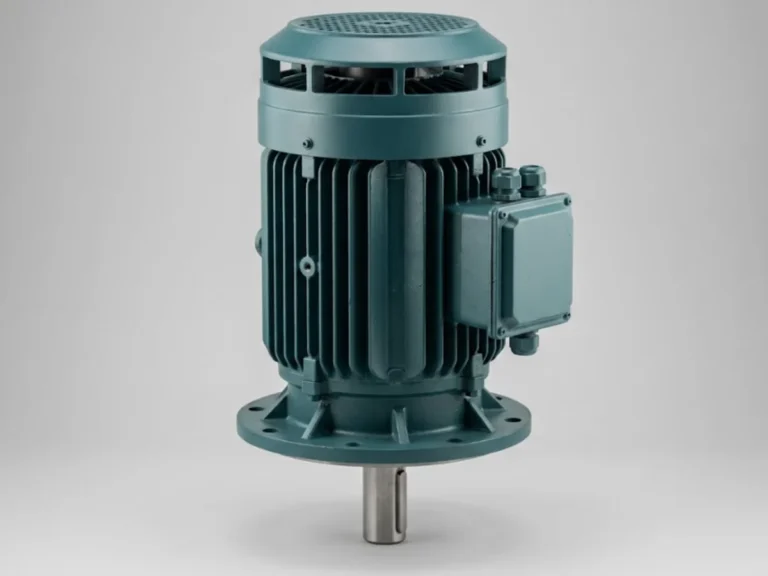
Most motor selection mistakes are not made on the kW figure. They are made on duty, speed, enclosure or starting torque, and the result shows up months later as a tripped overload, a hot winding or a motor that cannot start a loaded conveyor. This guide walks through how an experienced engineer chooses a low-tension (415 V) three-phase induction motor, and where the IE3 efficiency class actually pays for itself.
Start with the load, not the motor
Before looking at catalogues, write down what the driven machine needs. A motor is only a source of torque at a speed, so the load defines everything.
- Power at the shaft: the real kW the machine takes at its worst operating point, not the nameplate of the old motor. For pumps, read it from the pump curve at the duty point plus a margin for the highest flow you will ever run.
- Speed: the speed of the driven machine, and whether a gearbox or belt is needed to get there.
- Starting torque and inertia: a centrifugal pump starts light; a loaded belt conveyor, crusher or reciprocating compressor does not.
- Duty: continuous running, or frequent starts and stops.
- Environment: dust, water, corrosive vapour, explosive atmosphere, ambient temperature and altitude.
If you only know the old motor’s nameplate, remember the old motor may have been oversized. Measure the running current with a clamp meter before copying the rating. The motor current and cable calculator helps you convert kW to full-load current and size the cable and protection.
The ratings that decide the motor
Power and poles
The synchronous speed of a 50 Hz motor depends on the number of poles: 2-pole 3000 rpm, 4-pole 1500 rpm, 6-pole 1000 rpm and 8-pole 750 rpm. The running speed is a little lower because of slip, for example about 1450 to 1480 rpm for a 4-pole motor depending on size. A 4-pole motor is the default choice for most pumps, conveyors and general machines because it is widely available and efficient. Two-pole motors suit fans and pumps that need high speed, but they are noisier and have shorter bearing life at larger sizes.
Voltage and frequency
Standard LT motors are wound for 415 V, three phase, 50 Hz. Supply voltage in Indian plants swings with DISCOM conditions, so check the tolerance the motor is designed for and confirm that the voltage at the motor terminals, not just at the transformer, is within it. A long cable run to a remote pump can drop the terminal voltage enough to overheat the motor.
Duty type
S1 (continuous duty) is the default for process drives. Cranes, hoists, roller tables and machines with many starts per hour need an intermittent duty rating such as S3 or S4, and an S1 motor used there will overheat. The comparison is discussed further in our article on crane duty and mill duty motors.
Enclosure, cooling and insulation
- IP55, TEFC (totally enclosed fan cooled) is the standard for dusty or damp factory floors. Use IP56 or higher where hose-down or heavy dust is expected.
- Insulation class F with class B temperature rise is a common practical choice: it gives thermal margin so the winding runs cooler than its limit at full load. Class H is used for hot or severe duty.
- Ambient and altitude: standard ratings assume an ambient of 40 degrees C and altitude up to 1000 m. Hotter foundries, boiler houses or hill sites need derating or a larger frame.
- Hazardous areas need certified flameproof or non-sparking construction, covered in our flameproof motor guide.
IE2 vs IE3: what the class means
IEC 60034-30-1 defines efficiency classes for 50 Hz motors: IE1 (standard), IE2 (high), IE3 (premium) and IE4 (super premium). The classes are set as minimum nominal efficiency at full load for each kW rating and pole count. Higher classes use more copper and better steel, so the motor costs more but wastes less energy as heat.
| 4-pole, 50 Hz rating | IE2 minimum efficiency | IE3 minimum efficiency |
|---|---|---|
| 7.5 kW | about 88.7 % | about 90.4 % |
| 22 kW | about 91.6 % | about 93.0 % |
| 55 kW | about 93.5 % | about 94.6 % |
| 110 kW | about 94.5 % | about 95.4 % |
The gap is 1 to 2 percentage points. That sounds small, but motors run for thousands of hours a year, so you should work out the payback on your own tariff.
Worked example: 55 kW, 6000 hours a year
At full load, a 55 kW IE2 motor draws about 55 / 0.935 = 58.8 kW from the supply. An IE3 motor draws 55 / 0.946 = 58.1 kW. The difference is about 0.68 kW. Over 6000 hours that is roughly 4100 kWh. At an assumed tariff of Rs 8 per kWh, the saving is about Rs 33,000 a year. Divide the extra purchase price of the IE3 motor by that saving to get the payback in years; on a motor this size it is usually short. For a 7.5 kW motor running only 2000 hours, the saving is only about Rs 2,500 a year (0.16 kW x 2000 hours x Rs 8) and the payback is much longer.
The rule that follows: IE3 earns its premium on large motors with long running hours and steady loads, such as cooling water pumps, compressors, blowers and process fans. For small motors that run a few hours a day, IE2 can be the sensible purchase.
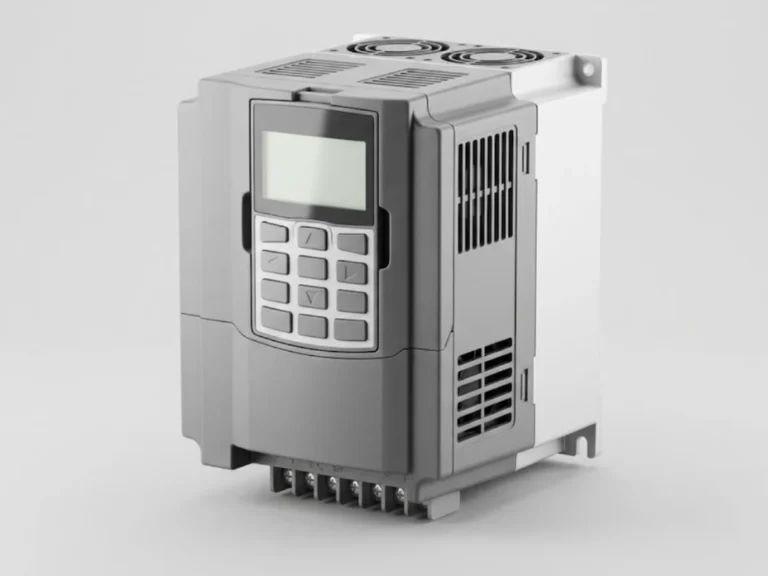
Two cautions. First, efficiency figures are at full load; a motor running at 40 % load is far less efficient, so the bigger saving often comes from not oversizing in the first place. Second, if the motor will run on a VFD, discuss the drive and motor together, because the savings come mainly from speed control, as explained in our guide to VFDs on pumps and fans. You can model the figures with the VFD energy savings calculator.
Match the motor to the starting method and the load
A squirrel-cage motor started direct on line draws roughly 6 to 8 times its rated current for a few seconds. A weak supply or a long cable will not tolerate that for large motors, so the starting method must be decided at the same time as the motor. The options are compared in our starting method guide, and the range of soft starters and variable frequency drives covers most industrial needs.
Where the load needs very high starting torque with low starting current, as in a loaded crusher or a heavy crane hoist, a slip-ring motor may be the better choice. See slip-ring versus squirrel-cage motors.
Common selection mistakes
- Oversizing by a large margin. A motor at 30 to 50 % load has low efficiency and poor power factor. Size for the real load plus a sensible margin.
- Ignoring frame and mounting. Replacement motors must match the shaft height, foot or flange dimensions and shaft size. See motor frame sizes and mounting types.
- Forgetting the driven machine’s speed limit. A 2-pole motor on a pump designed for 1450 rpm will overload it.
- Using a standard motor on a VFD for long periods at low speed without checking cooling; the shaft-mounted fan slows down with the motor.
- Not checking terminal voltage and cable size on long runs.
Our AC motor range and the wider motors category include cage, wound-rotor, flameproof and special-duty types. If you are unsure which fits, the product finder is a good starting point.
What to send us for a quotation: the motor kW and pole count (or rpm), voltage and frequency, frame size or the old nameplate photo, mounting type, duty and number of starts per hour, enclosure and efficiency class needed, and the application. Send these through the request a quote page or contact us and we will respond within 24 hours.
Frequently asked questions
Is an IE3 motor always better than an IE2 motor?
Not always. IE3 motors are more efficient, but they cost more, and the saving depends on running hours and load. For a large motor running most of the year at steady load, IE3 usually pays back within a few years. For a small motor that runs a few hours a day, the saving is small and IE2 can be the better buy. Calculate the payback on your own tariff and operating hours.
Which is better for pumps, a 2-pole or 4-pole motor?
It depends on the pump design speed. Most process and water pumps are designed for 4-pole speed, about 1450 rpm, and a 2-pole motor at about 2900 rpm would overload them and cause cavitation or damage. Use the speed the pump manufacturer specifies on its nameplate or datasheet, not the motor you happen to have available.
What enclosure should I choose for a factory motor?
IP55 totally enclosed fan cooled (TEFC) is the usual choice for general factory use because it resists dust and water jets. Use a higher protection class where there is heavy washdown or dust, and use certified flameproof or non-sparking motors where flammable gas or dust may be present. Check the area classification with a qualified engineer.
Can I run a standard motor on a VFD?
Yes, for most 415 V motors, but check the motor with the drive supplier. Winding insulation sees fast voltage edges, long cables increase the stress, and a motor with a shaft-mounted fan cools poorly at low speed. For continuous low-speed operation consider separate forced cooling, an inverter-duty motor or insulated bearings.