Buyers often ask for an “MCC panel” when the drawing calls for a PCC, or the other way round. The two sit next to each other in most industrial substations and look similar from outside, but they do different jobs and are built to different ratings. Getting this wrong at the enquiry stage leads to wrong breakers, wrong busbar sizes and a quotation that cannot be compared.
What a PCC panel does
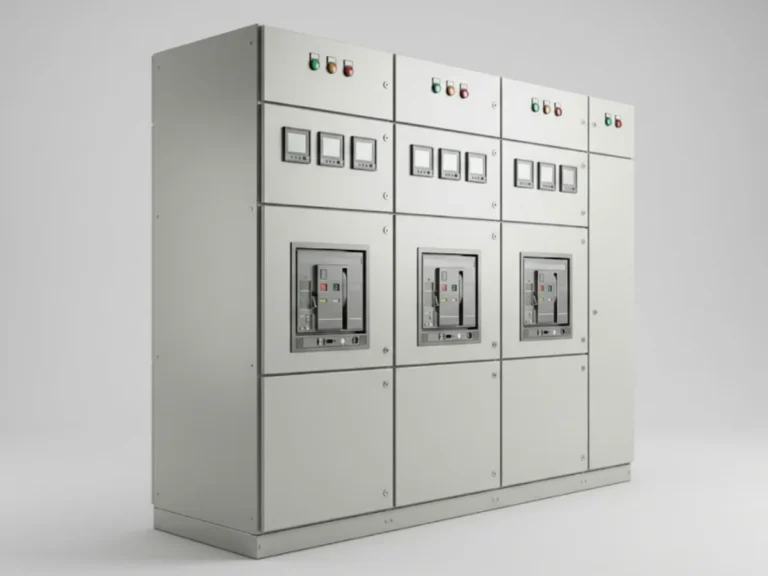
PCC stands for Power Control Centre. It is the main low-voltage distribution board of a plant, sitting directly after the transformer (or the DG set). Its job is to receive bulk power and split it into large feeders.
- Incomer from the 11 kV/415 V transformer, usually through an ACB.
- Bus coupler where two transformers feed a split bus, so one can carry the load if the other is out.
- Outgoing feeders to MCCs, to the APFC panel, to lighting and utility distribution boards and to large individual loads.
- Metering, protection relays and the DG changeover arrangement.
Because it carries the full plant current and the full fault level, a PCC is built around high busbar ratings (commonly in the range of 1600 A to 6300 A on 415 V) and air circuit breakers or large MCCBs. You can see our range on the PCC panel page.
What an MCC panel does
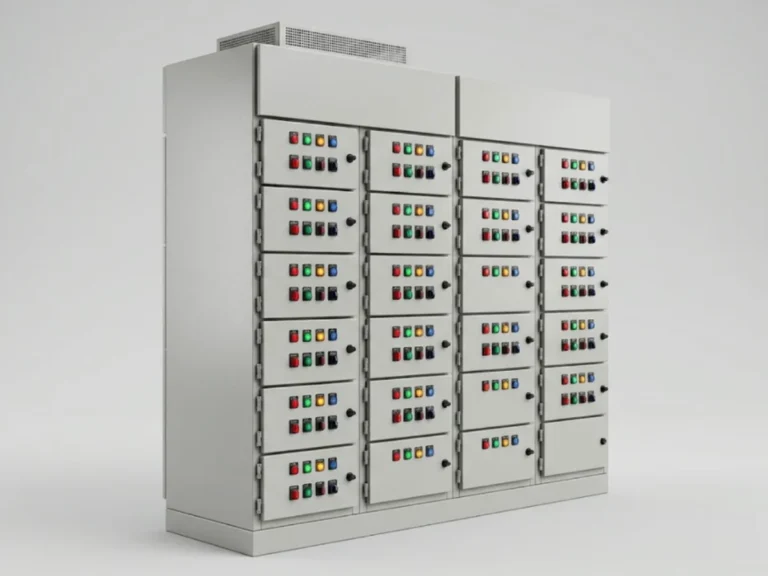
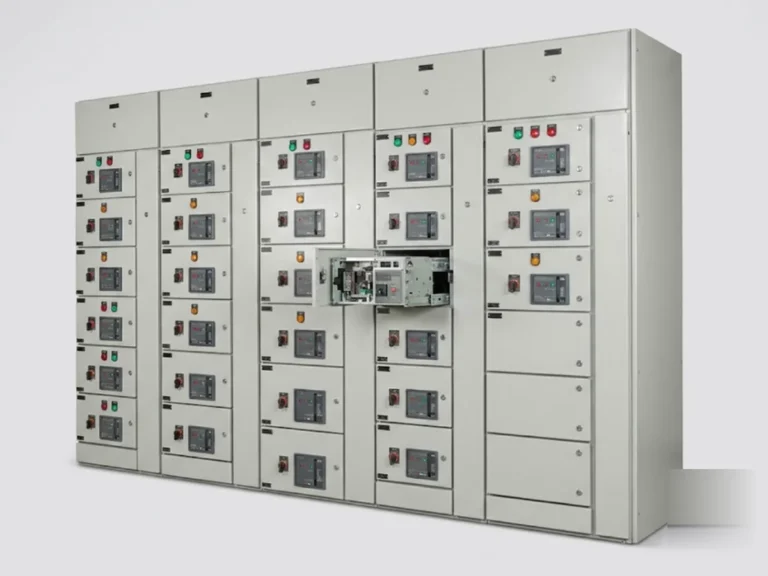
MCC stands for Motor Control Centre. It groups the starters and protection for a set of motors, pumps, fans, conveyors and similar drives in one lineup. Each motor gets its own compartment, called a feeder or module, with a short-circuit protective device, a contactor, an overload relay and the control gear.
- DOL, star-delta, reversing and soft-starter feeders.
- VFD feeders, either inside the MCC or in a separate drive panel.
- Outgoing terminals for motor cables and control wiring.
- Local start/stop and indication, plus interlocks to the process.
The MCC busbar is normally lower rated than the PCC that feeds it, and the feeders are many and small rather than few and large. See the MCC panel page for the typical configurations we supply.
Side-by-side comparison
| Point | PCC | MCC |
|---|---|---|
| Main purpose | Receive and distribute bulk power | Start, stop and protect motors |
| Position in the system | After transformer or DG | After PCC, close to the motors |
| Typical devices | ACB, large MCCB, relays, meters | MCCB or MPCB, contactor, overload relay, soft starter or VFD |
| Number of feeders | Few, high current | Many, small to medium current |
| Construction | Usually fixed or withdrawable breakers | Fixed, plug-in or fully drawout modules |
| Control wiring | Limited: relays, trip circuits, interlocks | Extensive: per-feeder control circuits |
How they work together
A common arrangement in an Indian factory is: transformer, then the PCC with an ACB incomer, then one or more MCCs fed from ACB or MCCB outgoing feeders on the PCC. The APFC panel connects to the PCC bus, and the DG set comes in through an AMF panel or a changeover arrangement ahead of the PCC incomer.
Small plants often merge the two. A single combined lineup with an incomer section and motor feeders is called a PMCC (power and motor control centre) or simply an LT panel. That works well up to a few hundred kVA of connected load, but beyond that the fault level and the number of feeders make separate boards easier to maintain.
Which one do you need?
Work from the single-line diagram, not from the name on the enquiry.
- Do you receive power from a transformer or DG and split it? You need a PCC (or a main LT panel doing the same job).
- Do you have five or more motors to be started and protected from a central point? You need an MCC.
- Is the plant small, with one transformer and a handful of motors? A combined panel may be enough.
- Are motors spread over several process areas? Use one MCC per area, fed from the PCC, instead of long motor cables from one central board.
Two things worth settling early: the short-circuit rating of the lineup (it must match the fault level at the transformer secondary, not the rating of the smallest breaker), and the form of separation and fixed or drawout construction you want. Both change the price noticeably. If you need drawout modules, see our drawout MCC panel page.
Specification mistakes to avoid
- Quoting an MCC with a busbar rating based on the sum of motor ratings. Apply diversity and check against the PCC feeder that supplies it.
- Choosing the PCC ACB on transformer rating alone. Check the fault level, the withstand rating and the future load.
- Forgetting spare feeders. A 20 to 25 percent allowance for spare modules is cheaper at the start than a new section later.
- Leaving out the arrangement for incomer interlocking with the DG or the second transformer, which causes a re-quote.
Panels should be assembled and verified to IS/IEC 61439 with the design verification evidence agreed in the purchase order. Final ratings and protection settings should be confirmed with a qualified engineer for your plant.
What to send us for a quotation
Send the single-line diagram, transformer or DG kVA, fault level, the motor list with kW and starting method, the incomer and bus ratings, the form of separation, and whether you want fixed or drawout construction. You can request a quotation or contact our team if you want help turning a motor list into a panel specification. We reply to quotation requests within 24 hours. Browse the full switchgear panels range for the other board types.
Frequently asked questions
Is an MCC panel the same as a PCC panel?
No. A PCC receives bulk power from the transformer or DG and distributes it through large breakers to MCCs and other boards. An MCC feeds and protects individual motors through starters, with many small feeders. In small plants both functions may be combined into one lineup, but they remain two different duties.
Can an MCC be fed directly from the transformer?
Yes, in small installations an MCC can have its own incomer and be fed directly. In larger plants the transformer feeds a PCC first, which gives a proper main protection point, metering and a place for the DG and APFC connections. Your fault level and protection scheme should decide it.
What is a PMCC panel?
PMCC means power and motor control centre. It is a single lineup that contains the incomer and bus coupler of a PCC along with motor starter feeders of an MCC. It saves floor space and cost in small and medium plants but gets harder to expand and maintain as the load grows.
Which standard applies to PCC and MCC panels in India?
Low-voltage switchgear and controlgear assemblies are covered by IS/IEC 61439, which replaced the older IEC 60439 approach. The individual breakers, contactors and relays have their own parts of IS/IEC 60947. Ask your supplier which edition and which design-verification evidence applies to your order.