Three pump families cover a large share of water and effluent duties in Indian plants: the submersible, the vertical turbine and the end-suction pump. They differ most in where the motor sits, how they handle suction, and what maintenance looks like. Choosing the wrong one usually shows up later as priming trouble, cavitation, or a pump you cannot pull out without a crane.
How each type is built
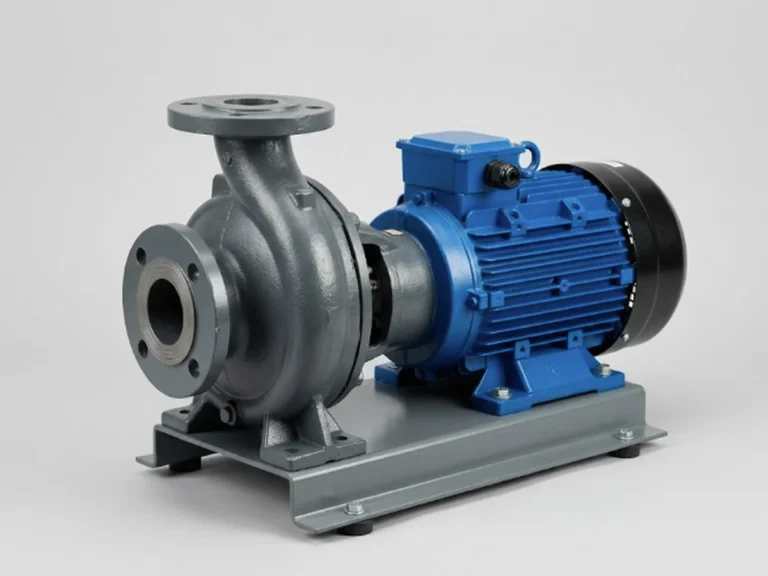
End-suction pumps sit above ground, on a baseplate or close-coupled to a motor, with a horizontal suction inlet at the end of the casing and a vertical discharge. They are the standard centrifugal pump for clean water, cooling circuits and process lines. The range on our site includes end suction monoblock pumps and process variants such as end suction process pumps.
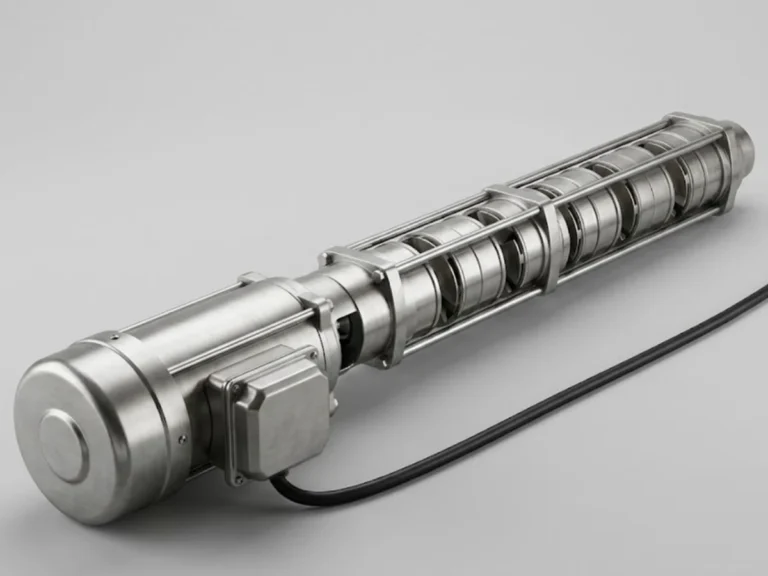
Submersible pumps put a sealed motor and pump together underwater. Borewell versions are long and slim to fit inside a casing; open-well and sewage versions are compact and sit in a sump. See borewell submersible pumps, open well submersible pumps and submersible sewage pumps.
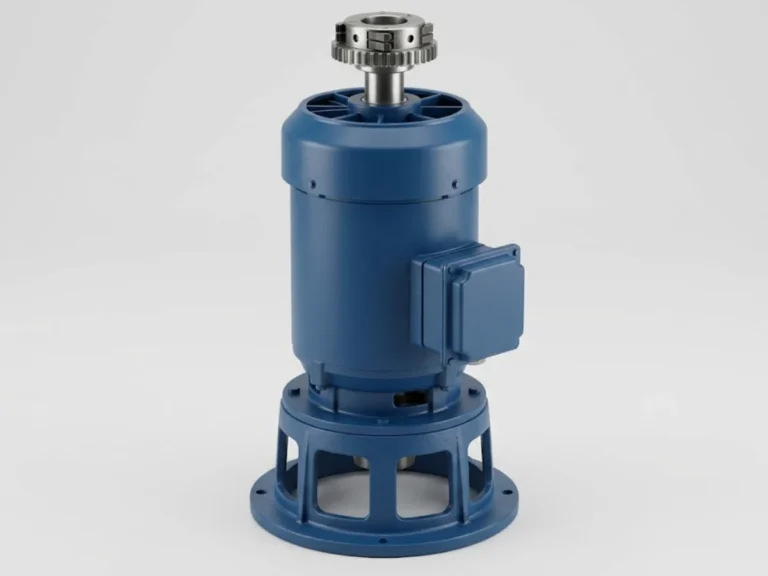
Vertical turbine pumps hang a multistage bowl assembly in the liquid on a column pipe, with the driving motor on top at floor level and a line shaft connecting them. They suit deep wells, large sumps and high flows. See vertical turbine pumps.
Side-by-side comparison
| Factor | End-suction | Submersible | Vertical turbine |
|---|---|---|---|
| Motor location | Above ground, air-cooled | Underwater, cooled by liquid | Above ground on top of column |
| Suction condition | Needs NPSH check, priming or flooded suction | Always flooded, no priming issue | Impellers submerged, no priming issue |
| Typical use | Plant water, cooling, boosting, process | Borewells, sumps, drainage, sewage | Deep wells, river or intake sumps, large flows |
| Servicing | Easy, everything accessible | Pull out for any repair | Motor accessible; bowls need lifting gear |
| Space | Pump room needed | Needs little floor space | Needs headroom and a foundation |
When each type is the better choice
End-suction: easy access, stable duty
Choose end-suction when the liquid source is at or above pump level or the suction lift is small, when you want the motor in a dry, visible and easily serviced location, and when flow and head are moderate. If the source is below the pump you must verify NPSH and provide priming. Close-coupled monoblock versions are compact; baseplate pumps with spacer couplings let you service the bearing without disturbing pipework.
Submersible: no suction problems, small footprint
Choose a submersible where the water is deep and the pump room would be awkward, such as a borewell, an open well, a sump or a lift station. Because the pump is below the water level, it never loses prime and cavitation from suction lift is not a concern. The trade-off is access: anything wrong with the motor or the pump means lifting the whole unit. Cable quality, cable joint and water level protection matter a great deal. Use a dry-run protection device and size the supply cable for voltage drop, using the motor current and cable calculator.
For sewage or trade effluent, pick a non-clog or vortex impeller, check the solid passage size and confirm the motor cooling suits a partly exposed duty.
Vertical turbine: depth, high flow, continuous duty
Vertical turbine pumps suit large flows from deep wells or wide sumps. Because the motor is above ground, it is air-cooled and easier to repair, and because the bowls are submerged there is no suction lift problem. The bowl assembly is built up in stages, so you can add stages to get more head. They need a stronger foundation, careful alignment of the shaft and column, and correct submergence over the first impeller; ask your supplier for the minimum submergence and the sump layout. For plant intakes with fluctuating levels, the setting depth of the bowls needs to match the lowest expected water level.
Motor, starter and control considerations
- Submersible motors: sealed, water-cooled; they need correct overload protection and, for deep installations, a cable sized for the length. Many use direct-on-line or star-delta starting.
- Vertical turbine motors: usually vertical hollow shaft or solid shaft motors with a thrust bearing capable of carrying the pump’s downthrust. Check the thrust rating when ordering the motor; see our vertical hollow shaft motors.
- End-suction motors: standard foot or flange-mounted IEC frame motors, often from the AC motor range.
For all three, a soft starter or VFD reduces starting stress on shafts and pipework and avoids water hammer on trips. Fit a non-return valve, preferably a slow-closing type, on rising mains, and choose the valves from our valves range.
Questions to settle before you order
- What is the lowest water level and the deepest the pump must reach?
- Is the liquid clean or does it carry silt, sand or solids?
- What are the flow and total head at the duty point?
- How will you lift the pump out for maintenance?
- What is the borewell or sump diameter available?
Running cost and maintenance in practice
Over the life of a pump the electricity bill usually exceeds the purchase price, so compare efficiency at the duty point, not only the price. A slightly larger vertical turbine or end-suction pump running near its best efficiency point can save more energy than it costs extra.
On maintenance, end-suction pumps are the easiest: you can check bearings, seals and alignment on site. Submersibles are normally serviced by lifting and replacing the unit or sending it to a workshop, so plan a spare unit for critical wells. Vertical turbines need a periodic check of the line shaft bearings, lubrication system and column joints, usually with a hoist or tripod. In all cases, record the pump head, current and flow at commissioning so that later readings show wear early.
What to send us for a quotation
Tell us the source (borewell, open well, sump, tank), water level range, flow, total head, liquid type, supply voltage and the available bore or sump size. For existing installations, a photo of the old pump nameplate helps. Send details through the request a quote page or contact us and we respond within 24 hours.
Frequently asked questions
Is a submersible pump better than an end-suction pump?
Neither is better in general. A submersible removes suction and priming concerns and takes little space, which suits wells and sumps. An end-suction pump keeps the motor in a dry, accessible location and is easier to service, which suits plant rooms with flooded or low-lift suction. Choose based on the source, the depth, maintenance access and whether the liquid carries solids.
When should I choose a vertical turbine pump?
Choose a vertical turbine pump for deep wells, wide intake sumps and large flows where you want an above-ground motor and no priming issue. Stages can be added to raise head. It needs a solid foundation, headroom for installation and the correct submergence over the first impeller, so share the water level range and sump layout with the supplier.
Do submersible pumps need a starter and protection?
Yes. Submersible motors need a starter suited to their rating, overload and short-circuit protection, and usually a dry-run or level protection device. Deep installations also need a cable sized for the length so voltage drop stays within limits. Have a qualified electrician select the starter and protection against the motor nameplate and cable length.
Can an end-suction pump lift water from a well?
Only for a limited suction lift. A surface pump relies on atmospheric pressure to push liquid to the impeller, so practical suction lift is a few metres and falls with altitude and temperature. Beyond that, use a submersible or vertical turbine pump. Always check NPSH available against the pump's NPSH required before choosing a suction-lift arrangement.