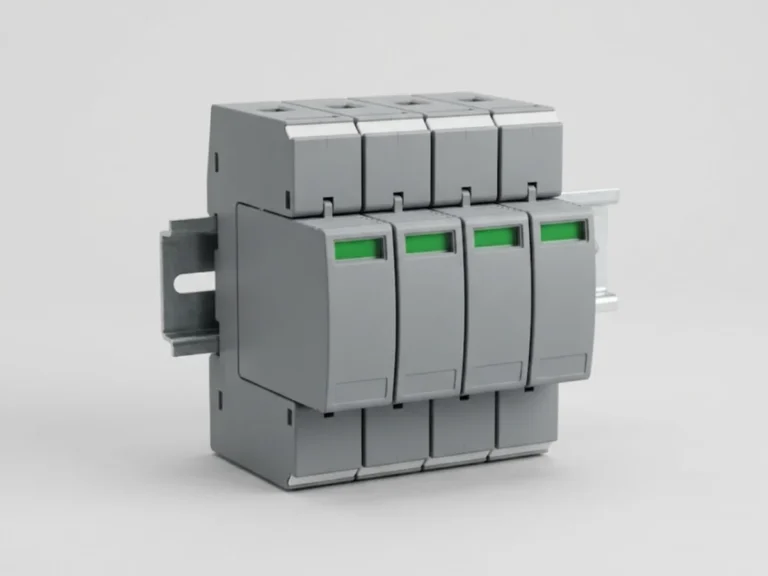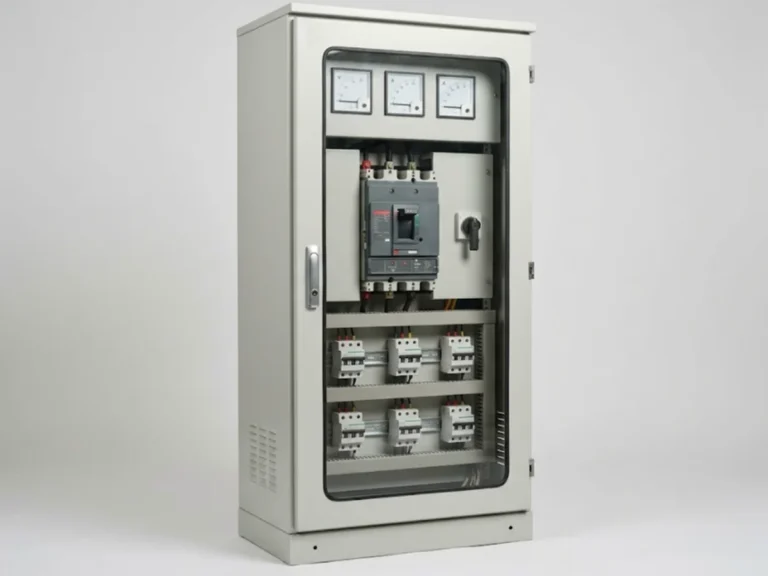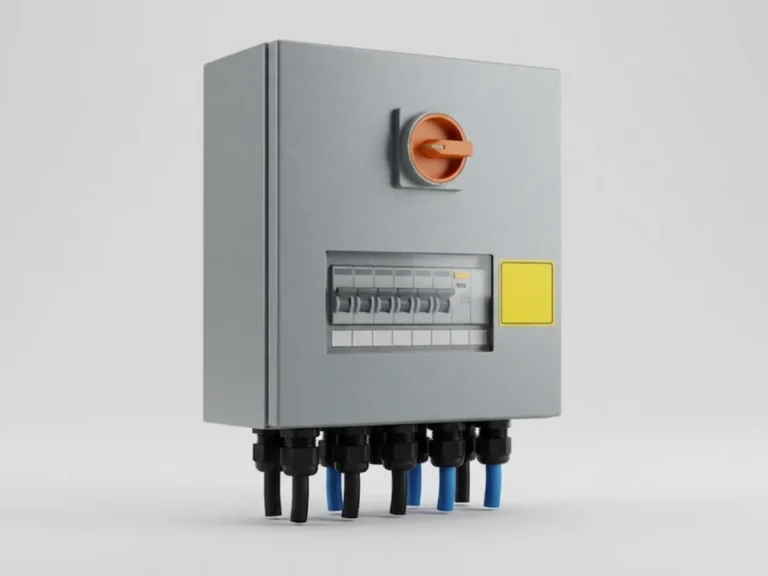
Surge protection devices (SPDs) divert transient overvoltages to earth before they reach the equipment. They come in three types, 1, 2 and 3, and most mistakes in the field come from putting the wrong type in the wrong place, or from wiring that undoes the protection. This guide explains what each type is for and how they fit together in an LT installation.
Where surges come from
- Direct or nearby lightning: the most severe, with currents that can reach tens of kA.
- Induced surges from lightning some distance away, on power or signal cables.
- Switching surges from large motors, capacitor banks, transformers and DISCOM operations.
Switching surges are smaller than lightning, but they happen all the time, and over months they damage drives, PLCs, UPS and electronics.
The three types
| Type | Test wave | What it handles | Where installed |
|---|---|---|---|
| Type 1 (Class I) | 10/350 µs impulse current (Iimp) | Partial lightning current, direct strike to the building or lightning protection system | Main incomer, service entrance, where an external lightning protection system exists or overhead lines enter |
| Type 2 (Class II) | 8/20 µs nominal current (In) and maximum current (Imax) | Induced and switching surges that pass the first stage | Main LT panel, sub-distribution boards, MCCs |
| Type 3 (Class III) | Combination wave, tested by open-circuit voltage (Uoc) | Residual surge at the equipment | Close to sensitive loads: sockets, machine control panels, PLC cabinets |
The standard for LV SPDs is IEC 61643-11, from which the T1, T2, T3 types originate. A combined “Type 1 + 2” device exists, which does both jobs in a single module, and is often used at the main incomer of an industrial plant.
Where each goes in a typical plant
- Main incomer (PCC): Type 1 + 2 if the building has an external lightning protection system or an overhead supply line. Otherwise a Type 2 with a high In rating.
- Sub-distribution and MCC: Type 2 in each board that feeds electronics or long cable runs to separate buildings.
- Control panels, PLC, VFD and UPS input: Type 3 or a small Type 2 near the equipment. Also protect incoming signal and communication lines with the right data-line SPD.
- Solar installations: DC-rated SPDs on the string and inverter side, plus AC SPDs at the AC side. See the solar products range for solar electrical equipment.
The stage approach is called coordinated protection. The upstream device takes the large energy, and the downstream device clamps what is left. The devices must be coordinated, so buy them as a matched series, and follow the maker’s guidance on distance between stages, since a long cable between two SPDs helps their coordination and a very short one may need a decoupling inductor.
How to select the ratings
- Uc, maximum continuous operating voltage: must be above the highest steady voltage that can appear on the system. On a 415 V, TN system with 230 V phase to neutral, 275 V is a common value, with higher Uc (such as 320 V or 385 V) in places with unstable supply, to avoid the SPD degrading under temporary overvoltage.
- Up, voltage protection level: the lower the better, but it must be lower than the withstand voltage of the equipment. 1.5 kV is a typical target for Type 2 on 230/400 V systems.
- Iimp (Type 1) or In/Imax (Type 2): pick the higher rating for exposed sites such as hilltops, open yards and overhead line entry. For Type 1, an Iimp of 12.5 kA (10/350 µs) per pole is a commonly used level, with higher values for high-risk sites.
- Short-circuit rating and backup fuse: SPDs need an upstream fuse or breaker of a size the maker specifies. Using a larger one voids the coordination.
- Earthing system: TN-S, TN-C-S and TT systems need different connection modes (such as 3+1 with a neutral-to-earth spark gap). Check which one your plant uses.
- Status indication: a visible window or a remote contact tells you when the SPD has reached its end of life. Prefer pluggable cartridges, which can be swapped without rewiring.
Signal and data lines
Power SPDs do nothing for a surge that arrives on a 4-20 mA loop, a network cable or an antenna feed. Where cables run between buildings or out to field instruments, add data-line protectors at both ends of the run and bond their earth to the same earth bar as the power SPD. Plants often lose a PLC input card or an Ethernet switch to a surge that came in through the signal cable, with the power side undamaged.
Installation mistakes that defeat the SPD
- Long leads. Every metre of connecting cable adds inductance and raises the let-through voltage. Keep the total lead length from phase to SPD to earth bar as short as possible, ideally under 0.5 m, and avoid loops.
- Poor earthing. The SPD is only as good as the earth connection. A high resistance earth pit, or a thin earth conductor, wastes the device. See earthing materials.
- Wrong place. A Type 2 at the incomer cannot protect a PLC 80 m away by itself.
- No backup fuse or a fuse rated too high.
- No replacement plan. SPDs wear out, and after a heavy strike the cartridge may have operated silently.
Surge protection is part of the overall lightning protection design. For buildings with a lightning protection system, the SPD scheme should follow the IEC 62305 series and be confirmed by a qualified engineer. See also surge protection devices (SPD).
What to send us for a quotation
Send the system voltage and earthing type (TN-S, TN-C-S, TT), whether the building has a lightning protection system, whether the supply is overhead or underground, the location of each board, and the equipment you want protected. You can request a quotation or contact us. Quotation requests are answered within 24 hours.
Frequently asked questions
What is the difference between Type 1 and Type 2 SPD?
Type 1 is tested with a 10/350 microsecond impulse that represents partial direct lightning current, so it can be installed where lightning can enter the installation, such as the main incomer with an external lightning protection system. Type 2 is tested with an 8/20 microsecond wave for induced and switching surges, and suits distribution boards.
Do I need all three types of SPD?
Not always. Many plants use a combined Type 1 + 2 at the incomer and Type 2 at downstream boards, adding Type 3 only for sensitive equipment far from the nearest Type 2. The need depends on lightning exposure, cable lengths and the value of the equipment protected.
What Uc should I choose for a 415 V system?
On a 230/415 V TN system, 275 V is the usual minimum, but where the supply has frequent overvoltages or a poor neutral, a higher Uc such as 320 V or more is better because it survives temporary overvoltage without degrading. Check the tolerance of your supply and ask your supplier.
How do I know if an SPD has failed?
Most modern SPDs have a window that changes colour or a remote contact that signals when the protective element has worn out or tripped its disconnector. Test or inspect SPDs on a regular schedule and after any known lightning event. Pluggable cartridges allow quick replacement.