A solar plant is more than panels and an inverter. Between them sit several enclosures that combine strings, protect equipment from faults and lightning surges, and give maintenance staff a safe way to isolate parts of the plant. Quotations list them under abbreviations: AJB, SJB, DCDB, ACDB, ACCB. Buyers often accept them as a lump item without knowing what is inside. That is how an under-rated box, or an AC breaker on a DC circuit, gets into a plant.
SKE Bharat supplies solar electrical products including array junction boxes, DC and AC distribution boards and combiner boxes. We do not design or install solar plants. Use this guide to read a quotation and ask the right questions; final design, ratings and protection settings must be confirmed by a qualified engineer.
The signal path in one picture
Power flows in this order in a typical plant:
- Panels connected in series form a string.
- Several strings meet in an array junction box (AJB), also called a string combiner box or solar junction box.
- AJB outputs go to a DC distribution board (DCDB) and then to the inverter. In small plants with string inverters, this box may be absent or built into the inverter.
- The inverter output goes to an AC combiner box (if there are several inverters) and the ACDB, then to your LT panel and the grid connection point.
Array junction box (AJB)
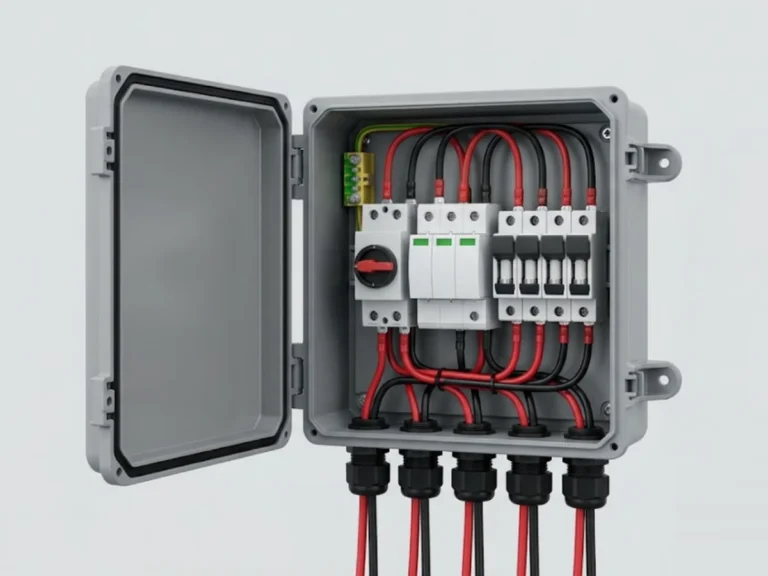
The array junction box brings the string cables together. Typical contents:
- String fuses rated for DC and for photovoltaic duty (gPV type) on each string, to guard against reverse currents when several strings are paralleled.
- DC surge protection device (SPD) for lightning-induced surges on the array wiring.
- DC switch disconnector (isolator) on the output so the box can be isolated.
- Terminal blocks, busbars, cable glands and a clear label for each string.
The enclosure goes on the roof or near the array, so it must be rated for outdoor use, normally at least IP65, with UV-resistant material and proper earthing. Some boxes include string current monitoring.
DC distribution board (DCDB)
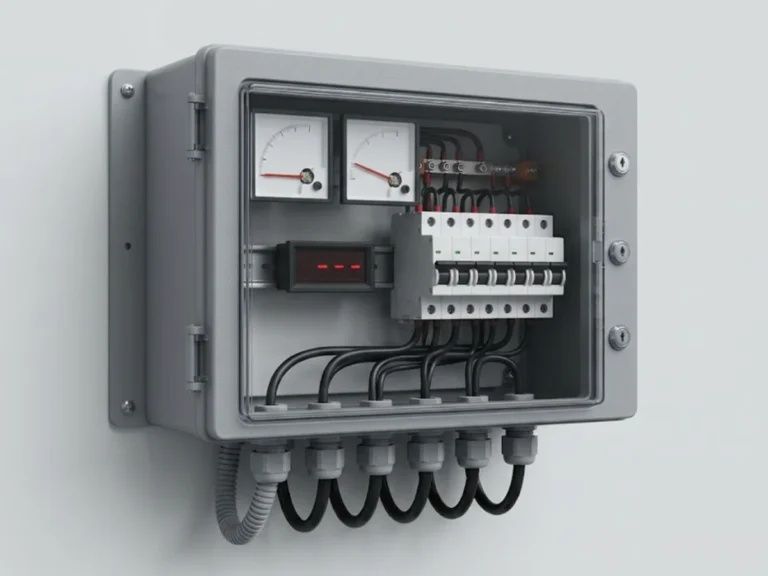
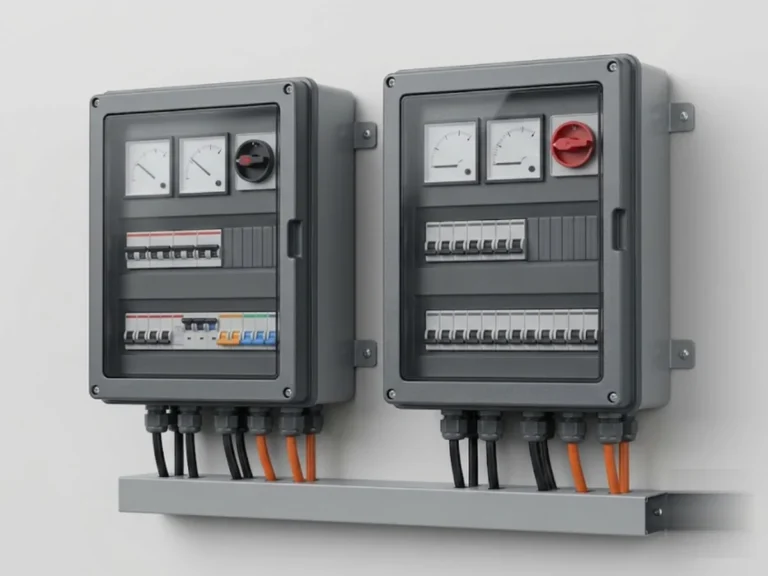
A DC distribution board collects the output of one or more AJBs before the inverter input. It carries DC breakers or isolators, SPDs, and sometimes metering of voltage and current. In plants that use central inverters or large string inverters, the DCDB is a real separate panel. In small plants using string inverters that already have DC isolators and surge protection built in, a separate DCDB may be unnecessary. Check the inverter datasheet and ask your designer before paying for a box you do not need. The combined item is also sold as a solar ACDB DCDB set.
AC combiner box and ACDB
The AC combiner box merges the outputs of several inverters, typically string inverters, onto one AC feeder. It includes an incoming breaker per inverter, a common busbar and an outgoing breaker.
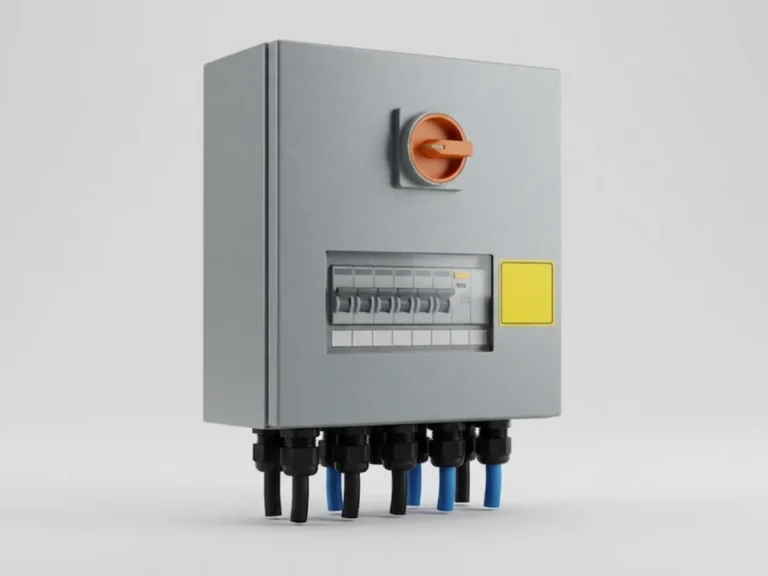
The AC distribution board (ACDB) sits between the inverter or combiner and the building supply. It usually contains:
- An MCB, MCCB or ACB as the main isolating and protective device, sized for the inverter AC output.
- An AC surge protection device.
- Voltmeter and ammeter, and often a generation energy meter.
- An earth fault device where specified by the designer.
The ACDB gives a visible disconnect point for the solar plant. Utility rules often require an isolation facility accessible to their staff; confirm this with your DISCOM. See also net metering in India: what to check.
Quick reference table
| Box | Location | Voltage type | Main purpose |
|---|---|---|---|
| Array junction box | Near the array | DC | Combine strings, fuse, surge protect |
| DCDB | Before inverter | DC | Combine AJB outputs, isolate inverter input |
| AC combiner box | After several inverters | AC | Combine inverter outputs |
| ACDB | Before LT panel / grid | AC | Protect, isolate and meter AC output |
What to check when buying
- DC voltage rating. The DC devices must be rated above the maximum open-circuit voltage of the string at the lowest site temperature, not the nominal voltage. Systems of 1000 V DC are common; very large plants use higher.
- DC-rated devices only. A normal AC MCB is not rated to interrupt a DC arc. DC current does not pass through zero, so the arc does not extinguish on its own. Ask for breakers, isolators and fuses specifically rated for DC at the system voltage. See our isolators and switch disconnectors and HRC fuses.
- Surge protection. Use SPDs made for PV DC circuits on the DC side; see surge protection devices.
- Enclosure. Outdoor boxes need IP65 or better, UV-stable material and drip-proof glands; panels indoors can be lower.
- Short-circuit rating and terminal capacity. Check that the busbars and terminals suit the cable size and fault level.
- Earthing and labelling. Provision for earth connection and clear string labels save time in maintenance. Pair with earthing materials.
Problems with poorly specified boxes
- Water ingress through unsealed glands or a damaged door gasket, leading to corrosion and tracking.
- Heat build-up in a sealed box with undersized terminals or busbars, especially on a sunlit roof.
- String fuses or isolators with a DC rating below the real string voltage.
- Unlabelled strings, which turns every fault-finding job into guesswork.
- No space or provision for adding a string later.
For cable sizing between these boxes read solar DC cables and protection basics. For the bigger picture, see our solar solutions page.
What to send us for a quotation
Send the number of strings, panel Voc and Isc, string length, inverter make and model with its DC input range and AC output, preferred enclosure rating and any utility requirement. Use request a quote or contact us; we answer within 24 hours.
Frequently asked questions
What is the difference between ACDB and DCDB in solar?
The DCDB (DC distribution board) handles the direct-current side, between the array junction boxes and the inverter input. The ACDB (AC distribution board) handles the alternating-current side, between the inverter output and your building supply or the grid. Each has devices rated for its own current type, so the two are not interchangeable.
Do I need an array junction box for a small solar system?
Often yes when several strings are combined, because the box holds string fuses, surge protection and an isolator. For a very small system with one or two strings going straight to a string inverter that has built-in DC protection, a separate box may not be needed. Check the inverter datasheet and ask your designer.
Can I use an ordinary MCB on the DC side of a solar plant?
No. Standard AC MCBs are not designed to break a DC arc at solar voltages and can fail dangerously. Use breakers, isolators and fuses explicitly rated for DC at the system voltage. Always have a qualified electrical engineer confirm device ratings before installation.
What IP rating should a solar junction box have?
For outdoor roof or ground-mount use, IP65 or better is commonly specified, together with UV-resistant enclosure material and suitable cable glands. Indoor boxes in a clean electrical room can have a lower rating. Your designer should confirm the exact requirement for your site and local conditions.