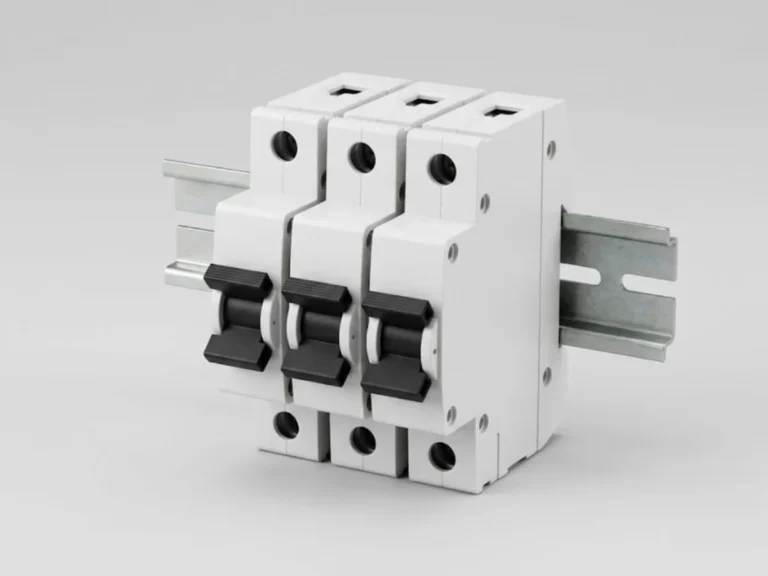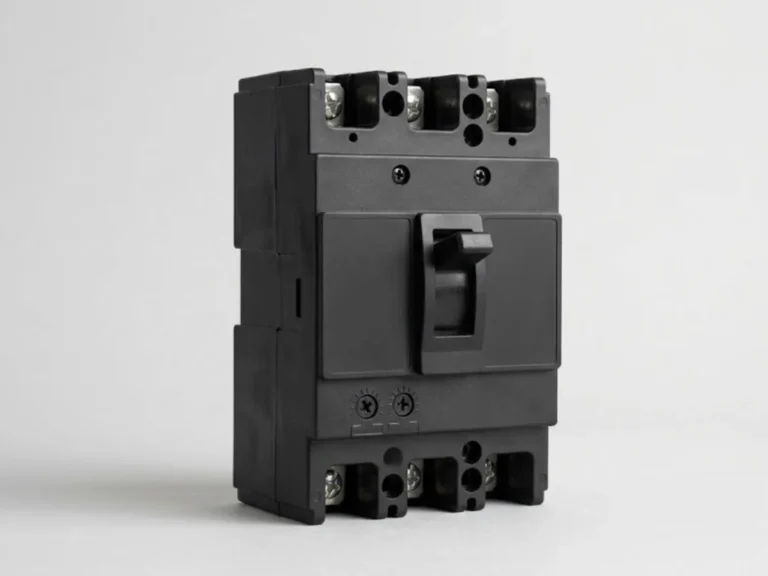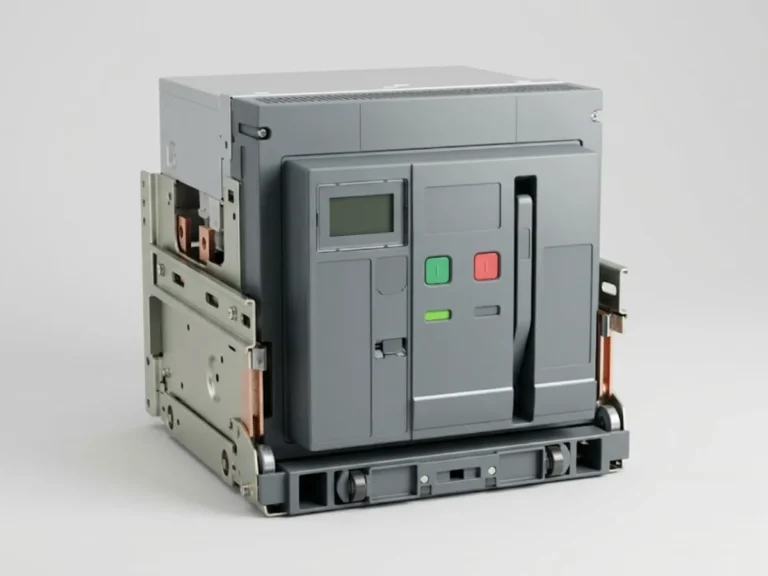
The three common low-voltage breakers, MCB, MCCB and ACB, cover different current ranges but overlap in the middle. A 125 A feeder could be an MCB or an MCCB; a 1000 A feeder could be an MCCB or an ACB. The choice then depends on fault level, how adjustable the protection must be, how you will maintain it and, of course, budget.
The three breakers in brief
MCB (miniature circuit breaker). Fixed thermal-magnetic trip, fitted in final distribution boards for lighting, sockets, small motors and control circuits. Typical ratings run from a few amperes up to about 125 A, with short-circuit capacity in the range of 6 kA to 10 kA for common types. Trip characteristics are fixed by curve: B, C or D. See MCB.
MCCB (moulded case circuit breaker). A sealed moulded housing with higher ratings, typically from about 16 A up to 1600 A in common ranges (some makes go higher) and fault ratings from about 25 kA to 100 kA at 415 V depending on frame. Larger frames offer adjustable overload and short-circuit settings, often through an electronic trip unit. See MCCB.
ACB (air circuit breaker). An open-frame breaker with a heavy contact system, usually drawout, in ratings from around 630 A or 800 A up to 6300 A. It has a high short-time withstand rating, so it can stay closed on a downstream fault long enough for a downstream breaker to clear it. Fully adjustable electronic trip units are standard. See ACB.
Comparison table
| Feature | MCB | MCCB | ACB |
|---|---|---|---|
| Typical current range | Up to about 125 A | About 16 A to 1600 A | About 630 A to 6300 A |
| Typical use | Final circuits, control | Feeders, motor and sub-main protection | Incomers, bus couplers, large feeders |
| Trip settings | Fixed (B, C, D curve) | Fixed or adjustable | Fully adjustable, with time delay |
| Short-time withstand | None | Limited | High, essential for selectivity |
| Maintenance | Replace | Mostly replace; limited service | Serviceable, contacts and mechanism |
| Relative cost | Lowest | Medium | Highest |
Four ratings that decide the choice
- Rated current (In). Select above the continuous load current, remembering ambient temperature derating inside a panel. Panels at 45 to 50 °C often need the breaker derated.
- Breaking capacity. Icu is the maximum fault the breaker can interrupt; Ics is the fraction it can interrupt and still keep working (often 100 percent, 75 percent or 50 percent of Icu). Choose Icu at least equal to the prospective fault at the point of installation. For critical feeders prefer an Ics at 100 percent of Icu.
- Short-time withstand (Icw). ACBs (utilisation category B) can carry a fault for typically 0.5 to 1 s while a downstream device clears it. Most MCCBs are category A, with no deliberate time delay.
- Trip unit. Thermal-magnetic is adequate for small feeders. For large feeders, electronic trips let you set long-time pickup, short-time delay, instantaneous and earth fault separately, which is how you achieve coordination.
Two further points sometimes decide the matter. First, back-up protection (cascading): an upstream MCCB with a high breaking capacity can let a downstream MCB with a lower rating be used above its own Icu, but only for combinations the manufacturer has tested and published, and cascading works against selectivity because the upstream device also trips. Second, pole count: a four-pole breaker switches the neutral and is needed where the neutral must be isolated, as in changeover with a DG; a three-pole breaker with a solid neutral link is fine elsewhere.
Selectivity, the reason ACBs exist
Discrimination (selectivity) means only the breaker nearest the fault trips. With an MCCB upstream of an MCCB, the two often trip together on a heavy fault because both go instantaneous. An ACB on the incomer with short-time delay lets the downstream MCCB clear the fault first, so the plant stays up. This is why large PCC incomers use ACBs, even where the load current alone could be served by a big MCCB.
For reference, a typical arrangement is: ACB on the transformer incomer, MCCBs on feeders to MCCs and distribution boards, MCBs and RCBOs on final lighting and socket circuits. Ask the manufacturer for selectivity tables for the exact combination you plan to use; they are tested, not calculated by eye.
Where each one goes: practical picks
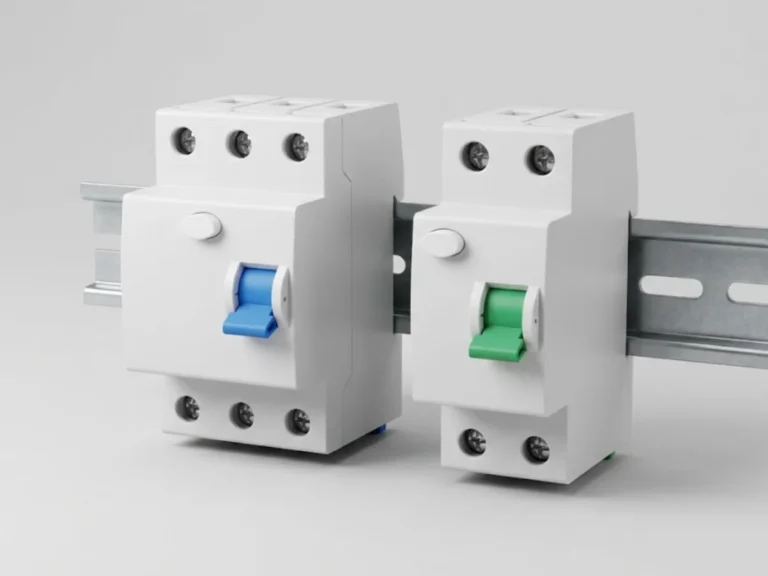
- Lighting and small power DB: MCB (C curve) with RCCB or RCBO for earth leakage protection (RCCB / RCBO).
- Motor feeders up to 90 kW or so: MCCB with magnetic-only trip or a motor protection circuit breaker, plus contactor and overload relay. Use a D curve MCB only for very small motors with high inrush.
- Sub-main feeders 100 A to 800 A: MCCB, electronic trip if you need coordination.
- Transformer incomer above about 1000 A: ACB, with metering and earth fault protection.
- Bus coupler: ACB, interlocked with the two incomers.
Mistakes to avoid
- Selecting on current alone and ignoring a fault level of 50 kA on a transformer secondary.
- Using a four-pole breaker without checking whether the neutral pole is protected or only switched.
- Skipping the discrimination study, then finding the incomer trips for a feeder fault.
- Mixing makes, which makes the manufacturer’s tested selectivity tables unusable.
Breaker selection for protection and coordination affects safety. Please confirm final choices with a qualified engineer against the actual fault level and cable data.
What to send us for a quotation
For breakers, send the voltage, current rating, number of poles, required Icu and Ics, trip unit type, fixed or drawout mounting, and any accessories such as shunt trip, undervoltage release and motor operator. For panels, share the single-line diagram. You can request a quotation or contact us; quotations are answered within 24 hours. Related items sit in circuit breakers and, for finding a matching product, the product finder.
Frequently asked questions
What is the main difference between MCB and MCCB?
An MCB is a small, mostly fixed-setting breaker for final circuits, rated up to about 125 A with modest fault capacity. An MCCB is a larger moulded-case unit, rated from tens of amperes to over 1000 A, with higher breaking capacity and, in bigger frames, adjustable trip settings. MCCBs suit feeders and motors, MCBs suit lighting and sockets.
When should I use an ACB instead of an MCCB?
Use an ACB on incomers and bus couplers, or on feeders above roughly 1000 A, particularly where you need selectivity with downstream breakers. An ACB has a high short-time withstand rating and fully adjustable electronic protection, and it can be serviced. For smaller feeders an MCCB is more economical.
What is the difference between Icu and Ics?
Icu is the ultimate breaking capacity, the highest fault current the breaker can interrupt, after which it may need to be replaced. Ics is the service breaking capacity, the fault current it can interrupt and still remain fit for continued service. Ics is stated as a percentage of Icu. Higher Ics gives more confidence after a fault.
Do I need an electronic trip unit on every MCCB?
No. Small MCCBs with thermal-magnetic trips are usually fine on simple feeders and motors. Electronic trip units are worth the extra cost on larger feeders, where you need separate settings for overload, short circuit and earth fault, or where coordination with the upstream ACB depends on adjustable time delays.