Replacing a motor sounds simple until the new one arrives and its feet do not line up with the base plate, or the flange is a size too small for the gearbox. Frame size and mounting type decide whether a motor physically fits. This guide explains the codes used on Indian motors, which follow the IEC pattern, and how to measure what you have when the nameplate is missing.
What the frame number means
In the IEC system the frame number is the height of the shaft centre above the mounting surface, in millimetres. A 132 frame has a shaft centre 132 mm above the base. A letter after the number tells you the length of the frame: S for short, M for medium and L for long. A 132S and a 132M have the same shaft height and foot-hole pattern across the width, but different foot spacing along the length.
The frame also fixes the shaft diameter and length for standard motors. Foot and shaft dimensions for foot-mounted motors are laid down in IS 1231 and flange dimensions in IS 2223, which follow the corresponding IEC dimension standards; the point is that a motor of the same frame from different makers should fit the same base.
Typical kW to frame size
Frame size depends on kW and poles, and it varies a little between manufacturers and between IE2 and IE3 designs. These are typical values for 4-pole, 415 V, 50 Hz motors; always check the maker’s table.
| Rating (4-pole) | Typical frame | Typical shaft diameter |
|---|---|---|
| 0.75 kW | 80 | 19 mm |
| 2.2 kW | 100L | 28 mm |
| 5.5 kW | 132S | 38 mm |
| 11 kW | 160M | 42 mm |
| 22 kW | 180L | 48 mm |
| 37 kW | 225S | 60 mm |
| 55 kW | 250M | 65 mm |
| 90 kW | 280M | 75 mm |
| 132 kW | 315M | 80 mm |
A 2-pole motor of the same kW is often one frame size smaller, with a smaller shaft diameter in the larger sizes. An IE3 motor can come in a larger frame than an IE2 motor of the same rating, which matters when you replace an old motor in a tight base.
Mounting arrangements: B3, B5, B35 and others
The mounting code, written IM followed by letters and numbers, tells you how the motor is fixed and which way the shaft points. The common ones are:
- IM B3 (foot mounted): the motor sits on its feet on a base plate or rail, shaft horizontal. Most general purpose machines such as pumps, fans and compressors use B3. Coupling or belt drive.
- IM B5 (flange mounted): the motor bolts to the machine through a flange with through holes at the drive end, shaft horizontal, no feet. Used on gearboxes, many pumps and close-coupled machines where the shaft must be centred precisely.
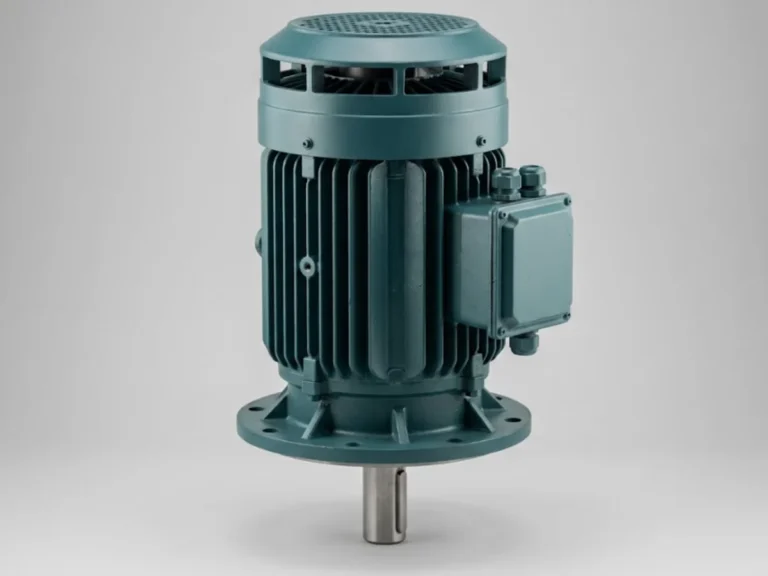
- IM B35 (foot and flange): feet plus a B5 flange, so the motor can be mounted on its feet and also bolted to a gearbox or pump flange. It gives support for the heavy motor and accurate alignment. Common on larger gear motors and on cooling tower drives.
- IM B14 (face mounted): a small flange with tapped holes in the face, used on small motors in lighter machinery. B34 is B14 plus feet.
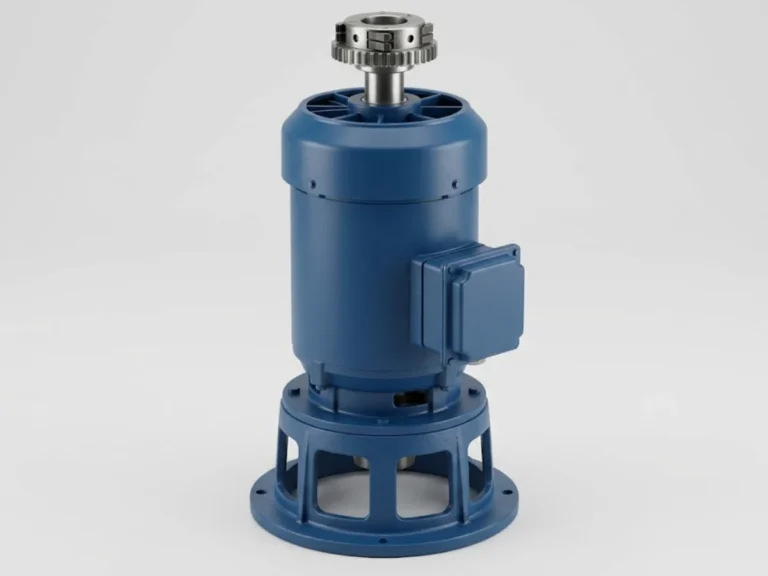
- IM V1 / V3 (vertical): flange mounted with the shaft down (V1) or up (V3). Used on vertical pumps, agitators and mixers, and some fan drives. For vertical pump drives with a hollow shaft see vertical hollow shaft motors.
If the motor is mounted vertically but was built for horizontal use, the bearings and sometimes the cooling arrangement will not be suitable. Mention the mounting orientation when ordering, and whether there is a water splash risk to the shaft end.
Flange types and shaft details
A B5 flange is identified by a flange code (FF for the free-holes type in IEC practice) followed by the pitch circle diameter in mm. The flange must match the machine’s mating face. Four things must agree:
- Pitch circle diameter and number of holes.
- Spigot (register) diameter, which centres the motor in the machine.
- Shaft diameter and shaft length, with the key size.
- Distance from the flange face to the shaft end.
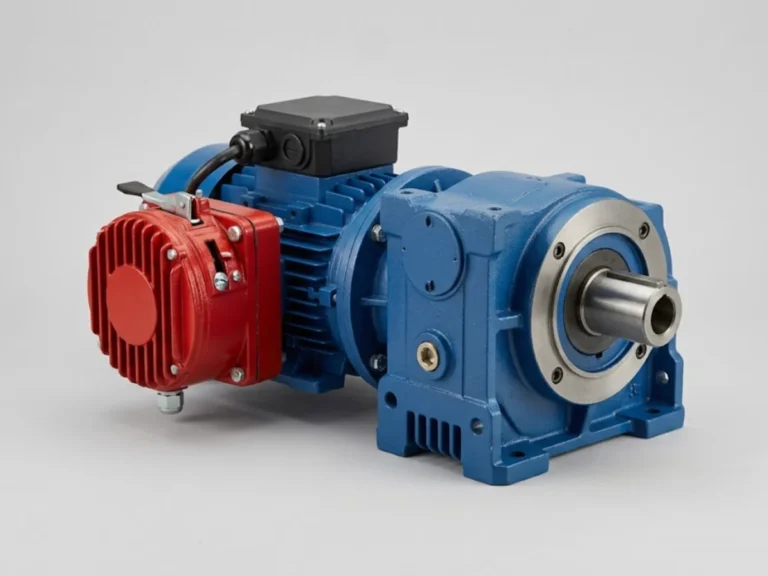
When a geared drive is involved, the motor flange must also match the gearbox input; many gearboxes list the motor flange codes they accept. Motors with an integrated gearbox, such as the gear motor with brake, avoid the coupling problem.
How to measure an old motor with no nameplate
- Measure the shaft centre height (from the base of the feet to the centre of the shaft) to find the frame number.
- Measure foot hole spacing across (A) and along (B) the feet, and the hole diameter.
- Measure the shaft diameter, shaft length and key size.
- For flanged motors, measure the pitch circle diameter, spigot diameter and the number of bolt holes.
- Note the mounting orientation, direction of rotation and the position of the terminal box, which is usually on top, with options for left or right.
- Count the winding leads and note the voltage on the label, if there is one.
Photograph the base plate, since a new motor with the same frame but a longer body may hit the machine. A common problem on replacing old Indian motors is that the old frame was the pre-IEC standard, so the new motor needs adaptor plates or a new base plate. Check with a supplier before you remove the old unit.
See also how to read a motor nameplate for the other fields. Our AC motors and brake motors are available in B3, B5 and B35 versions, subject to the model, and cooling tower motors have their own mounting needs.
What to send us for a quotation: kW and poles, frame number or the measured dimensions above, mounting code with a photo of the base or flange, shaft size, terminal box position, and the driven machine. Use the request a quote page or contact us; we reply within 24 hours.
Frequently asked questions
What is the difference between B3 and B5 mounting?
B3 motors are fixed by their feet to a base plate, with the shaft horizontal. B5 motors have a flange at the drive end and bolt directly to the machine or gearbox, with no feet. B35 combines both. Choose B3 for belt and coupling drives, B5 for close-coupled gearboxes or pumps, and B35 when you want both support and flange alignment.
What does frame size 132 mean on a motor?
The number is the distance from the mounting surface to the shaft centre line in millimetres, so a 132 frame has a shaft centre height of 132 mm. A letter S, M or L follows to show body length. The frame number gives the shaft height and foot pattern, which are what must match the base plate when you replace a motor.
Can I use an IE3 motor to replace an IE2 motor in the same frame?
Sometimes, but not always. IE3 motors use more active material and may be built in the next larger frame, or have a longer body, for the same kW. Check the shaft height, foot spacing and overall length in the maker's dimension sheet before ordering, and be ready to use shims or a new base plate.
Can a B3 motor be mounted vertically?
Only if the manufacturer confirms it for the model. Vertical operation puts different loads on the bearings, and a shaft-up motor needs protection against water and dust entering the shaft gap. Ask for a motor built for V1 or V3 mounting with suitable bearings and a drip cover where needed.