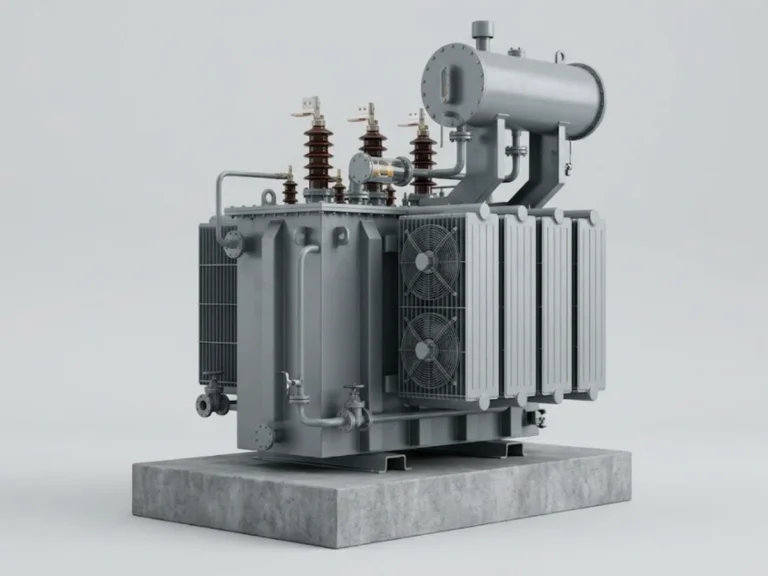
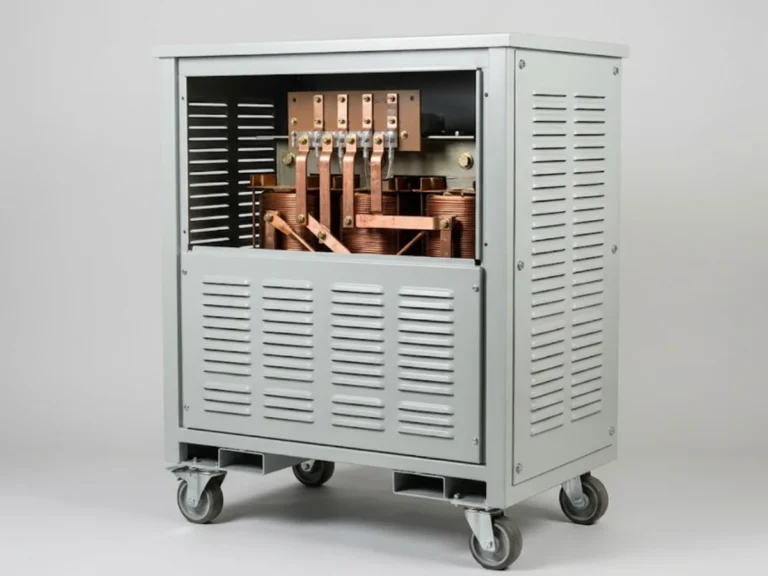
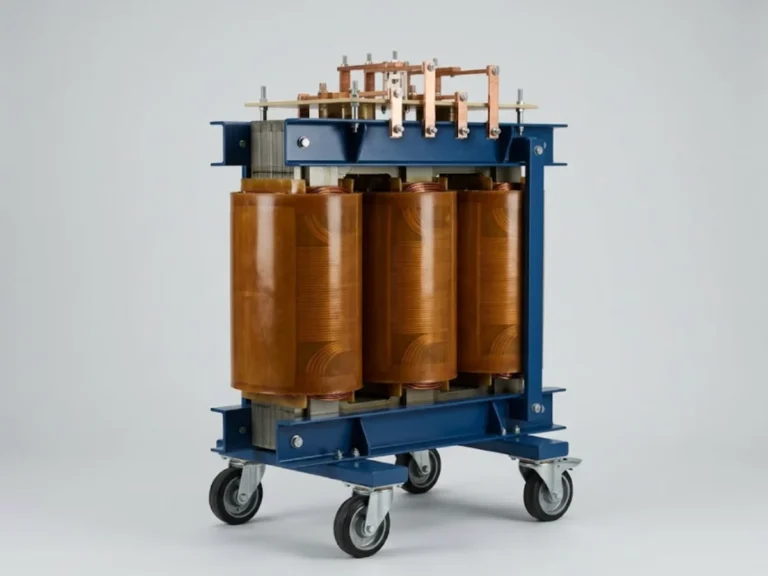
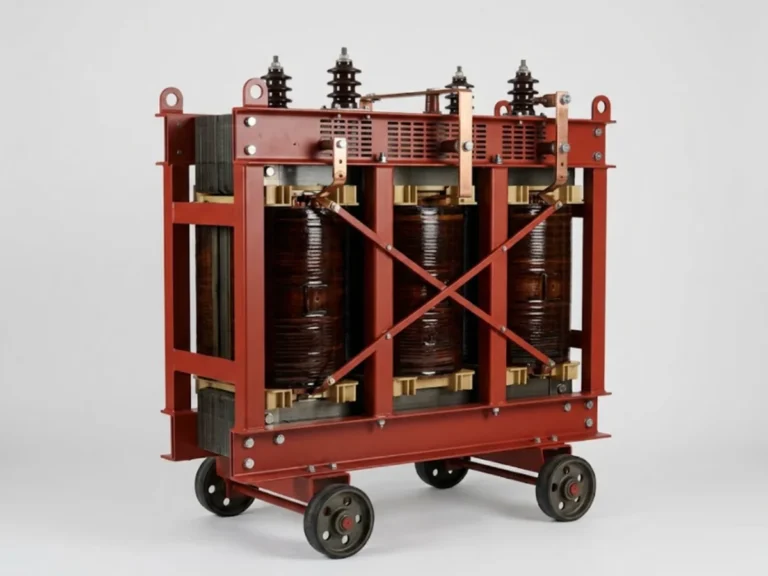
Both types do the same electrical job: step 11 kV or 33 kV down to 415 V. The difference is what carries the heat away and what insulates the windings. In an oil-immersed transformer the core and windings sit in mineral oil inside a steel tank. In a dry-type transformer the windings are insulated with air, resin or varnish and cooled by air. That single difference drives cost, location, fire rules, maintenance and the largest rating you can buy, so the choice is mostly decided by where the transformer will stand.
How each type works
Oil-immersed. The oil is both insulation and coolant. Heat moves from the windings into the oil, up through the tank walls or radiators, and out to the air. A conservator tank (on larger units) takes up oil expansion, a breather keeps moisture out, and protective devices such as a Buchholz relay, oil and winding temperature indicators and a pressure relief device watch the unit. Our oil-immersed transformers and distribution transformers follow this construction.
Dry-type. There is no liquid. Windings are either vacuum pressure impregnated (VPI) with varnish or encapsulated in cast epoxy resin, and air circulates around the coils. See our dry-type transformers, which include resin cast and VPI designs.
Side-by-side comparison
| Factor | Oil-immersed | Dry-type |
|---|---|---|
| Typical location | Outdoor yard, plinth, dedicated transformer bay | Indoor: basements, floors, malls, hospitals, data centres |
| Fire behaviour | Mineral oil is combustible; needs spacing, soak pit, fire walls or sprinkler/deluge protection | Low fire load; resin and varnish systems are self-extinguishing in most designs |
| Purchase price | Generally lower for the same kVA | Generally higher, especially cast resin |
| Maintenance | Oil sampling, silica gel, gaskets, leaks, periodic filtration | Cleaning of dust, tightening, thermal checks; no oil work |
| Overload tolerance | Good thermal mass; short overloads usually well tolerated | Less thermal mass; follow the manufacturer’s overload curve |
| Rating and voltage range | From small distribution units to very large power transformers and EHV | Usually distribution range, up to a few MVA and medium-voltage class |
| Sensitivity to dust and moisture | Sealed tank, little affected | Cast resin copes well; VPI needs cleaner, drier rooms |
| Noise | Generally quieter at the same rating | Fan-cooled units can be noisier |
When oil-immersed is the right call
- Outdoor yards. If you have an open transformer yard with clearances from buildings, oil units give the lowest cost per kVA.
- Large ratings. Above the range dry-types are built for, and for any 33 kV or higher application, oil is effectively the only option. See our power transformers and EHV transformers.
- Heavy, fluctuating loads. Furnaces, rolling mills and similar duties need special designs; our furnace transformers are an example, and are oil-cooled.
- Dusty, humid or corrosive plant areas where a sealed tank is easier to protect than open coils.
When dry-type is the right call
- Inside buildings. Fire codes and insurers are far more comfortable with a dry-type in a basement or on a floor with occupants above. Check the local fire authority and the National Building Code requirements for your building before deciding.
- Critical load centres. Hospitals, IT parks, airports and metro stations prefer low fire load and no oil containment.
- Load close to the centre of demand. Placing the transformer near the load shortens LT cable runs, which cuts voltage drop and copper cost. Dry-types make that possible indoors.
- Sites where oil handling is a nuisance such as food, pharma or clean manufacturing floors.
The cost question: look beyond the price tag
A dry-type costs more up front. Whether that premium is justified depends on what the alternative costs you. For an indoor installation, an oil unit often needs a separate fire-rated room, oil sump, drainage, possibly an automatic extinguishing system and civil work. Added together, the gap can narrow considerably. For an outdoor yard the oil unit usually wins on total cost.
Also compare losses. A transformer runs 24 hours a day, so no-load (iron) loss is paid for all year while load (copper) loss depends on how hard the unit works. Ask for guaranteed loss figures from both options at your expected loading rather than comparing kVA and price alone. A lower-loss design usually pays back over its life. The same applies when you are comparing two oil units.
Worked example
A 1000 kVA transformer at 80 percent average load delivers about 800 kVA. At 0.95 power factor that is roughly 760 kW. If you can see a difference of even 2 to 3 kW in total loss between two offers, that is 17,000 to 26,000 kWh a year (2 to 3 kW multiplied by 8,760 hours), which at your energy rate is real money. Use the guaranteed figures from the datasheet and your own tariff to do this sum.
Questions to settle before ordering
- Is the transformer indoors or outdoors, and what is directly above and next to it?
- What are the HV and LV voltages, the kVA, the impedance you need, and the vector group (Dyn11 is the usual choice for distribution transformers in India)?
- Do you need an OLTC (on-load tap changer) or is off-circuit tapping enough?
- What is the ambient temperature and altitude of the site? Ratings are derated for heat and altitude.
- Will harmonic-rich loads such as VFDs, UPS or LED drivers be connected? If yes, discuss a K-factor or harmonic-rated design with the manufacturer.
- What protection do you need on the transformer (temperature indicators, Buchholz, WTI/OTI, RTDs)?
If you are still working out the kVA, our transformer sizing calculator is a quick starting point.
What to send us for a quotation
To quote accurately, send us the kVA rating, HV and LV voltages, indoor or outdoor installation, cooling preference, required impedance and vector group, tap-changer requirement, and any applicable specification or tender clause. You can also upload drawings. Send these through our request a quote page or reach the team via contact us, and browse the full transformers category meanwhile. Confirm the final choice, especially for indoor installations and fire safety, with a qualified electrical engineer.
Frequently asked questions
Is a dry-type transformer safer than an oil-immersed one?
Dry-type units carry far less fire load because there is no combustible oil, so they are the usual choice inside occupied buildings. Oil units can be installed safely too, but they need clearances, a soak pit, fire barriers and sometimes automatic suppression. Always check the applicable fire norms with a qualified engineer and your local fire authority.
Which is cheaper, oil-immersed or dry-type?
For the same kVA the oil-immersed transformer generally costs less to buy. For an indoor installation the gap can narrow once you add the fire-rated room, oil containment and drainage that an oil unit needs. Compare total installed cost and guaranteed losses, not just the transformer price.
Can a dry-type transformer be installed outdoors?
Only with a suitable enclosure and the correct environmental class. Cast resin designs handle humidity and dust better than VPI, and an outdoor-rated enclosure with the right IP degree is needed. Many buyers simply use an oil unit outdoors. Ask the manufacturer to confirm the enclosure rating and class for your site.
What maintenance does each type need?
Oil units need periodic oil testing, checking silica gel breathers, gaskets and leaks, and tightening of terminals. Dry-types need regular cleaning of dust, checks of connections and temperature monitoring, but no oil work. Follow the maintenance schedule in the manufacturer's manual and your site's electrical safety practice.