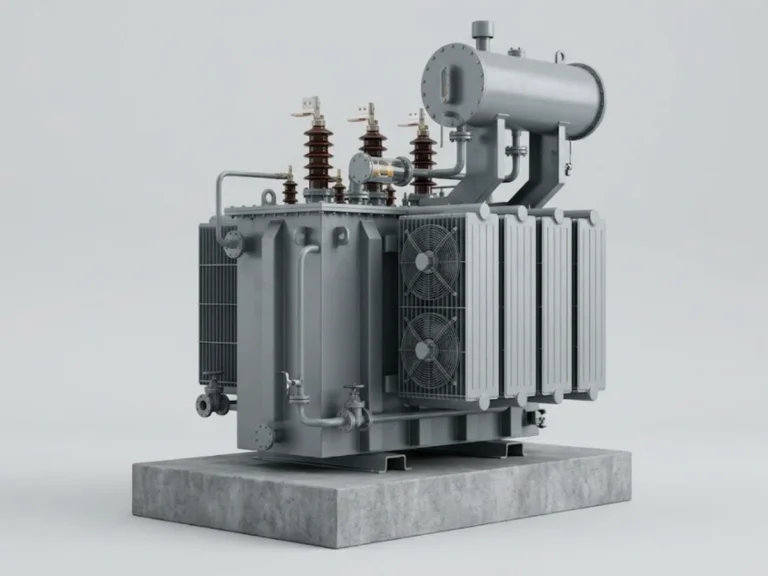
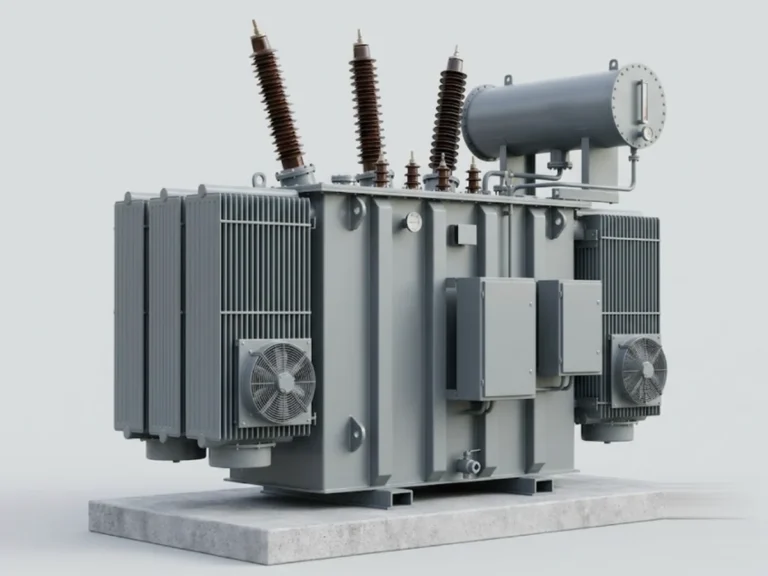
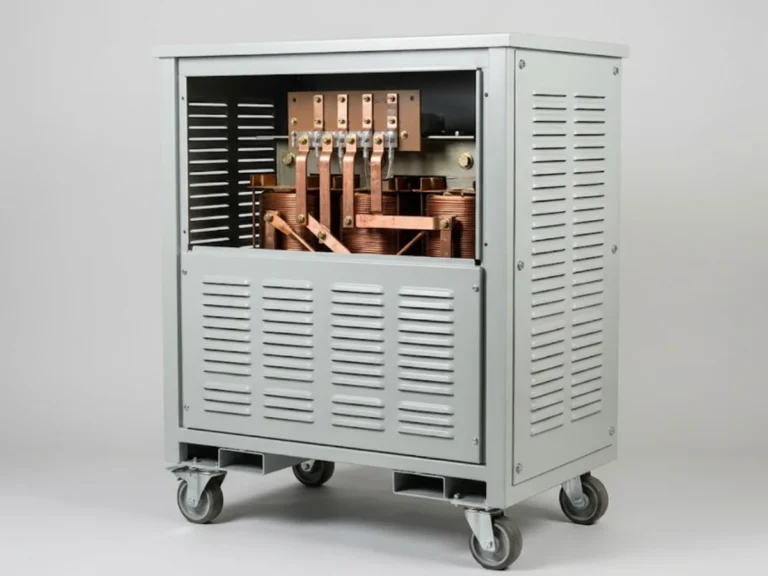
Every transformer loses a little energy as heat in its core and windings, and that heat must leave the unit or the insulation ages quickly. The cooling class on the nameplate tells you how heat is removed and, for many units, how much the rating changes when the fans or pumps are on. The codes look cryptic but follow a simple pattern.
How the four-letter code works
Oil-immersed transformers use a code with four letters, read in order.
- First letter: internal cooling medium. O means mineral oil. (Other fluids such as synthetic esters have their own letters.)
- Second letter: how that medium circulates. N means natural convection, F means forced circulation by a pump, D means forced and directed through the windings.
- Third letter: external cooling medium. A means air, W means water.
- Fourth letter: how the external medium circulates. N means natural, F means forced (fans or water pumps).
So ONAN is oil natural, air natural. ONAF is oil natural, air forced. OFAF is oil forced, air forced. ODAF is oil directed, air forced. OFWF is oil forced, water forced. Older nameplates may use letters such as OA, FA and FOA, which map to the same ideas. Dry-type transformers use a two-letter code: AN for air natural and AF for air forced.
The common classes in practice
| Class | What it means | Typical use |
|---|---|---|
| ONAN | Oil circulates naturally; heat leaves by natural airflow over tank walls and radiators | Most distribution transformers; the default for plant yards |
| ONAF | As ONAN, with fans blowing air across the radiators when load is high | Larger transformers; often rated ONAN/ONAF with two ratings |
| OFAF | Oil is pumped through radiators or coolers, fans move the air | Large power transformers in compact spaces |
| ODAF | Pumped oil is directed through the windings | Very large or high-flux units, EHV |
| OFWF | Oil is pumped through a water-cooled heat exchanger | Where air cooling is not practical, such as underground or industrial sites with a water supply |
| AN | Dry-type cooled by natural air movement | Cast resin and VPI units under normal loading |
| AF | Dry-type with fans giving extra airflow | Short-term overload, or a higher rating from the same coil |
What the “ONAN/ONAF” double rating means
A nameplate that says ONAN/ONAF 10/12.5 MVA is saying: 10 MVA with natural cooling, and 12.5 MVA when the fans are running. The extra cooling lets the same transformer carry about 25 percent more load. In practice many manufacturers offer stages, for example ONAN/ONAF1/ONAF2. The fan stages are controlled by the winding temperature indicator (WTI), cutting in when the winding temperature reaches a set value.
For dry-types, an AN/AF rating works the same way, with fans adding a percentage to the base rating. The increase depends on the design, so read the manufacturer’s data. In both cases there is a catch: fan-assisted rating is a reserve, not a design basis. If the fans fail, you lose that capacity and the unit must be reduced to the AN or ONAN rating.
Why it matters for your project
Rating and loading
The cooling class sets the base kVA you can rely on. When sizing, treat the ONAN or AN rating as the continuous capacity and the ONAF or AF figure as extra margin for peaks or emergency loading. Use our transformer sizing calculator and the sizing steps for factory loads to check this against your demand.
Auxiliary power and controls
Fans and pumps need a reliable auxiliary supply, thermostats or temperature controllers and contactors or a small control panel. Power for these should come from a source that remains available when the transformer is loaded, and failure of cooling should raise an alarm. Ask what is included in the offer.
Noise
Fans add noise. If the transformer is next to offices, a hospital or a residence, check the sound level with the fans running, not only with natural cooling.
Maintenance
ONAN units have no moving parts to maintain. ONAF and OFAF add fans, motors, pumps and oil flow indicators that need periodic checks. For dry-types, AF fans and filters need attention, and dust on the winding surfaces reduces cooling.
Choosing a class
- Small and medium distribution transformers (up to a few MVA): ONAN is the normal choice. It is simple and the lowest maintenance. See our oil-immersed transformers and distribution transformers.
- Larger or space-constrained units: ONAN/ONAF gives extra capacity for peaks without buying a bigger transformer. See power transformers.
- Very large or special duty: OFAF, ODAF or OFWF are chosen by the manufacturer and the consultant. See EHV transformers and furnace transformers, which often use forced cooling due to the heavy duty.
- Indoor dry-types: AN as the base, AF when the room is warm or you want temporary overload capacity. See dry-type transformers.
Site factors that change the answer
- Ambient temperature and altitude. Standard ratings assume an ambient limit and a height above sea level. Hotter or higher sites need derating or a larger unit. Tell the manufacturer the site values.
- Room ventilation. For indoor transformers the room must remove all the heat the transformer produces. If it cannot, even a good cooling class will run hot.
- Harmonic loads. VFDs, UPS and rectifiers raise winding losses and temperature. Discuss a harmonic-rated or derated unit.
- Cycling loads. Plants with large short peaks can use the thermal mass of an oil unit, but repeated overloading shortens life.
Protection linked to the cooling system
Oil temperature indicators (OTI) and winding temperature indicators (WTI) start the fans, raise alarms and trip the breaker if temperature goes too high. Dry-types use PT100 or PTC sensors with a controller. These feed into your protection scheme; see the protection relays and transformers pages for related products. A qualified engineer should confirm alarm and trip settings.
What to send us for a quotation
Provide the kVA you need at base cooling, whether you want a fan-assisted second rating, ambient temperature, altitude, indoor or outdoor location and noise limit. Send these through request a quote or contact us. Cooling and overload margins should be confirmed with a qualified engineer.
Frequently asked questions
What does ONAN mean on a transformer?
ONAN stands for Oil Natural, Air Natural. The transformer is filled with mineral oil that circulates by natural convection, and the heat leaves the tank and radiators by natural airflow, with no fans or pumps. It is the standard cooling method for most distribution transformers.
What is the difference between ONAN and ONAF?
Both use natural oil circulation. ONAF adds fans that blow air over the radiators, increasing heat removal so the transformer can carry a higher load. A rating such as ONAN/ONAF 10/12.5 MVA means 10 MVA without fans and 12.5 MVA with them running.
What are AN and AF in dry-type transformers?
AN means Air Natural, with no fans, and AF means Air Forced, where fans increase airflow over the windings. AF lets the same dry-type carry extra load for a time or gives a higher rated capacity. Always size on the AN rating for continuous duty, and confirm the AF increase with the manufacturer.
Can I rely on the fan-assisted rating for continuous load?
It is risky. If fans, controller or auxiliary supply fail, the usable capacity drops to the base rating. Treat the ONAN or AN figure as your continuous capacity and the fan-assisted rating as reserve for peaks or emergencies, and have a qualified engineer confirm.