Power factor sounds like a theory topic, but it shows up in two real places: your electricity bill and the loading of your transformer and cables. Plants with induction motors, welding machines, transformers and fluorescent or LED lighting draw not only useful power (kW) but also reactive power (kVAR) that does no work yet still loads the supply. Correcting it is one of the more reliable ways to cut recurring cost and free capacity.
What power factor means
Power factor (PF) is the ratio of real power (kW) to apparent power (kVA). A PF of 1.0 means all current is doing useful work. A PF of 0.80 means for every 80 kW of work, the supply must carry 100 kVA. The extra current heats cables, drops voltage and uses up transformer capacity.
Induction motors and transformers need magnetising current, which is reactive and lags the voltage. That is why industry typically has a lagging PF. Capacitors supply reactive power locally, so the reactive current no longer has to flow all the way from the utility.
How it affects your bill, in general terms
Tariff rules differ between states and DISCOMs and change from time to time, so read your own bill and the current tariff order. In general terms, HT and large LT industrial consumers see power factor affect them in one of these ways:
- Billing on kVAh instead of kWh, so a poor PF directly raises the energy units billed.
- Maximum demand in kVA, which grows as PF falls.
- A penalty or surcharge when average PF falls below a stated threshold, and sometimes an incentive when it exceeds a higher threshold.
The exact limits, percentages and conditions are set by the state electricity regulator, so do not assume a number. Check your latest bill and tariff schedule, or ask a qualified engineer or the DISCOM. A multifunction meter can show your real PF over time, see multifunction meters and power analysers and energy meters (kWh/kVAh).
Benefits beyond the bill
- Lower current in transformers and cables, so lower I²R losses and more spare capacity.
- Better voltage at the load end.
- A smaller or deferred transformer upgrade. Correcting from 0.80 to 0.97 on a 500 kW load reduces apparent power from 625 kVA to about 515 kVA,.
How to size the capacitor bank
Required kVAR = kW × (tan φ1 − tan φ2), where φ1 is the present angle (from the existing PF) and φ2 the target angle.
Worked example
- Load 500 kW at PF 0.80. tan φ1 = 0.75.
- Target PF 0.98. tan φ2 = 0.203.
- kVAR = 500 × (0.75 − 0.203) = 273 kVAR. A practical bank would be 275 kVAR, split into steps.
- Capacitor current at 415 V: 275 ÷ (1.732 × 0.415) = about 383 A.
The power factor calculator does this sum for you. Use measured kW and PF at your typical load, and not the connected load, or you will overcompensate.
Avoid targeting exactly 1.0. Going above about 0.98 to 0.99 gains little, and an oversized bank at light load can push the PF leading and raise voltage.
Fixed, group and automatic correction
| Method | How it works | Best for |
|---|---|---|
| Individual (at the motor) | A capacitor connected across a motor and switched with it | Large, steady motors; limited by overvoltage risk if the motor is also driven by a VFD or soft starter |
| Group (at an MCC) | A capacitor bank on a section of the plant | Clusters of motors that run together |
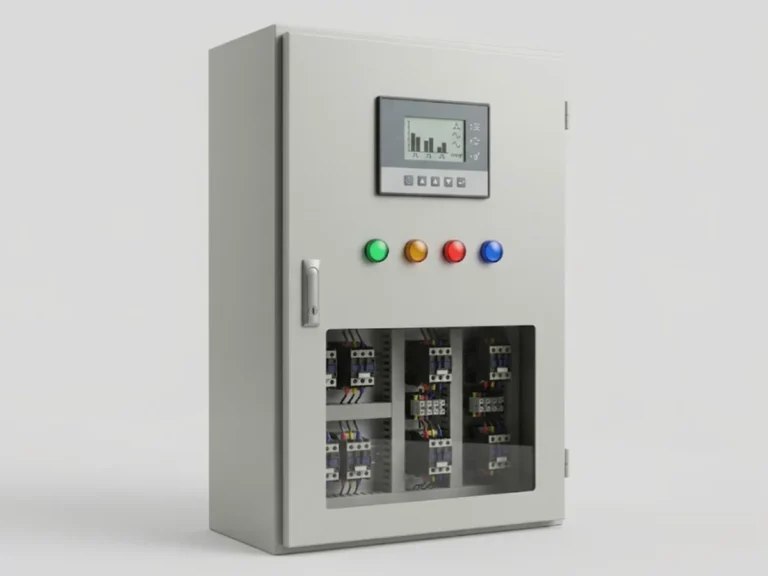
| Central automatic (APFC panel) | A controller switches capacitor steps in and out to track the changing load | Most plants and buildings with varying load |
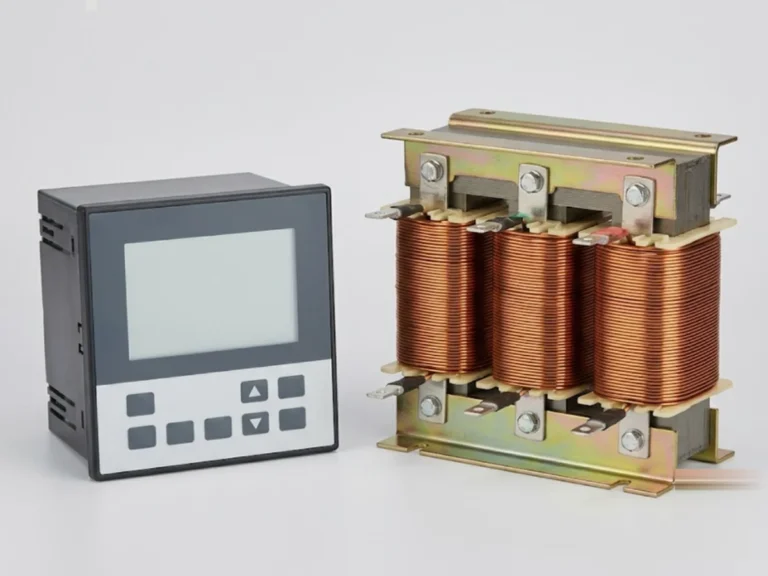
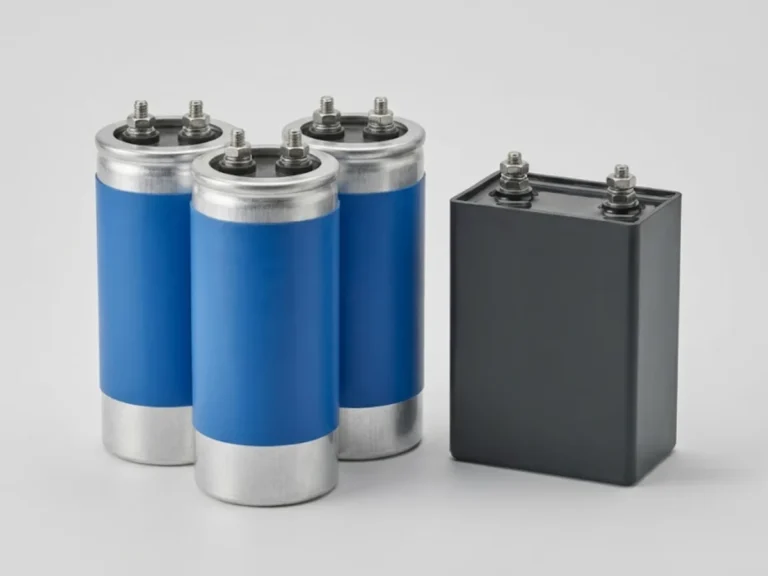
For most factories the answer is a central APFC panel on the LV bus, with an APFC controller choosing the steps, power capacitors as the steps and contactors (capacitor-duty) or thyristor switches. Our power factor correction category covers the components.
The harmonics problem and detuned reactors
Capacitors and system inductance can resonate at a harmonic frequency. If the plant has VFDs, UPS, rectifiers, LED drivers or arc furnaces, harmonic currents can be amplified by plain capacitors, which then overheat and fail. The usual protection in India is a detuned (series) reactor in series with each capacitor step. A 7 percent reactor is commonly used with the 5th harmonic being the main concern; 14 percent is used where the 3rd harmonic is significant. Heavy-duty capacitors rated for higher voltage are normally supplied together. If non-linear loads are more than a small share of the plant, ask for a harmonic measurement and a properly detuned bank. This is a design decision for a qualified engineer.
What goes wrong with correction systems
- Capacitors lose capacity over the years. Check current and capacitance periodically and replace failed units.
- Controller set to wrong CT ratio or phase. The CT must be on the incomer side, so it sees the load plus the capacitors. See current transformers (CT).
- Contactor welding from high inrush with ordinary contactors. Use capacitor-duty types.
- Overcorrection at light load, for example at night or on holidays. A good controller prevents this.
- Genset and UPS sources. Capacitors fed from a diesel generator can cause voltage instability; many plants disconnect the bank on generator mode. Ask your engineer.
Steps to take
- Log your kW, kVA and PF with a power analyser over at least a typical week.
- Check the bill for penalty or incentive terms.
- Measure harmonics (THD of voltage and current).
- Size the bank with the formula and decide on detuning.
- Select an APFC panel with the right number of steps, usually 6 to 12, protection (HRC fuses, see HRC fuses) and ventilation.
- Install, commission and verify PF on the next bills.
What to send us for a quotation
Send the transformer kVA, present average PF, kW demand, harmonic data if available, supply voltage and the room available for the panel. Use request a quote or contact us. Please also have a qualified engineer confirm the final sizing, detuning and protection.
Frequently asked questions
What is a good power factor for an industrial plant in India?
Most plants aim for 0.95 to 0.99 lagging. Going above that gains little and risks a leading power factor at light load. Your DISCOM's tariff may set a target threshold for penalties or incentives, so check your own bill and tariff order for the actual limits.
How do I calculate the capacitor kVAR required?
Use kVAR = kW × (tan φ1 − tan φ2), where φ1 is the angle for your present power factor and φ2 for the target. For 500 kW going from 0.80 to 0.98, that is about 273 kVAR. Use measured demand rather than connected load, and select the bank in steps.
Do I need a detuned reactor with capacitors?
If the plant has significant harmonic loads such as VFDs, UPS or rectifiers, yes. A detuned reactor, commonly 7 percent, prevents the capacitor from resonating with the network and being damaged by harmonics. For a plant with mostly linear motor load, plain capacitors may be acceptable. Confirm with a harmonic study.
What is an APFC panel?
An APFC (automatic power factor correction) panel contains capacitor steps, contactors, fuses and a controller. The controller measures the load PF through a CT and switches steps in and out to hold the target. It suits plants where load varies through the day.