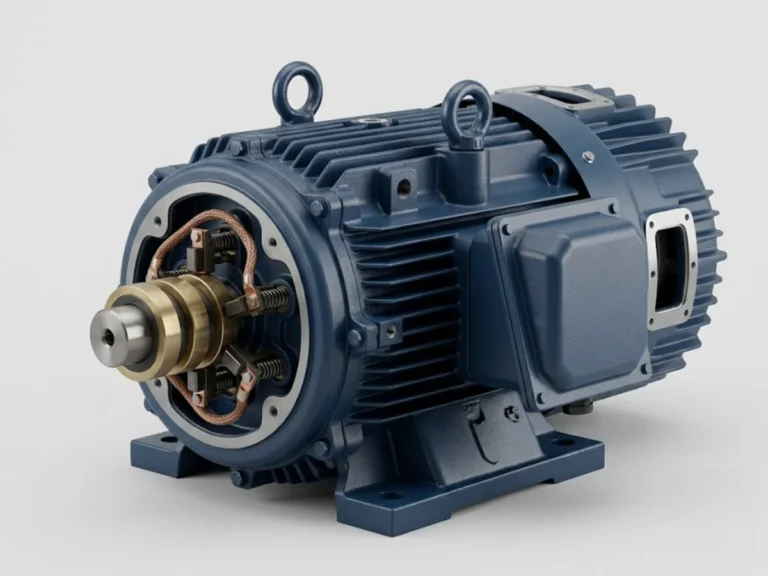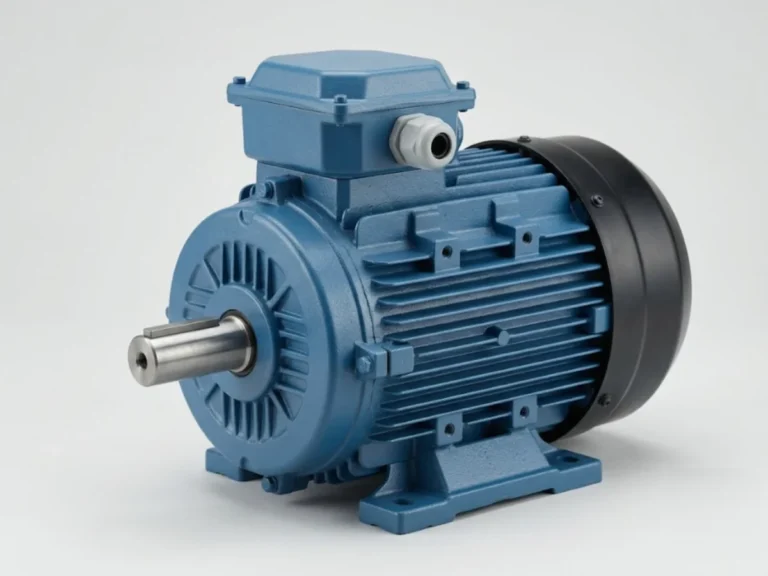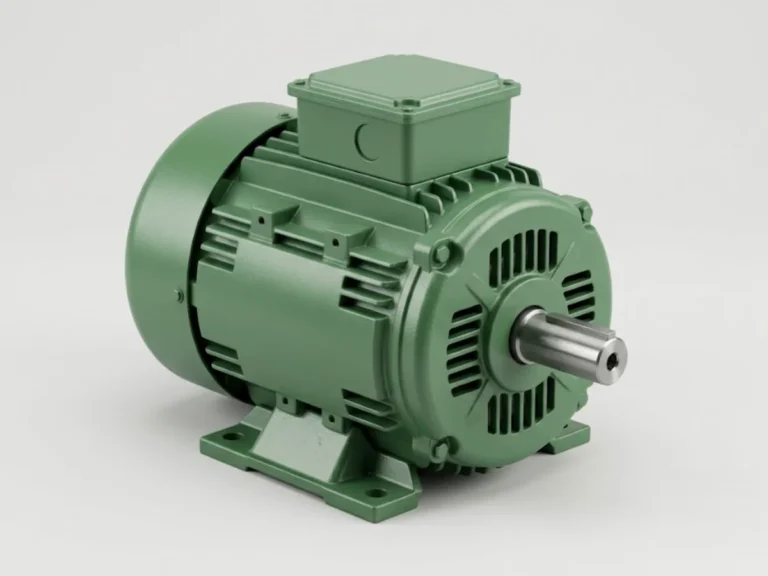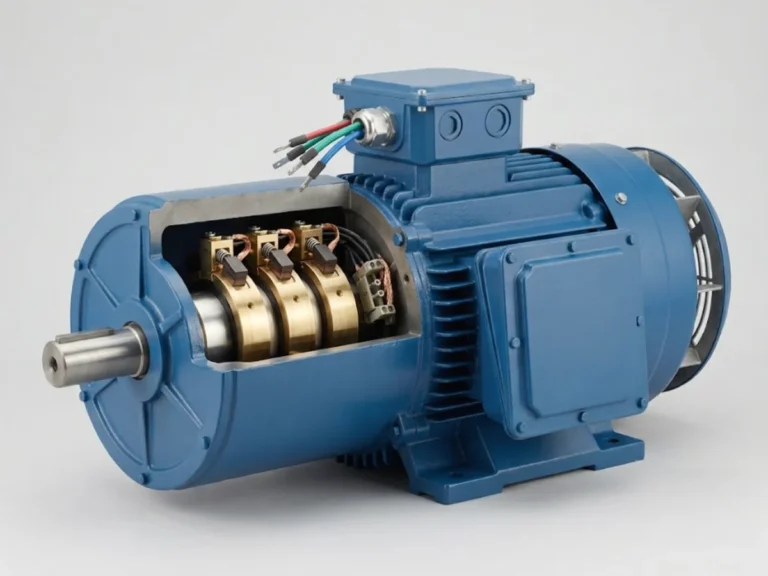
Both machines are three-phase induction motors with the same stator. The difference is the rotor. A squirrel-cage motor has solid bars short-circuited by end rings, and a slip-ring motor (also called a wound-rotor motor) has a three-phase winding on the rotor brought out to three slip rings. That one change alters how the motor starts, how its speed can be controlled and how much maintenance it needs. This guide helps you decide between them for a given job.
How each motor works
Squirrel-cage rotor
The rotor bars are permanently shorted, so nothing can be connected to the rotor from outside. Starting behaviour is fixed by the rotor design (bar shape and material). A standard cage motor draws about 6 to 8 times full-load current at start, and develops a starting torque of roughly 1 to 2 times rated torque, depending on the design class. Starting is managed on the stator side, using a DOL, star-delta, soft starter or VFD. See the starting method comparison.
Slip-ring (wound-rotor) rotor
The rotor winding ends at three copper or bronze slip rings, and carbon brushes carry the rotor current to an external resistor bank. At start, the resistance is high, which limits rotor current, reduces line current and improves the rotor power factor so that the motor develops high torque. As the motor accelerates the resistance is cut out step by step, until the rings are short-circuited for running. Starting torque can be brought up to the motor’s peak (breakdown) torque, which can be well over twice rated torque, while line current stays around 1 to 2 times rated current. This is the main reason slip-ring motors persist for heavy-start duties.
Comparison table
| Aspect | Squirrel-cage | Slip-ring |
|---|---|---|
| Starting current | High (6 to 8 x FLC on DOL) | Low and controllable, about 1 to 2 x FLC |
| Starting torque | Fixed by design | Adjustable up to peak torque |
| Speed control | By VFD only | Limited range with rotor resistance, with high loss in the resistor |
| Maintenance | Bearings only | Brushes, slip rings, brush holders and resistor bank |
| Cost | Lower | Higher, plus starter |
| Robustness in dust | Very good | Needs enclosed slip-ring housing or clean air |
| Typical use | Pumps, fans, compressors, conveyors, machine tools | Cranes, hoists, crushers, ball mills, high-inertia drives |
Where slip-ring motors still win
- Heavy starts on a weak supply. A large ball mill or crusher on a limited transformer cannot take a 7 x FLC inrush. A slip-ring motor with a rotor starter keeps the line current low while delivering high torque.
- Cranes and hoists. Cranes need smooth torque control in both directions, and a rotor resistance controller gives step-wise speed control and holds load. Our crane duty slip-ring motors are built for this duty. The matching points are covered in our crane and mill duty comparison.
- High inertia loads with long acceleration. Fans, centrifuges and mills that take many seconds to reach speed. The resistance absorbs the energy during start rather than the rotor cage, so rotor heating is not a problem.
- Retrofits. Existing plants often already have rotor starters or liquid resistance starters installed, and the cheapest route is to keep them.
Where squirrel-cage motors are better
For most industrial duties, the cage motor is the first choice. It is simpler, cheaper, has no brushes to wear and can be fitted with a soft starter or VFD to handle current. Today, a cage motor with a VFD gives full torque from near zero speed, current limited to about rated value, and speed control with high efficiency, so many new cranes, conveyors and mills specify cage motors with drives instead of slip-ring motors. The saving in maintenance can be substantial, because brushes, rings and resistors are eliminated.
See our closed cage type motors and open type cage motors, alongside the wound close type and wound open type slip-ring motors. The full AC motor category includes all four.
Maintenance and operation of slip-ring motors
If you operate a slip-ring motor, the routine matters:
- Check brush length and spring pressure; replace brushes before they reach their wear limit. Mixed brush grades on the same ring cause uneven wear.
- Inspect the slip rings for grooving, ovality or a glazed surface; a good ring develops a thin, even film.
- Clean carbon dust from the housing and insulators. Dust build-up can track across to earth.
- Check the rotor resistor connections and contactors, since loose rotor leads cause heating and uneven torque.
- Never start the motor with the rotor circuit open or the resistor cut out; the starting current will be very high.
- Some motors have a brush-lifting and ring short-circuiting device that reduces brush wear during running; confirm it is working.
Rotor voltage and current appear on the nameplate (see reading a motor nameplate) and must be used when sizing the starter. Wear parts and complete sets are listed under motor spares.
Replacing a slip-ring motor with a cage motor and VFD
Customers often ask whether they can retire a failing slip-ring motor. It is possible when the machine permits, but check three things: the VFD must supply the starting torque the machine needs (many heavy loads need a VFD sized one step up and vector control), the motor frame and shaft must match the base plate, and the existing rotor starter and brush gear are then removed. For hoists, the drive must also control the brake and prove torque before release. Discuss with a qualified engineer, and compare drive options in drives and motor starters.
What to send us for a quotation: motor kW, poles and voltage, rotor voltage and current for slip-ring motors, frame and mounting, duty (S1, S3 or cyclic duration), enclosure type, and the machine it drives. Send details through the request a quote page or contact us and we will reply within 24 hours.
Frequently asked questions
Why do cranes use slip-ring motors?
Crane drives need high starting torque, smooth stepwise speed control and frequent starts without drawing heavy current. A slip-ring motor with rotor resistance gives exactly this, and the resistors take the heat outside the motor. Many newer cranes now use cage motors with VFDs, which provide the same control with less maintenance, but slip-ring crane motors remain common in existing plants.
Can I control the speed of a slip-ring motor?
Yes, in a limited way. Adding resistance in the rotor circuit reduces speed at a given torque, but the extra power is lost as heat in the resistor, so it is inefficient and speed becomes sensitive to load. It is acceptable for short or intermittent duty such as cranes, and a poor method for continuous speed control, where a VFD is far better.
Is a slip-ring motor more efficient than a cage motor?
No. At full load running with the rings short-circuited, the efficiencies are similar, and the slip-ring motor has some extra brush losses. Its advantage is at starting: it can develop high torque with low line current. For efficiency over a run cycle, a cage motor with a VFD is typically better.
How often do slip-ring brushes need replacement?
It depends on duty, dust and brush grade, so there is no standard interval. Heavy crane duty can need frequent inspection, while a lightly used fan drive may last long. Inspect brushes and rings on a fixed schedule, often monthly, and replace brushes before they reach the wear mark. Follow the motor manufacturer's manual.