A battery in a solar system works harder than one in a plain inverter. It is charged by the sun and drained every evening, so it is cycled daily, and it often sits partly charged on cloudy days. That duty rewards batteries built for deep cycling. This guide compares the four options you will be offered for solar storage, tubular flooded, gel, AGM and lithium, and shows how to size the bank.
Where the battery sits in a solar system
Only systems that store energy need a battery: off-grid and hybrid systems. A grid-tied system without storage, such as one built around the Microtek single-phase grid-tied inverters, has none. For stored energy, the battery connects through a solar PCU or hybrid inverter such as the Microtek Solar PCU Hi-End MPPT, the Uniline Solaron MPPT PCU or Redon solar PCUs (hybrid solar inverters). See solar inverters and PCUs for the range.
The four options
Tubular flooded
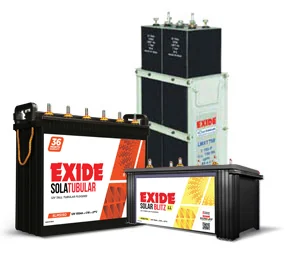
The workhorse of Indian solar. Tubular positive plates tolerate deep, repeated cycling. They need periodic water topping and ventilation, and they tolerate heat better than sealed batteries. Examples include the Exide Solatubular 12 V LMS series and the 2 V Solatubular LMXT series, which is used where large banks are built from individual 2 V cells.
Gel (tubular gel)
Electrolyte is immobilised as a gel in a sealed battery, so there is no topping, no spilling and low gas emission. Gel tolerates deep cycling well and is a good choice for remote sites where visits are rare. It is sensitive to overcharging, so the charge controller must be set correctly. See the Exide Solatron Tubular Gel.
AGM VRLA
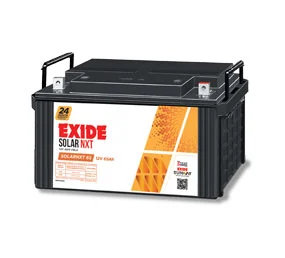
Electrolyte is absorbed in glass mat separators; the battery is sealed and maintenance-free. It handles charging currents well and suits compact installations such as the Exide AGM VRLA Solar NXT. Like all sealed types, it dislikes heat and overcharge.
Lithium (LFP)
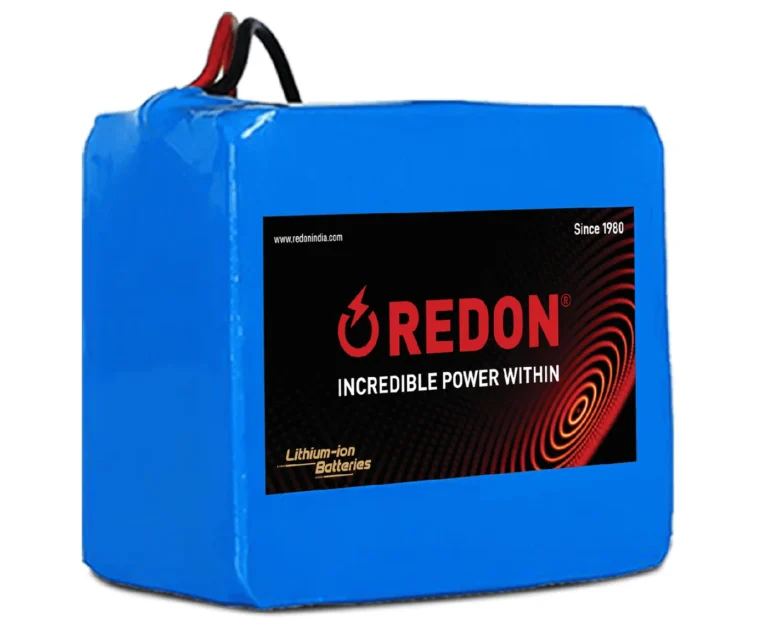
Lithium iron phosphate batteries give high usable capacity, long cycle life, light weight and fast charging. Higher purchase cost is the trade-off. They need a BMS and an inverter or charge controller with a lithium setting. Options include Redon solar batteries (small lithium packs) and the larger RedONstacK ESS and high-voltage series.
Comparison
| Point | Tubular flooded | Gel | AGM VRLA | Lithium (LFP) |
|---|---|---|---|---|
| Daily cycling | Good | Good | Fair to good | Very good |
| Usable depth of discharge | Moderate, to protect life | Moderate | Moderate | High |
| Maintenance | Water topping | None | None | None |
| Heat tolerance | Better of the lead-acid types | Moderate | Lower | Needs temperature control and BMS limits |
| Space and weight | Heavy | Heavy | Heavy | Compact and light |
| Upfront cost | Lowest of the four | Higher than flooded | Moderate | Highest |
| Ventilation need | High | Low | Low | Low |
Cycle-life claims differ by maker and test method; compare datasheet curves, not slogans.
Sizing a solar battery bank: a worked example
Suppose a home uses 6 kWh per day of essential energy, wants one day of autonomy and has a 48 V system.
- Energy to store: 6 kWh x 1 day = 6 kWh.
- Divide by round-trip and inverter losses: take 0.85 combined, so 6 / 0.85 = 7.06 kWh from the battery.
- Divide by usable depth of discharge. For tubular lead-acid planned at 50 per cent: 7.06 / 0.5 = 14.1 kWh nominal. For lithium at 90 per cent: 7.06 / 0.9 = 7.84 kWh nominal.
- Convert to Ah at 48 V: lead-acid 14,100 / 48 = about 294 Ah, so a 300 Ah, 48 V bank (24 cells of 2 V in series). Lithium: 7,840 / 51.2 V = about 153 Ah.
This shows why lithium looks expensive per kWh yet may need roughly half the nominal capacity. Compare the total cost, including space, racks and replacement. Autonomy longer than one day multiplies the figures. Try our solar calculator and battery backup calculator to test other cases.
Charging limits and the charge controller
- The charge controller (MPPT or PWM in the PCU) must have a profile for your battery type. Gel, AGM, flooded and lithium need different absorption and float voltages.
- Limit charging current to the battery maker’s recommendation, commonly stated as a fraction of Ah capacity.
- Match the bank voltage to the PCU: 12 V, 24 V, 48 V or higher depending on size.
- Do not mix battery types or ages in a bank.
Panels, battery and the daily budget
Remember that the battery only stores what the panels produce beyond the daytime load. On a cloudy day the bank may not reach full charge, so a system with a generous panel array relative to the battery recovers faster and protects the battery from sitting undercharged, which is especially harmful for lead-acid. Size the array and the battery together, not separately.
Charge controller settings deserve a line of their own. Many flooded batteries want an occasional higher-voltage equalising charge, which gel and AGM do not, and an equalising setting left on a sealed battery can damage it. Set the battery type in the PCU menu at commissioning, and check the temperature compensation setting if the battery sits in a hot room.
Which one should you pick?
- Budget off-grid, accessible site, someone to look after it: tubular flooded.
- Remote or unattended, little ventilation: gel or AGM.
- Daily cycling, tight space, long-term view: lithium.
- Large industrial or telecom solar-hybrid: 2 V cells in a rack, either tubular or lithium modules.
See all solar storage batteries, plus solar products for panels, combiner boxes and distribution boards that complete the system.
What to send us for a quotation
Send the daily energy need in kWh, autonomy days, system voltage, PCU or inverter make and model, location and available space. Submit through request a quote or write via contact us. Quotations are answered within 24 hours.
Frequently asked questions
Which battery is best for a solar system at home?
It depends on budget, space and upkeep. Tubular flooded batteries are the cost-effective choice if you can top up water. Gel and AGM are maintenance-free. Lithium gives the best cycling and usable capacity at a higher price. Pick by daily cycling, maintenance ability and total cost over life.
Can I use a normal inverter battery with solar?
Not ideal. Standard inverter batteries are designed for float duty with occasional discharge. A solar system cycles the battery daily, so a battery built for deep cycling, such as a solar tubular, gel, AGM solar type or lithium, will last better. Check the maker's application guidance.
How many batteries do I need for a 5 kW solar system?
The panel capacity does not decide the battery size; your night-time energy use and autonomy do. Estimate the kWh you need from the battery, divide by efficiency and usable depth of discharge, then convert to Ah at the system voltage. Use our calculators and send your numbers for a recommendation.
Does lithium work with any solar inverter?
No. The inverter or charge controller must support lithium charging, ideally with a communication link to the BMS. Some PCUs only have lead-acid profiles. Check compatibility with the PCU maker before buying a lithium pack, and never mix lithium with lead-acid in the same bank.