Every battery-based solar system needs a charge controller between the panels and the batteries. The two designs on sale are PWM and MPPT. Both protect the battery from overcharge, but they extract very different amounts of energy from the same panels. For anything beyond a small system, the choice affects how many panels you need and how they must be wired.
In India the charge controller is usually built into a solar PCU, so the real question when buying is whether the PCU is a PWM or an MPPT model. This guide explains the difference in plain terms and shows how to decide. SKE Bharat supplies solar PCUs and batteries but not solar installation; confirm the final design with a qualified engineer.
How a PWM controller works
A PWM (pulse width modulation) controller is essentially a fast switch between the panel and the battery. It connects the panel to the battery directly, then reduces the on-time as the battery fills. While connected, the panel is pulled down to the battery’s voltage.
That has a cost. A panel produces its most power at its own maximum power voltage, which is higher than the battery’s voltage. A PWM controller forces the panel to operate at the battery voltage instead, so the extra panel voltage is simply lost. In an illustrative 12 V battery system with a panel whose maximum power voltage is about 18 V, the panel is held near 13 to 14 V and a large share of its potential power is not used.
The consequence is a design rule: with PWM, the panel’s voltage must match the battery bank. A 12 V battery needs a nominal 12 V panel arrangement, a 24 V battery needs two in series, and so on. The array is limited to what the battery voltage allows.
How an MPPT controller works
MPPT stands for maximum power point tracking. The controller contains a DC-to-DC converter that continuously finds the voltage at which the panel produces its maximum power, operates the panel there, and then converts the output down to the battery voltage, increasing the current. Because the panel operates at its best voltage, the energy that PWM wastes is recovered.
The practical benefits are:
- More energy harvested. Gains of roughly 10 to 30 per cent over PWM are often quoted, but the figure depends on temperature, battery state of charge and panel type. Gain is lower on very hot days.
- Flexible wiring. Panels can be connected in longer strings at higher voltage, as long as the string stays within the controller’s input limit. Higher string voltage means lower current, so thinner cables and lower cable loss.
- Better with weak light. MPPT keeps tracking as light levels change through the day.
Comparison
| Point | PWM | MPPT |
|---|---|---|
| Panel voltage vs battery | Must closely match | Can be much higher |
| Energy harvest | Lower | Higher |
| Cost | Lower | Higher |
| Cable size and loss | Higher current, thicker cable | Lower current at higher string voltage |
| Best suited to | Small, simple systems | Medium and large systems, longer cable runs |
| Typical solar PCU names | PWM, Hi-End PWM | MPPT, Hi-End MPPT |
Sizing a controller
For an MPPT controller, check two limits on the datasheet.
- Output current. Divide the array power by the battery voltage. A 3,000 W array charging a 48 V battery gives about 62 A of charging current, so you need a controller with an output rating above that, with some margin.
- Maximum input voltage. The array’s open-circuit voltage at the coldest expected temperature must stay below the controller’s maximum PV input voltage. Exceeding it can destroy the controller.
Also check the minimum voltage needed to start charging, the maximum PV power the controller will accept, and the battery chemistry settings. Lead-acid tubular, gel, AGM and lithium all need different charge profiles. See our solar storage batteries and lithium-ion batteries; use the battery backup calculator to size the battery side.
Which should you choose?
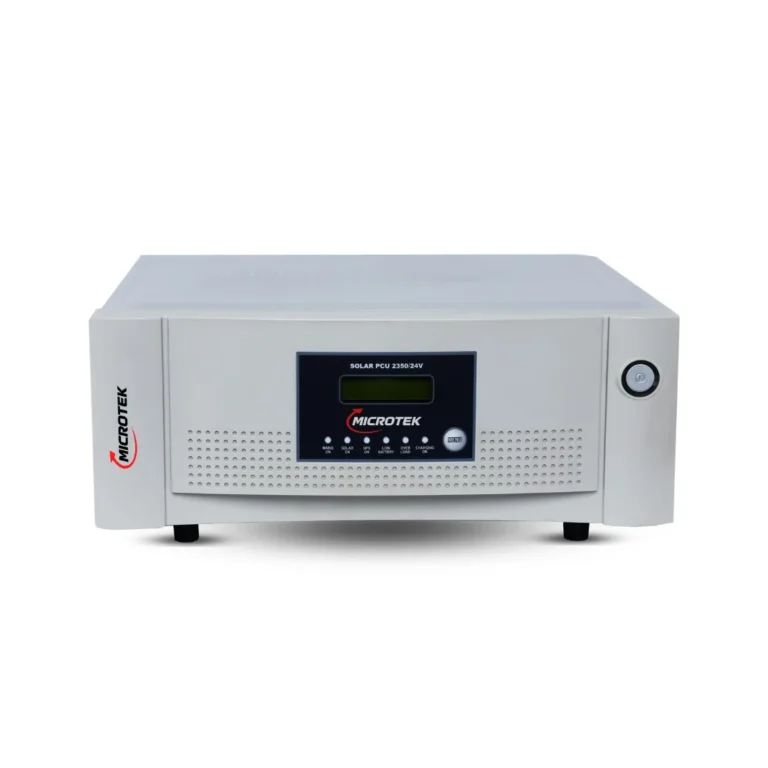
- Small backup system, short cable run, low budget: PWM is acceptable, such as the Microtek Solar PCU (PWM) or the Hi-End PWM. Make sure panel and battery voltages are matched.
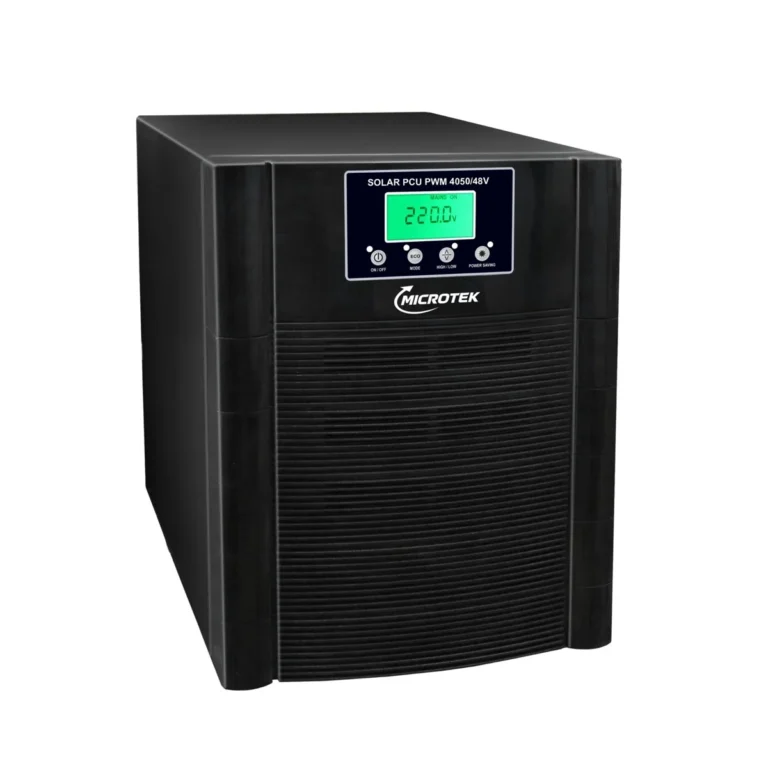
- Larger bank, higher voltage, long cable runs, or limited roof area: MPPT, because it gets more energy from every panel. Options include Microtek Hi-End MPPT, Uniline Solaron MPPT PCU and Exide Aditya MPPT PCU.
- No battery at all: you do not need a charge controller; a grid-tie inverter has its own MPPT input. See solar PCU vs hybrid vs grid-tie inverter.
The extra cost of an MPPT PCU is usually worth it when panels are a significant part of the budget, since you can buy fewer panels or get more energy from the same roof. When in doubt, ask the supplier for the PV input voltage range and maximum PV power of each PCU you compare.
Common mistakes
- Connecting an MPPT string whose cold-weather Voc exceeds the controller limit.
- Pairing a PWM controller with high-voltage grid-type panels. They will not charge properly.
- Choosing by kVA only and not by PV input power and current.
- Using the wrong battery chemistry setting, which shortens battery life.
Our solar solutions page and solar calculator help with early planning.
What to send us for a quotation
Send your battery voltage and type, backup load in watts and hours, the panel wattage and voltage you plan to use, and the available roof area. Use request a quote or contact us and we will answer within 24 hours.
Frequently asked questions
Is MPPT always better than PWM?
MPPT harvests more energy and handles higher panel voltages, so it is better for medium and large systems and long cable runs. For a small system where panel and battery voltages match and the budget is tight, a PWM controller is acceptable. The gain from MPPT varies with temperature and battery state of charge.
How much more energy does MPPT give over PWM?
Gains in the range of roughly 10 to 30 per cent are often quoted, but there is no fixed figure. The gain is higher when the battery is low or the panels are cool, and lower on hot days or when panel voltage already matches the battery. Ask your supplier for conditions behind any specific claim.
Can I connect a high-voltage solar panel to a PWM controller?
No. A PWM controller works properly only when the panel voltage is matched to the battery bank, for example a 12 V nominal panel for a 12 V battery. Connecting a high-voltage panel can overload the controller or fail to charge. Use an MPPT controller designed for the string voltage.
How do I size an MPPT charge controller?
Divide array power by battery voltage to get the charging current, and choose a controller rated above that. Also confirm that the array's open-circuit voltage at the lowest site temperature stays below the controller's maximum PV input voltage. Check the maximum PV power rating on the datasheet as well.