Overview
Also searched as: protection relays, control relays, timing relays, numerical relay, electrical relay
Selection notes
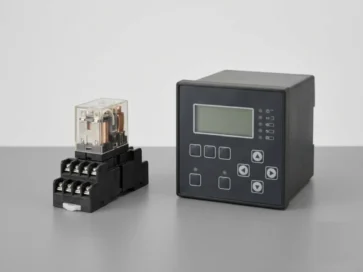
The label "relay" covers several jobs, so be clear about which you need: protection (overcurrent, earth fault, motor), control (auxiliary or interposing) or timing. A like-for-like replacement is simple if the old unit is identical; otherwise the following details must match.
- Auxiliary supply: the control voltage and whether it is AC or DC.
- Inputs: CT secondary of 1 A or 5 A, or a voltage input from a PT.
- Contacts: number and type of changeover or normally open contacts, and their ratings.
- Mounting: flush, surface or plug-in base, with matching cut-out and terminal layout.
- Time range for timers.
Replacing an old electromechanical relay with a numerical one gives more functions, but the settings, wiring and tripping logic must be reviewed and tested. Never copy dial settings across without a check against the protection study. See the protection relays and control relays and timers for current ranges, and current transformers for matching the input. Testing should be done by a competent engineer.
Frequently asked questions
Can a numerical relay replace an electromechanical one?
Usually yes, and it adds measurement and event records, but wiring, CT burden, tripping logic and settings need to be reviewed. Test the scheme after the change. Allow time for settings to be calculated, entered and tested, and for the panel wiring to be adapted where terminal layouts differ.
What information is needed to order a replacement relay?
Make and model of the old relay, its auxiliary supply, CT or PT input ratings, contact arrangement and mounting style. A photograph of the nameplate and the wiring diagram help. Mention whether it is for protection, control or timing duty, since that decides which relay suits.
Why does CT secondary rating matter?
Relay inputs are built for 1 A or 5 A secondaries. A mismatch gives wrong readings and wrong operating currents, and can overburden the CT. Always confirm the CT secondary rating. Also confirm the burden the relay places on the CT, which is usually lower for numerical relays than for older electromechanical ones.
What is a relay in electrical systems?
A relay is a switching device that operates a contact when its input crosses a set value. In power systems, protection relays sense current, voltage or other conditions and trip the breaker on a fault. Control relays and timers switch circuits in sequence.
What are the types of protection relays?
Common types are overcurrent and earth fault relays, differential relays, distance relays, under and over voltage relays, and directional relays. They are used for motors, feeders, transformers and generators. The type depends on the equipment being protected.
What is an IDMT relay?
IDMT stands for Inverse Definite Minimum Time. The relay trips faster when the fault current is higher and slower when it is lower, with a definite minimum operating time. It is widely used for overcurrent and earth fault protection of feeders.
What details are needed to order a relay?
Send the make and model, the function and setting range, the auxiliary supply voltage, and the CT secondary (1 A or 5 A) if it is a protection relay. SKE Bharat prepares the quotation within 24 hours of receiving these details and your make preference.